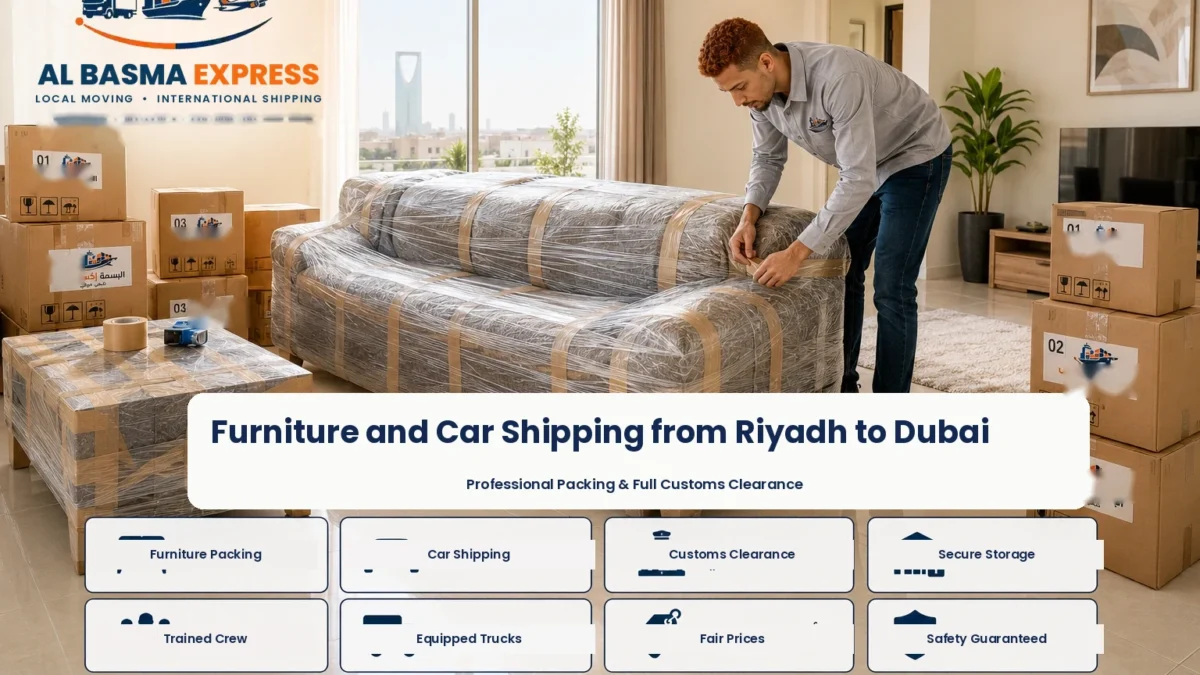

Moving from Riyadh to Abu Dhabi isn’t just loading furniture into a truck and putting a car on a carrier; it’s a project that needs several decisions arranged at once. The family is thinking about the housing handover date, the business owner about cutting the office’s downtime, and the car’s owner wants to know the type of carrier and how the condition will be documented. So choosing a furniture and car shipping company from Riyadh to Abu Dhabi should rest on the way the work is managed as much as on the price.
Topics in this guide61 topicsShowHide
In this article Al Basma Express takes a different approach from the usual pieces that repeat the same list of services. We’ll walk with the customer from the first decision, through the survey, the packing, the documentation and choosing the vehicles, right up to the shipment entering the building in Abu Dhabi and the main pieces being assembled. We’ll also set out the mistakes that raise the cost, the questions that reveal a company’s quality, and the difference between a service suited to a small family and a full villa or office move.

🧭 How to use this guide
Start by setting the result you want on delivery day, then choose the service level, then compare quotes on the same items rather than on the final figure alone.
Start from arrival day, not loading day
Setting how the home will look after the delivery, the order of the rooms, where the car goes, and who receives if the customer is delayed. Start from the picture of the last day: where the family will sleep the first night, which room has to be ready before the others, and whether you need the car the same day or a week later. These answers set the loading order in Riyadh before they set the unloading order in Abu Dhabi.
Linking the plan to the building’s permits, the elevator times and the truck’s parking spot in Abu Dhabi.
Why is Abu Dhabi different from a local move inside Riyadh?
The long distance makes any gap in the documentation or packing more damaging. The distance between Riyadh and Abu Dhabi is over a thousand kilometers, and any piece that isn’t secured properly will vibrate the whole way, not for a few minutes. That’s why the packing standard here differs from a local move between two Riyadh districts, where any mistake can be fixed in half an hour.
Managing the arrival in towers, islands and compounds needs information in advance that can’t be postponed.
Who benefits from a combined furniture and car package?
Families, relocating employees, business owners and new offices. The real benefit of combining the furniture and the car isn’t the price, but having one person responsible who knows when each part arrives. A family moving for work needs the car early, while a family moving into a ready home needs the furniture first.
Unified management doesn’t mean one vehicle; it means one follow-up contact and a synchronized plan.
The survey that prevents the price changing
Measuring the dimensions, setting what can be dismantled, the number of sensitive pieces and the state of the entrances. A good survey measures rather than estimates: the room door’s width, the wardrobe’s height, the number of pieces that can’t be taken apart, and the number of mirrors and screens. The difference between a photo survey and an on-site one shows in the choice of truck, which is the biggest item on the invoice.
Recording the car’s type, its height, whether it can move and any modifications it has.
Three service levels
Basic transport, a complete service, and a fully managed move with inventory and storage. The basic level moves what’s already packed, the complete one starts inside the home with the disassembly and packing, and the fully managed one adds the inventory, storage and assembly. Choosing the lowest level with a whole home means the customer will do half the work themselves.
Choosing the level by the time, the sensitivity and the budget rather than picking the cheapest automatically.
Packing built on the type of risk
Distinguishing between scratching, breakage, moisture, pressure and movement inside the truck. Wood fears scratches, glass fears pressure, screens fear twisting, and soft furnishings fear dust and tearing. Identifying the type of risk for each piece before buying packing materials is more precise than buying a large quantity of one material and using it on everything.
Choosing cardboard, felt, foam or a wooden crate according to each piece’s nature.
Disassembly day inside the home
Dividing the rooms, ordering the priorities, and keeping the screws and fittings in labeled bags. Disassembly day starts with the least-used rooms and ends with the kitchen and bedrooms. And every piece taken apart gets its fittings in a bag carrying the same code, because searching for a wardrobe’s screws in Abu Dhabi among dozens of bags costs a full hour.
Setting aside a corner for the things that won’t be shipped and preventing conflicting instructions between family members.
Numbering the boxes usefully
Using a code for the room, the type of contents and the opening priority. Useful numbering answers three questions on a single carton: which room it goes to, its number in the inventory, and whether it opens first. That’s far faster than writing a long contents list nobody reads on unloading day.
Sending the boxes straight to the rooms on arrival instead of piling them in the living room.
Electrical appliances need their own plan
Drying the fridges, securing the washing machines, and protecting screens in an upright position. The fridge is emptied and dried two days before, not an hour before, the washing machine’s drum is secured, and screens travel upright inside a suitable crate. The serial numbers of the large appliances are recorded before loading to make any later claim easier.
Documenting with serial numbers and not switching appliances on quickly without reviewing their condition.
When do we use a wooden crate?
For glass, paintings, antiques, screens and high-value precision equipment. A wooden crate isn’t a luxury for every glass item; it’s for what is hard to replace: a painting, a large mirror, an antique or a large screen. The criterion is the difficulty of replacement and the way it’s handled, not simply that the piece is breakable.
The decision rests on the difficulty of replacement and the handling method, not the piece’s shape alone.

Choosing the furniture truck
The volumetric size and the stacking method matter more than the number of rooms written in the advert. The truck is chosen by the volumetric size after disassembly and packing, not by the home’s number of rooms. A crowded three-bedroom apartment may need more space than a simply furnished villa, and a truck smaller than required means a second trip nobody counted.
Having securing points, barriers and a closed truck protects against movement and dust.
The art of stacking and weight distribution
Putting the heavy pieces at the base, separating the sensitive surfaces and preventing friction. Good stacking starts from the unloading order: what enters the home first is loaded last. The heavy pieces go at the base, glossy surfaces are separated by a layer that prevents friction, and the load’s balance stays steady the whole way.
Thinking about the unloading order from the start while keeping the load balanced.
The car’s separate track
Photographing the bodywork, recording the odometer, the fuel and the scratches, and removing the personal items. The car’s file starts with clear photos from all four sides plus the odometer reading, the fuel level and the tire condition, then emptying the cabin and boot of personal items that the vehicle transport policy may not cover.
Choosing a multi-car carrier, a flatbed or an enclosed carrier according to the value and the date.
When does an enclosed carrier make sense?
Luxury, classic and low cars, and special paintwork. An enclosed carrier makes sense when the car is a classic, has special paintwork, or sits low enough to make the loading angle critical. An ordinary family car may not need that level, and the cost difference is worth discussing before booking.
Comparing the protection level against the cost rather than treating one option as right for everyone.
Inspecting the car before handing over the key
Clear photos from every angle, a copy saved in the cloud, and recording the accessories. The inspection before handing over the key isn’t a formality: photos from every angle, a copy saved in the cloud, and a record of the accessories inside the car. And at the handover in Abu Dhabi the comparison is repeated before the vehicle is driven any distance.
Re-inspecting at the handover before driving the car a long distance.
The arrival starts before leaving Riyadh
Registering the truck and workers’ details, booking the service elevator and issuing the permits. The arrival starts in Riyadh: the truck’s, driver’s and crew’s details are sent to the building management in Abu Dhabi, the service elevator is booked, and the entry permit is issued. This step alone prevents the most common waiting cases on delivery day.
Knowing the height and parking restrictions and choosing a smaller distribution vehicle when needed.
| Type of service | Usually suits | The decision note |
| Full furniture shipping | Villas and large apartments | Usually covers the disassembly, packing, loading, unloading and assembly as agreed. |
| Partial furniture shipping | Boxes or a small studio | Saves cost when the date is flexible and the space is shared. |
| Multi-car carrier | Family cars | An economical option, with clear documentation essential. |
| Flatbed or enclosed carrier | Low or luxury cars | Higher protection and flexibility for a higher cost. |
Delivery in towers
Protecting the walls and floors, respecting the elevator window and reducing wasted time. Delivery in towers needs protection for the walls, floors and elevator, and a commitment to a time window that may be no more than two hours. The crew that knows the apartment’s layout in advance finishes inside the window, while the crew asking about every piece runs past it.
Preparing a simple plan for distributing the furniture so the crew can move without repeated questions.
Addresses differ inside Abu Dhabi
The city center, Yas, Saadiyat, Khalifa City and the farther areas aren’t one case. The city center isn’t Yas Island, and Saadiyat isn’t Khalifa City or the farther areas toward Al Dhafra. The entry procedures, the truck parking and the last-mile distance all differ, so the address is written by area and building, not by the emirate’s name alone.
Setting the final address prevents last-mile fees or a sudden change of vehicle.
Storage between two leases
Setting the storage period, the warehouse’s nature, the numbering and whether the items can be reached. Storage between two leases needs the period, the type of warehouse and whether the belongings can be reached during storage all set. And an urgent-needs box is separated before the load goes in, so the family doesn’t have to open a storage unit for one item.
Separating an urgent-needs box so the family doesn’t have to open the storage units.
Reading the insurance carefully
Knowing the scope of cover, the compensation value, the exclusions and the claim procedure. Reading the insurance policy means knowing three things: what’s covered, how the compensation value is assessed, and what the exclusions are. High-value pieces are mentioned explicitly with their photos and invoices, because a general description isn’t enough in any claim.
Declaring the high-value pieces and keeping the photos, invoices and valuations.

Reading the quote
Separating the packing, disassembly, loading, transport, unloading, assembly and the car’s track. A clear quote separates the packing from the disassembly from the loading from the transport from the unloading from the assembly, and puts the car’s track in its own line. A quote that merges all of that into one figure is hard to compare with any other.
Comparing equal items and not being misled by a quote that leaves out basic services.
| The item | What should appear in the quote | Warning sign |
| Packing | The materials and the sensitive pieces covered | The phrase “full packing” with no details. |
| Disassembly and assembly | The scope of work and the pieces covered | Assembly added after arrival with no prior agreement. |
| Delivery | The address and the unloading point | Naming Abu Dhabi only without specifying the location. |
| The car | The type of carrier and the documentation | The carrier being changed without approval. |
| Waiting | The duration and how extra time is calculated | Open-ended, undefined fees. |
Furniture cost factors
The size, the difficulty, the floors, the protective materials, the storage and the external hoist. The furniture’s cost is affected by the size, the floors, the protective materials and the need for an external hoist. And the best way to lower it is excluding what you don’t need and improving the stacking, not removing the protection from mirrors and screens and paying for that later.
Cutting the cost by excluding and organizing, not by removing the protection from sensitive pieces.
Car cost factors
The type of carrier, the delivery point, the height, the condition and the timing flexibility. The car’s cost is affected by the type of carrier, the delivery point inside Abu Dhabi and the flexibility of the date. A car that can’t move needs a winch and different equipment, so its condition must be declared before the price is issued, not after.
A non-running car needs different equipment and may change the price.
The hidden cost of waiting
The home not being ready, a permit not issued, or nobody there to receive. Waiting hours are one of the items that surprise customers most: the apartment not ready, the building permit not issued, or no one there to receive. Confirming the appointment a day ahead and naming an alternative person saves hours charged for the crew and the truck together.
Confirming before the date and naming a substitute protects against extra waiting hours.
A realistic timeline
Splitting the trip into approval, survey, preparation, packing, departure and delivery. A realistic schedule is split into approval, survey, preparation, packing, departure and delivery, and each stage gets a window rather than an exact hour. Promising a precise arrival hour across a thousand kilometers is a promise nobody can guarantee.
Using a time window and real updates instead of precise promises that can’t be guaranteed.
One unified communication plan
One contact, one order number and updates at the stages that matter. A good communication plan means one follow-up contact, one order number and an update at every stage that matters: loading, departure, arrival, delivery. And any change is sent in writing so the instructions don’t differ between the office, the driver and the crew.
Sending any change in writing to prevent the office, the driver and the workers getting different instructions.
What stays with the customer?
Passports, medicines, jewelry, keys, work devices and daily needs. Passports, medicines, jewelry, keys and work devices always stay with the customer. And an “open first” box is prepared holding bedding, cleaning supplies, chargers and some kitchen tools, so the first night doesn’t start by opening twenty cartons.
Preparing a moving bag and an “open first” box to reduce the pressure in the first days.
Office moves
Inventorying the departments, numbering the furniture and linking the pieces to the new site’s plan. An office move starts with inventorying the departments, numbering the furniture and linking every piece to the new site’s plan in Abu Dhabi. Phased execution outside working hours reduces the downtime, with advance coordination with the IT team to disconnect the devices and restart them.
Phased execution, less downtime, and coordination with IT.
Showrooms and shops
Shipping the shelving, display furniture, goods and point-of-sale devices in the order the place will open. Showrooms and shops are shipped in the opening sequence: the shelving first, then the display furniture, then the goods and point-of-sale devices. And the commercial lists are kept separate from the personal belongings because the inventory and receiving routes are completely different.
Separating the commercial lists from the personal belongings to ease the inventory and the receiving.
Custom-made furniture
Checking the new site’s dimensions before shipping bookcases, kitchens and wall units. Custom-made furniture needs the new site measured before the shipping, not after, especially bookcases, wall units and kitchens. Whoever doesn’t measure may pay to move a wall unit that fits no wall in the new apartment.
Documenting the disassembly method and linking the photos to the piece numbers to prevent guesswork at assembly.
Antiques and paintings
Individual valuation, dedicated crates, securing points and protection that doesn’t stick to the surface. Antiques and paintings need an individual valuation, dedicated crates and protective materials that don’t stick to the surface. And in some cases shipping them in a separate batch is less risky than putting them in the middle of a whole home’s load.
Some pieces can be shipped in a separate batch when the risks are high.
Mistakes that repeat on moving day
Postponing the sorting, not measuring the entrances, leaving the drawers full, and no permits. The recurring mistakes are known: postponing the sorting to packing day, not measuring the entrances, leaving the drawers full, and no building permit. Each one adds hours, and together they can turn one working day into two.
Leaving items inside the car or not declaring its low clearance or modifications.
The 48-hour list
Confirming the address, the contacts, the elevator, the permits, preparing the appliances and taking the photos. The forty-eight-hour list is short: confirming the address and contact numbers, booking the elevator and permit, preparing the appliances, and photographing the car. Plus reviewing the number of boxes and telling the supervisor about any increase before the crew arrives, not after.
Reviewing the number of boxes and telling the supervisor about any change before the crew arrives.
The receiving-day list
Matching the count, checking the packing, directing the pieces and opening the sensitive ones with the supervisor present. On receiving day the counts are matched against the inventory, the packing is checked before opening, and every carton is directed to its room. And the sensitive pieces are opened with the supervisor present rather than after they leave, because recording any remark afterwards becomes harder.
Inspecting the car, comparing the photos, and recording the odometer and any remarks immediately.
Choosing the company away from the advertising
Asking who executes, how the volume is estimated, how they follow up and how claims are handled. Choosing a company starts with four questions: who actually does the work, how the volume is estimated, how the updates reach you, and how claims are handled. A company that answers all four clearly is different from one that settles for general phrases.
Making sure the quote, the contract and the conversations match, and rejecting vague terms.
Questions specific to the furniture
Does it include disassembly and assembly? What materials? How are the fittings kept? And what’s the waiting policy? The furniture questions are specific: are the disassembly and assembly included? What packing materials? How are the fittings kept? And what’s the waiting policy? Add to those a question about protecting the floors and walls inside the Abu Dhabi apartment.
Asking about protecting the floors and walls and the pieces that need special crates.
Questions specific to the car
What type of carrier? Where is the delivery? How is the condition documented? And who receives the key? The car questions are four as well: what type of carrier? Where exactly is the delivery point? How is the condition documented? And who is authorized to receive the key? And any modification or lowered suspension is mentioned from the first call.
Mentioning any modification or lowered suspension from the start to avoid changing the plan.
Three customer cases
A large villa, a small apartment and an office each need a different plan. A large villa needs a bigger crew and perhaps more than one trip, a small apartment may suit a shared partial load, and an office needs phased execution outside working hours. Tailoring the service prevents paying for work the customer doesn’t need.
Tailoring the service prevents loading the customer with work they don’t need or skipping necessary work.
Shipping in two batches
Sending the non-essential furniture early then the daily needs later. Shipping in two batches suits anyone moving before the housing is ready: the non-essential furniture first, then the daily needs later. And the cost of the two trips is compared with the temporary storage alternative before the decision is made.
Comparing the extra vehicle cost with the benefit of less pressure or the storage alternative.
Assessing what deserves shipping
Comparing the piece’s value and condition and the cost of moving it with a new replacement in Abu Dhabi. Before shipping any large piece, compare its current value and condition and the cost of moving it with the price of a new replacement in Abu Dhabi. Sentimental and custom-made pieces are usually worth moving, while worn furniture may be cheaper to replace than to ship.
Keeping the sentimental or custom-made pieces and letting go of the worn and unsuitable ones.
Using an external hoist
Spotting the pieces that won’t pass through the elevator or stairs and measuring the entry points. An external hoist isn’t a decision taken on delivery day; it’s a decision built on measuring the elevator, the stairs and the entry points. Running it needs a permit and a safe spot in front of the building booked in advance with the property management.
Getting the permits, preparing a safe site, and not leaving the decision to delivery day.
The first three days’ plan
Assembling the beds, the bedding, the bathroom and the kitchen first, then the clothes and décor. The first three days’ plan starts with the beds, the bedding, the bathroom and the kitchen, then the clothes, then the décor. And opening the boxes by priority while recording what’s been opened stops the new apartment turning into an open warehouse for two weeks.
Opening the boxes by priority and recording what’s been opened to keep the order.
The post-assembly review
Testing the doors and drawers, the stability of the beds and tables, and checking the fittings. After the assembly the doors and drawers are tested along with the stability of the beds and tables, and the remaining fittings are checked. Any remark is recorded before the crew leaves, with a quick check of the walls and floors the large pieces passed through.
Recording the remarks before the crew leaves and checking the walls and floors.
Managing the packing waste
Setting who collects the cardboard and plastic and when they’re taken out of the building. Packing waste piles up fast: cardboard, plastic and felt. It’s agreed in advance who collects it and when it’s taken out, because many Abu Dhabi towers set times for removing waste and don’t allow it to be left in the corridors.
Sorting what can be recycled and keeping the corridors safe during the work.
Coordinating the date with travel and work
Leaving a margin between the packing and the travel and not setting important commitments on delivery day. Coordinate the packing date at least a day away from your travel date, and don’t set important commitments on delivery day. And if you’ll arrive in Abu Dhabi after the shipment, authorize someone you trust and record their details within the service offer in advance, not at the last moment.
Naming an authorized person in Abu Dhabi if the customer may be delayed.
Why does photographing the disassembly help?
Preserving the shelf arrangement, the cable routes and the securing points, and linking the photos to the numbers. Photographing the disassembly documents the shelf arrangement, the cable routes and the securing points, with the photos linked to the piece numbers. These photos help twice: in fast assembly inside the new apartment, and in telling an old scratch from one that happened during the transport.
Using the photos in the assembly, the documentation, and telling the old condition from the new.
Receiving the car keys
Recording the number of keys and remotes and the person authorized to hand over and receive. When the car is received, the number of keys and remotes and the name of the authorized person are recorded. It’s best to test-start it after the visual inspection rather than before, making sure no original document has stayed inside the vehicle since loading day in Riyadh.
Testing the start after the inspection and not leaving original documents inside the vehicle.
Frequently asked questions about shipping furniture and cars from Riyadh to Abu Dhabi
Do the furniture and car travel in the same vehicle?
Usually not; the furniture needs a closed truck while the car needs a specialized carrier, but both dates and the follow-up can be managed within one file.
Can I pack some things myself?
You can for some boxes, using suitable materials and a clear description, and knowing how self-packing affects the company’s responsibility and the insurance.
Is the delivery inside the unit?
That’s set in the quote, and you must confirm there’s an elevator, an entry permit and a suitable parking spot.
What if the new home isn’t ready?
Temporary storage can be arranged, then a final distribution date set once the unit is ready.
Can items be left inside the car?
It’s better to empty it, because undocumented items may not be covered and may obstruct the inspection or the procedures.
Does the assembly include electrical and plumbing work?
Furniture assembly differs from electrical and plumbing work, and the limits must be set in the contract.
How is the truck chosen?
By the volumetric size, the nature of the pieces, what can be dismantled and the stacking method, not by the number of rooms alone.
When should I request the survey?
The larger the shipment or the more it’s tied to a housing date or a building permit, the better it is to start early.
Can someone else receive the car?
Yes, with an authorization, clear details and proof requirements agreed in advance.
How do I inspect the car on arrival?
Compare it with the photos, record the odometer and the accessories, and inspect it before driving it any distance.
What’s the most important document to keep?
The inventory list, the handover record, the written quote and the condition photos taken before the transport.
How do I cut the cost without cutting the safety?
Exclude what you don’t need, coordinate a clear date, and choose a service level that actually suits your size.
In summary: an organized move starts with the right information
The success of a furniture and car shipping company from Riyadh to Abu Dhabi isn’t measured by how fast the pieces are loaded, but by how clear the plan is from the survey to the last signature at the handover. The more the customer knows the service scope, the type of packing, the car’s transport method and the building’s requirements, the calmer the execution and the fewer the surprises.
Al Basma Express brings managing the furniture shipment and coordinating the car’s transport into one track that can be followed, with the plan tailored to the type of home or office, the value of the contents and the nature of the arrival address inside Abu Dhabi. Before requesting a price, prepare the photos, the addresses and your disassembly, assembly and storage needs, then ask for a written quote that explains clearly what’s included.
✅ Before getting in touch
Send photos of the furniture and the car, specify the type of building in Abu Dhabi, mention any sensitive pieces or a low car, and say whether you need assembly, storage or an entry permit.