
The distance between Saudi Arabia and Morocco makes the key question different from nearby shipping routes: it isn’t just how we move the shipment, but how do we stop the trip’s many stages from turning a simple job at home into a chain of disorganized handling? Furniture may start inside an apartment in Riyadh, move by land to the shipping point, enter the international transport stage, then reach Morocco and need fresh distribution to Rabat, Casablanca, Marrakech, Tangier or Fez. That’s why the shipment must be designed to stay understandable and protected at every transfer — not just at the first loading.
Al Basma Express operates as a shipping company from Saudi Arabia to Morocco for furniture, household goods, appliances, cars, goods, equipment and parcels, with pickup from Riyadh, Jeddah, Dammam, Khobar, Al Ahsa, Makkah, Madinah, Qassim, Hail and other Saudi cities, and delivery coordinated to Casablanca, Rabat, Tangier, Marrakech, Fez, Agadir, Meknes, Oujda, Kenitra, Tetouan and other Moroccan cities depending on the consignee’s location and the service plan.
Topics in this guide44 topicsShowHide
A long shipping trip is usually built on more than one stage: it starts with local transport inside the Kingdom from the customer’s address to the consolidation or shipping point, then comes the international stage — sea for larger loads or air for suitable parcels — and then receipt and distribution inside Morocco. So assessing the service shouldn’t be reduced to the ship’s or plane’s time alone.
Air freight for suitable and urgent shipments takes 24 to 48 hours depending on the flight, content acceptance and handling, while supporting land transport stages where this range applies can take 2 to 5 days depending on the pickup or distribution city and the type of service. Sea freight itself depends on the sailing schedule, port, service, and handling and clearance procedures, so its duration is set according to the actual booking rather than one number for all shipments.
The cost doesn’t follow a fixed price: a shipment of parcels from Jeddah to Casablanca differs from a whole household from Riyadh to Marrakech, and a car or equipment differs from furniture. The cost depends on volume, weight, the pickup city, the final Moroccan city, the transport method, type of packing, disassembly and assembly, property difficulty, storage or lifting, and the number of delivery points if any.
The free survey helps set these elements before the quote is issued, while GPS tracking is used for the land stages alongside order status updates to follow the shipment between pickup, preparation, the shipping point, arrival in Morocco and local distribution.
To arrange a survey or send an initial description of your load, contact Al Basma Express on +966553923364 with your pickup city, type of contents and Moroccan destination, so the assessment starts from real data.

The idea of this article: don’t build the trip from Saudi Arabia to Morocco as a straight line
Nearby shipping routes sometimes let the customer picture a single vehicle driving from their home to the neighboring country. Morocco needs a different way of thinking: the shipment may move between vehicles, sites and international stages, so it must be designed from the start to stay organized even when the transport method changes.
The trip can be pictured as three circles. The first is the home or pickup site, where sorting, disassembly, packing and inventory happen. The second is international transport, where volume, weight, stacking and the sea or air service are the most important factors. The third is arrival inside Morocco, where the type of property, the city, the floor, the elevator and assembly come back to the fore.
If each circle is planned on its own and then linked to the other stages, the service becomes clearer. Trying to manage all these details at once can make the customer focus on one element and forget the rest.
A customer may choose suitable sea freight but not prepare the furniture to withstand handling, choose excellent packing but not specify the final delivery address, or book space for the shipment before sorting out the things they don’t even need.
So the plan starts from two questions: what will leave Saudi Arabia? And exactly where will it settle in Morocco? The route is built between those two questions.
Circle one: pickup
- Sorting.
- Disassembly.
- Packing.
- Inventory.
Circle two: international transport
- Volume.
- Weight.
- Sea or air.
- Handling.
Circle three: arrival
- City.
- Property.
- Unloading.
- Assembly.
◆ A long trip makes organization more valuable than speed at the start
Closing boxes quickly doesn’t mean the shipment is ready — what matters is that every box has known contents, destination and sensitivity, and that dismantled parts are linked to their furniture.
An extra hour spent on the inventory before departure can save a lot of time when the delivery stage begins in Morocco.
The free survey: look for the hidden volume before counting the visible volume
The load inside the home doesn’t always look like the load that will go into the vehicle. Some items shrink after disassembly and others grow after protective crates are added, so looking at rooms or photos alone isn’t enough.
A large wardrobe, for example, may look huge inside the room but becomes neat panels after disassembly. On the other hand, a slim mirror that takes little space on the wall can become much thicker once bubble wrap, padding, cardboard or a rigid crate are added.
The survey also looks for spaces the customer forgets to include: the storeroom, balcony furniture, bicycles, spare appliances, old boxes and home office contents.
Then the things you won’t need in Morocco are separated out. This stage matters because shipping over a long distance means any unnecessary item goes through many stages for nothing.
Home entrances, the elevator, stairs and vehicle position are also reviewed, since the quote isn’t affected by the load alone but by the work needed to move it from its current place to the transport.
At the Moroccan end, the type of property must be known before the plan is confirmed: an apartment in Casablanca differs from a villa in Rabat, a home in Marrakech or a warehouse in Tangier.
▪ The volume that matters isn’t your room’s size but the load’s size once it’s ready to travel
That’s why relying on the number of rooms can be misleading, while a survey, detailed photos and an item list give a picture closer to the real space.
The closer the estimate gets to the final volume, the more suitable the shipping method and space that can be chosen.
Sea or air? Don’t compare speed alone — compare what each method does
On the Saudi Arabia–Morocco route, the two methods can do two different jobs within the same order, and there’s no need to pick one and reject the other for all the contents.
Sea freight usually suits furniture, larger loads, many cartons and some goods, equipment and vehicles depending on the service. Its main advantage is handling a large volume within one plan.
Air freight serves shipments where time matters more than volume. It may suit one or a few small parcels the customer needs before the main load arrives.
Suitable air services take 24–48 hours depending on the flight, content acceptance and handling. Supporting land transport before or after the international stage may fall within a 2–5 day range where applicable, depending on the city and service.
Sea freight is best not assessed with a uniform time promise, because the booking depends on a sailing schedule, port, service, handling and clearance — so the date is set according to the available voyage.
For example, the household furniture can go by sea while a box of work tools or early needs goes by air if suitable, with original documents, money and essential medicines kept with the customer.
| Comparison point | Sea | Air |
|---|---|---|
| Volume | Suits larger loads | Better for limited shipments |
| Time | According to the sailing schedule and service | 24–48 hours for the suitable service |
| Use | Furniture, goods and large loads | Urgent and limited parcels |
| Assessment factor | Volume, service and port | Volumetric weight and speed |
Packing for a long trip: the “surface, inside, surroundings” system
Choosing packing materials becomes more precise by dividing protection into three zones: the item’s surface, what’s inside it or between its parts, and its surroundings during transport.
Surface protection means preventing scratches, friction and dust. It matters for wood, upholstery, appliances and painted surfaces, using blankets, soft materials, covers and corner guards depending on the item.
Inside protection means stopping whatever is inside a box or appliance from moving. Cartons that aren’t full need padding, and appliances may need doors, accessories or moving parts secured.
Surroundings protection means stopping another item from pressing or falling on it. That’s the job of load arrangement, not of the wrapping alone.
Mirrors and glass need special edge protection and no direct pressure. More rigid or wooden crates may be used when sensitivity or size calls for it.
TVs need front protection and must never become a base for stacking cartons, while mattresses and sofas need protection from dust and friction more than rigid reinforcement.
Fridges, washing machines and large appliances must first be prepared by emptying, cleaning, drying and securing accessories before the outer wrap is added.
The item’s surface
Preventing scratches, dust and friction with materials suited to each surface.
Inside the package
Preventing movement with padding and by securing moving parts.
The item’s surroundings
Preventing pressure and sliding through load arrangement and securing.
◆ More layers of packing are no substitute for the right arrangement inside the load
A TV may be in an excellent package, but placing heavy furniture next to it without securing keeps the risk high.
Real protection is complete only once the item is placed in a position that suits its weight and sensitivity within the transport system.
Disassembly and numbering: let every item be able to rebuild itself in Morocco
Useful disassembly doesn’t just reduce volume — it must leave behind a system that makes reassembly easy. That’s why each piece of furniture is treated as a “set” with its own code.
Before disassembly, complex furniture can be photographed from several angles, especially wardrobes, desks and large storage units. Then the item gets a code, and all its panels, parts and fittings carry the same code.
Screws, hinges and handles go in a separate bag linked to the item, and the fittings of a whole room aren’t gathered in one bag.
It must also be assessed whether disassembly is needed at all. Some items can easily be moved whole, and dismantling them would add parts without saving meaningful space.
For large furniture that won’t pass through the door or elevator, or that becomes safer once dismantled, disassembly is a core part of preparation.
On arrival in Morocco, assembly doesn’t start before the item’s final position is confirmed, so it isn’t assembled in one room and then moved whole to another.
▪ The real test of disassembly happens at assembly
If all the parts reach Morocco but the crew doesn’t know which screws belong to which item, the disassembly wasn’t organized, however fast it was.
Numbering, photos and fitting bags make the end of the trip a natural continuation of its beginning.
From Saudi Arabia to Moroccan ports: how to think about the sea gateway
When sea freight is used, the port becomes a transfer point, not an end point. International shipping services may head to major Moroccan sea gateways such as Tanger Med or Casablanca depending on the shipping line and available service, and then distribution to the final city begins.
This means a customer in Rabat, Marrakech or Fez shouldn’t base the date on the ship reaching port alone — there’s receipt, handling and procedures, then land transport to the city.
The plan is also affected by the starting city in Saudi Arabia. A shipment leaving Jeddah has a different local stage from one starting in Riyadh or Dammam, even if both later use the same sea service.
You must also specify whether the service required is door to door, or whether some stages will be handled by the customer or another party. This detail is very important when comparing quotes.
The nature of the load must be known before choosing the sea booking method: a full household differs from a few items, palletized goods differ from cartons, and a car has separate arrangements.
The sea transit time is set according to the sailing schedule, the actual service, the arrival port and the handling and clearance stages, rather than publishing a fixed duration that may not suit a particular order.

◆ Don’t compare a “port-to-port” quote with a “door-to-door” quote
One quote may look far cheaper because it doesn’t include transport from the Saudi home or distribution inside Morocco.
Before comparing prices, make sure the start point, end point and included services match.
From Jeddah, Riyadh and the Eastern Province to Morocco: three different starts before the sea
The Kingdom isn’t a single starting point, so the customer’s location affects how much inland land transport there is before the international stage begins.
From Jeddah: furniture and household goods can be prepared and the shipment linked to a suitable sea or air plan. The city’s proximity to Jeddah Islamic Port makes the sea stage a clear part of planning, but the property location, load volume and packing still matter.
From Riyadh: the load needs a land transport stage inside the Kingdom before entering the international shipping point, so the furniture must be secured and ready for a multi-stage trip from the moment it leaves the home.
From Dammam, Khobar and Dhahran: the right consolidation or transport route is set according to the available sea or air service, with the inland distance included in the quote.
From Makkah and Madinah: the furniture is dismantled and packed, then moved to the right shipping point, and classifying sensitive items shouldn’t be left until reaching the port.
From Qassim and Hail: the inland transport stage becomes important in the final schedule, so the consolidation or departure point is set according to the load volume.
From Al Ahsa: furniture, goods, equipment and cars can be organized once the nature of each category and the destination in Morocco are known.
West
Planning is directly linked to Jeddah Port’s services and the chosen sea route.
Central
Inland transport is added to the international shipping stage and must be counted in the schedule.
Eastern Province
The consolidation point and international service are set according to the type of load and the available plan.
Shipping cars to Morocco: three approvals within one decision
When shipping a car, three matters must be kept separate: the car’s readiness for transport, how it’s shipped, and the regulatory requirements for bringing it into Morocco. Getting one right doesn’t automatically mean the other two are covered.
Stage one is the vehicle’s readiness. The car and owner details are recorded, the exterior condition photographed from several angles, and tires, battery, running condition and any visible leaks checked.
Stage two is the transport method. The suitable service is set according to the type of vehicle, the shipping line and the arrival port or point, with the car’s file kept separate from the furniture inventory.
Stage three is the official requirements. The regulations and documents in force at the time must be reviewed according to the vehicle, the owner and the purpose of entry, without relying on someone else’s case or outdated procedures.
Personal belongings are removed from the cabin, and the car isn’t used as random space for furniture cartons unless there are known, permitted arrangements.
On arrival, the visible condition is inspected and compared with the initial documentation before the delivery is completed.
▪ The car and furniture can be in the same order without being in the same file
Furniture needs a room-by-room inventory, while the vehicle needs its own photos, data, documents and transport method.
Separating the two files keeps tracking and delivery clearer, even if the two schedules are coordinated.
Commercial goods: plan the container meter before planning the number of packages
With goods, the number of boxes isn’t the most important figure. A large box that can’t have anything placed on top may take more space than several small stackable boxes.
That’s why the item, quantity, dimensions, weight, packing method, stackability and any handling instructions must be provided.
If the goods are on pallets, the dimensions, weight and lifting method of each pallet are recorded. The packages must also be stable on the pallet so they don’t shift during handling.
Goods heading to a warehouse in Casablanca or Tangier need information about the warehouse gate, receiving hours and unloading equipment.
Goods heading to a shop or office in a busy city may need a final distribution stage with a smaller vehicle than the main transport vehicle.
Commercial goods shouldn’t be combined with personal belongings under one general description — each category needs a clear list and handling that suits it.
| Information | Why does it matter? | Its effect on the plan |
|---|---|---|
| Dimensions | Sets the space | Choosing the shipping method and space |
| Weight | Affects handling | Distribution and lifting |
| Stacking | Sets how the height is used | Load arrangement |
| Location | Sets the unloading method | Arrival vehicle and equipment |
Shipping equipment to Morocco: design the route around the lifting point
Heavy equipment isn’t assessed like furniture, even if it takes up a similar volume to a large piece of furniture. Its weight, lifting method and center of gravity can matter more than its dimensions.
The plan starts with the individual weight of each piece, its dimensions, lifting points, the correct transport orientation, and whether parts or accessories need separating before moving.
Then a pallet, base or securing gear suited to it is chosen, and straps aren’t placed on parts not designed to bear pressure.
The unloading method in Morocco must also be known before the equipment moves from Saudi Arabia. If the arrival site has no forklift or crane, this is arranged early.
The type of final site is sent — factory, workshop, warehouse, project or other — along with gate information and the space for the vehicle to enter.
These details tie the equipment plan to its actual movement, rather than relying on an external photo that doesn’t reveal the weight or lifting point.
◆ With equipment, the last meter of the trip may determine its first decision
If the arrival site won’t let a large vehicle in or has no lifting equipment, you need to know that before choosing the shipping method.
Delivery isn’t a separate later stage — it’s a constraint that must be built into the trip design from the start.
Casablanca, Rabat, Tangier and Marrakech: four different delivery personalities
Morocco isn’t one destination, and delivery cities differ in their distance from arrival gateways and in the nature of their properties, streets and commercial areas — so the final address must be set before booking.
Casablanca: one of the main residential and commercial destinations. Apartments and offices need the district, floor, elevator and stopping point specified, while warehouses need gate information and receiving times.
Rabat: furniture, parcels and cars can be delivered according to the consignee’s address and type of property, including whether the service covers assembly.
Tangier: the city may be part of the sea arrival route or a final destination, and the shipment reaching the port area must be distinguished from it reaching the property.
Marrakech: the distribution stage from the arrival gateway to the city must be built into the schedule, especially for large furniture.
Fez: the location, type of property and vehicle access are set before the delivery stage.
Agadir: a relatively long inland distribution stage is added depending on the arrival gateway, so the address matters in the assessment.
Meknes: furniture, parcels and goods can be organized according to the city, the consignee’s location and the type of building.
Oujda: this eastern destination needs its inland distribution route calculated separately from the international transport time.
Tetouan, Kenitra and other cities: the service is set according to the location, the operating route and vehicle access.
City center
- Parking.
- Elevator.
- Street width.
Villa or house
- Gate.
- Room distribution.
- Assembly.
Warehouse
- Receiving time.
- Loading gate.
- Unloading equipment.
▪ The word “Morocco” isn’t enough to define the delivery stage
Casablanca, Marrakech, Tangier and Agadir need different distribution routes, and the type of property within a city can change how the job is done.
Send the city, area and location before confirming the quote so the assessment covers the last part of the trip.
GPS tracking on a multi-method trip: don’t look for a single dot all the way
On a long trip the transport method may change, so don’t expect a single GPS point representing the shipment from inside the home in Saudi Arabia to inside the home in Morocco.
Tracking starts with the land pickup stage, where GPS tracking can help follow the vehicle from the customer’s location to the preparation or shipping point.
Then the shipment moves to the preparation and international transport stage, where the order status matters more than the previous vehicle’s location.
After arriving in Morocco, the local receipt stage begins, and land tracking returns when the vehicle heads out for distribution to Casablanca, Rabat, Marrakech or elsewhere.
That way the customer combines location when location is the useful information, and shipment status when it’s in a stage not represented by a single land vehicle.
If the order contains a car and furniture moving under different arrangements, each file’s status must be followed separately rather than assuming they’re at the same stage.
◆ Long-distance tracking needs “status” more than a map
What matters is that the customer knows whether the shipment is still in preparation, has entered international transport, has arrived in Morocco or has gone out for delivery.
This information helps prepare for the next step better than watching a dot that doesn’t explain what’s happening.
The price of shipping to Morocco: break the number into five mental invoices
To understand the price practically, it can be split mentally into five stages instead of treating it as a vague number.
1. Pickup inside Saudi Arabia: affected by the customer’s city, floor, elevator, vehicle position and the amount of work needed to get the load out.
2. Preparation: includes disassembly, packing, inventory, labor, protective materials and special crates when needed.
3. International transport: affected by volume, weight, the type of sea or air service and the shipping point.
4. Arrival inside Morocco: includes receipt, handling and transport to the required city.
5. Delivery inside the property: affected by the floor, elevator, lifting, assembly and furniture placement.
Separate files may be added, such as a car, storage, equipment or multiple delivery points.
This breakdown shows why a single price can’t be published for every “shipment from Saudi Arabia to Morocco”. Even with a similar volume, the cities, packing, property and services can differ greatly.
It also helps with saving: the customer can drop unnecessary furniture or cut services they don’t need, instead of lowering the protection of items they really want.
| Stage | Factors | Best data to provide |
|---|---|---|
| Pickup | City, property and labor | Location, floor and elevator |
| Preparation | Disassembly and packing | Photos and a survey |
| International | Volume, weight and method | The load list |
| Morocco | City and distance | The final address |
| Delivery | Unloading, assembly and lifting | Type of property |
An inventory by “arrival priority” instead of random numbering
On a long trip, the order in which boxes are needed can matter more than their number alone. So a “priority” level can be added to the inventory system.
Essential boxes get a first priority mark: bedding, kitchen supplies, essential clothes and some everyday tools.
Then comes the second priority: books, tools and appliances the customer needs once the home is set up.
The third priority covers décor, seasonal items and contents that can be opened later.
Alongside the priority, the room name and number are written — for example “Priority 1 – Master bedroom – 04”.
Dismantled furniture gets its own code and sub-numbering, and a sensitivity mark is placed on mirrors, TVs and glass.
This system makes storage and delivery easier: if the customer needs to reach some belongings early, they know exactly what to look for.
▪ Not every box matters equally on day one
Opening a box of books before the bedding isn’t much help, even if a book inside is important to the customer.
Priority classification links the inventory to how the home will be used after arrival, not just to how it was packed.
Temporary storage: a solution when the new home doesn’t line up with the shipment date
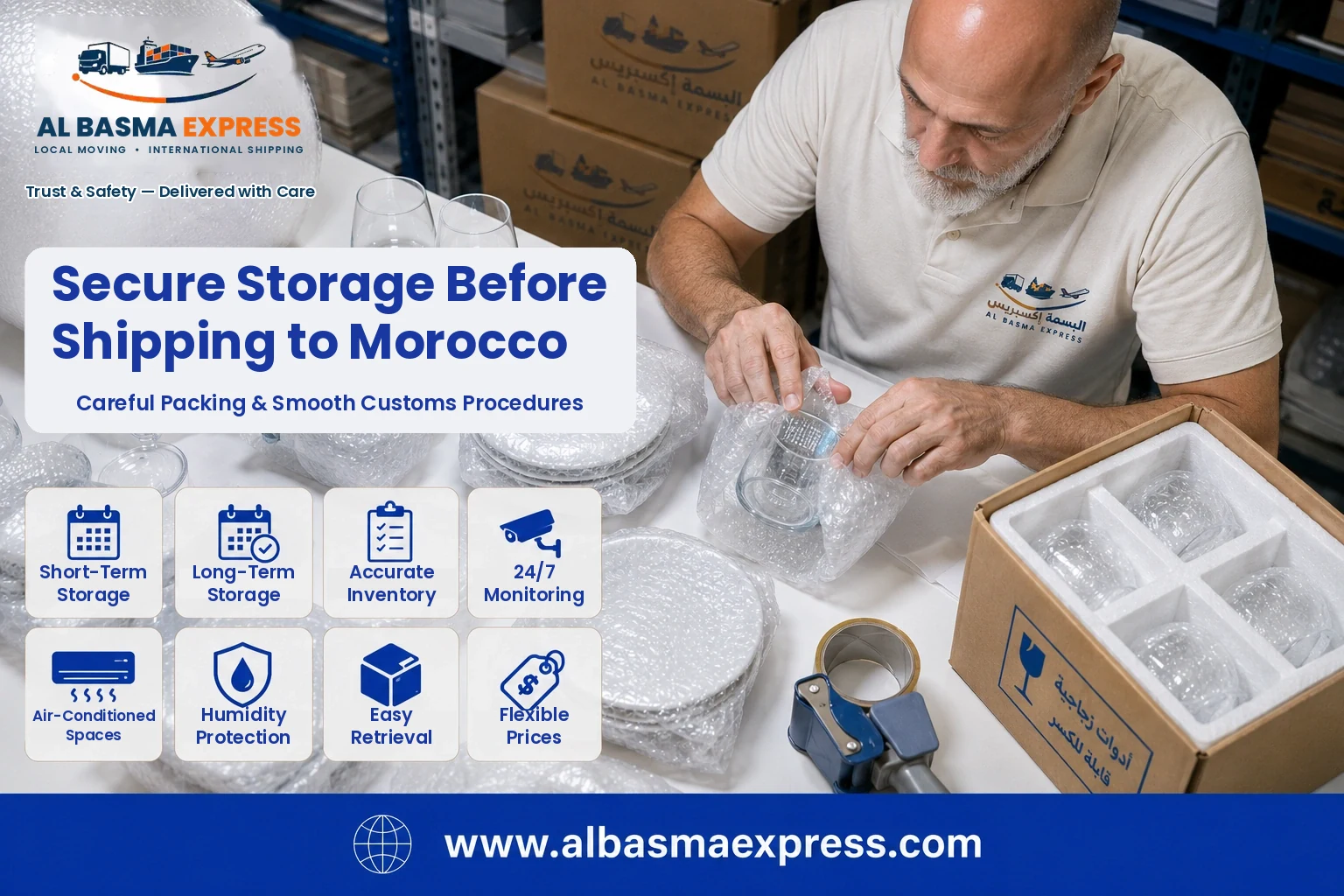
The customer may arrive in Morocco before the new home is ready, or the lease in Saudi Arabia may end before the Moroccan property is handed over. In that case, temporary storage can be built into the plan if it’s suitable and available.
If storage is known in advance, the load is prepared to stay sealed for an extra period: appliances are dried thoroughly, upholstery protected and cartons sealed to withstand stacking.
The same inventory continues inside storage, so boxes from different rooms don’t get mixed and a furniture item’s fittings aren’t separated from it.
Priority boxes are placed where they can be reached easily if the customer needs them before the whole load is released.
When the delivery address is ready, the units are checked and then loaded in order of city, property and room.
◆ Storage isn’t a place to re-mix the shipment
The goal is for units to enter storage in the same order they’ll leave, so the delivery stage stays based on the original inventory.
Every unnecessary re-sort adds handling and time without adding value.
The day before shipping: test the home as if you were leaving in an hour
Before the moving crew arrives, try a simple test: if you had to leave the home right now, would everything traveling with you be separate from everything going into the shipment? If not, there’s sorting still to finish.
Passports, documents, money, jewelry, medicines, personal bags and devices traveling with the customer go in a separate area.
Then wardrobes and drawers are emptied, and fridges and washing machines prepared by emptying, cleaning and drying.
The connections of computers, TVs and electronics are photographed, then cables and accessories gathered with each device.
Make sure furniture that won’t travel is separated or clearly marked so it doesn’t end up on the load list.
Building management, the service elevator, the vehicle spot and loading time are also checked if the compound has rules.
In Morocco, the consignee’s name, phone, city, area, location, floor and elevator or warehouse information are confirmed.
Arrival day in Morocco: don’t let fast unloading turn into chaos inside the property
The goal of delivery day isn’t to get everything out of the vehicle as fast as possible, but to bring everything as close as possible to its final place with the fewest moves.
The process starts by matching units against the inventory and inspecting sensitive items during unloading.
Then large furniture goes in first — beds, wardrobes, tables and majlis seating — because these items need space to move and be assembled.
If assembly is part of the agreement, each item’s position is fixed before assembly starts.
Then the cartons go to the rooms written on them: the kitchen box straight to the kitchen and the bedroom box to its room.
Once matching is complete, first-priority boxes are opened, then second-priority ones, while décor and non-urgent contents can wait.
This way the home can be used quickly without opening every box or moving every item several times.
▪ The best unloading cuts the “second distance” inside the home
If a box goes into the living room and then moves to another room, it has been handled twice inside the property.
Room codes make the path from the front door to the final spot shorter and clearer.
Why Al Basma Express for shipping from Saudi Arabia to Morocco?
Shipping to Morocco needs management that can link pickup inside Saudi Arabia, preparation, international transport and final distribution inside Morocco, rather than treating each stage as a separate service that doesn’t know what came before.
Al Basma Express starts with a free survey to set the volume, the items that need disassembly, the packing level and the difficulty of the pickup site.
Solutions cover home and office furniture, cars, goods, equipment and parcels, with the option of choosing the right transport method for each category instead of imposing one method on everything in the order.
Suitable air services are available within 24–48 hours for suitable urgent shipments, with supporting land transport services that may fall within 2–5 days depending on the city and service, while the sea transit time is set according to the sailing schedule, booking and handling stages.
GPS tracking also helps during the land transport stages, and order status updates are used as the load moves between preparation, international transport, arrival in Morocco and distribution.
The price is set according to volume, weight, pickup city, Moroccan city, transport method, packing, disassembly and assembly, type of property, storage, lifting, and any car or equipment.
Delivery can be organized to Casablanca, Rabat, Tangier, Marrakech, Fez, Agadir, Meknes, Oujda, Kenitra, Tetouan and other areas according to the operating route and final address.
To arrange a survey, call +966553923364 or visit the official Al Basma Express website.
Frequently asked questions about shipping from Saudi Arabia to Morocco
What’s the best way to ship furniture from Saudi Arabia to Morocco?
The method is chosen according to the load volume, starting city, destination and time required. Sea freight can be assessed for furniture and larger loads, while air suits limited parcels that need speed.
How long does air freight from Saudi Arabia to Morocco take?
Suitable air services usually take 24 to 48 hours depending on the flight, content acceptance and handling, and a door-to-door service may need extra time for pickup and distribution.
Does sea freight to Morocco have a fixed transit time?
It’s best not to set one duration for all sea shipments, because the time depends on the sailing schedule, departure point, arrival port, type of service, handling, clearance and inland distribution.
Can a whole household be moved from Saudi Arabia to Casablanca or Rabat?
A full household move can be organized after a survey and listing of furniture, appliances and cartons and setting the disassembly, packing, inventory and space — then transport and distribution to the required address are arranged.
Does Al Basma Express offer a free survey?
Yes. The free survey helps set the volume after preparation, the items that need disassembly, the packing level, property difficulty and extra services before the quote is prepared.
Can a car be shipped from Saudi Arabia to Morocco?
Vehicle shipping can be assessed according to the available service, with the car’s file managed separately and its condition, transport method and the official requirements in force reviewed before confirming the booking.
What are the best packing materials for furniture going to Morocco?
It depends on the item: blankets, bubble wrap, reinforced cartons, corner guards, padding and outer wrapping can be used, with rigid or wooden crates for items that need more reinforcement.
Can the shipment be tracked by GPS?
GPS tracking helps in the land stages and works alongside order status updates during preparation, international transport, arrival in Morocco and dispatch for distribution.
How is the price of shipping from Saudi Arabia to Morocco determined?
It depends on the pickup city, volume, weight, type of load, transport method, packing, disassembly and assembly, the Moroccan city, the property location, storage, lifting and extra services.
Can goods and equipment be shipped to Morocco?
Permitted goods and equipment can be assessed once the item, quantity, weight, dimensions, stackability, lifting points, packing method and consignee location are provided.
Does the service reach Marrakech, Fez, Agadir and Tangier?
Delivery can be organized to Casablanca, Rabat, Tangier, Marrakech, Fez, Agadir, Meknes, Oujda, Kenitra, Tetouan and other cities according to the operating route and final address.
How do I start a shipping request to Morocco?
Call +966553923364 and send your pickup city, Moroccan city, type of load and a rough list or photos — then the survey is arranged and the right transport method set.
From Saudi Arabia to Morocco: make your shipment ready to change method without losing its identity
A long distance doesn’t have to make the move complicated for the customer if it’s broken down correctly. What’s needed is for the load to stay organized however the transport method or handling stage changes.
Furniture gets a code, packing and disassembly when needed; the car gets a separate file; goods get dimensions and weights; equipment gets lifting points; and urgent parcels can be separated for a faster service if suitable.
These categories are then linked to the origin city inside Saudi Arabia and the final city inside Morocco, so local transport before and after international shipping is part of the plan from the start.
Al Basma Express offers a free survey and options for furniture, cars, goods, equipment and parcels, with GPS tracking for the land stages and shipment status updates across the trip’s different stages.
Suitable air services take 24–48 hours, some supporting land stages may fall within 2–5 days depending on the service, and the sea shipping time is set according to the actual sailing schedule, booking and handling stages.
Whether your destination is Casablanca, Rabat, Tangier, Marrakech, Fez or Agadir, the best starting point is knowing what will be shipped and which address it will reach — then building the route between them.
To get started, call +966553923364 and send your load details, origin city and destination, then a survey is arranged and the most suitable service chosen.