Moving from Saudi Arabia to Algeria puts the customer in front of a different problem from most nearby shipping routes: the load is large, the distance is long, and the arrival stage inside Algeria may be far from the port itself. So the best plan doesn’t start with “how do I ship?” but with “what shape must the shipment take to move through several stages without losing its order?” Furniture needs to be turned into protected units that can be inventoried, a car needs a separate file, goods need weight and dimension data, equipment needs a lifting plan, and urgent parcels may benefit from air freight instead of waiting for the main load.
Your guide inside this article42 topicsShowHide
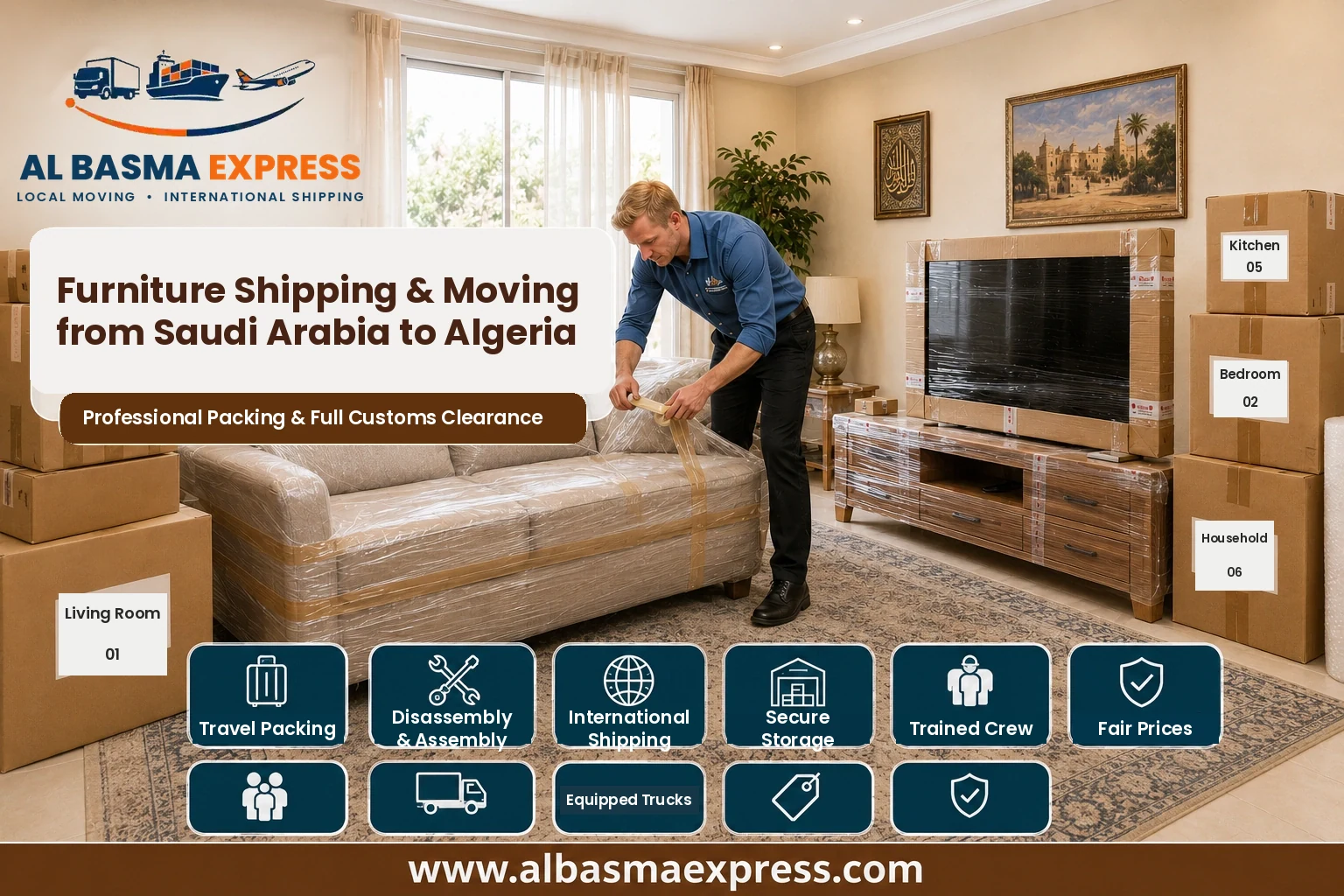
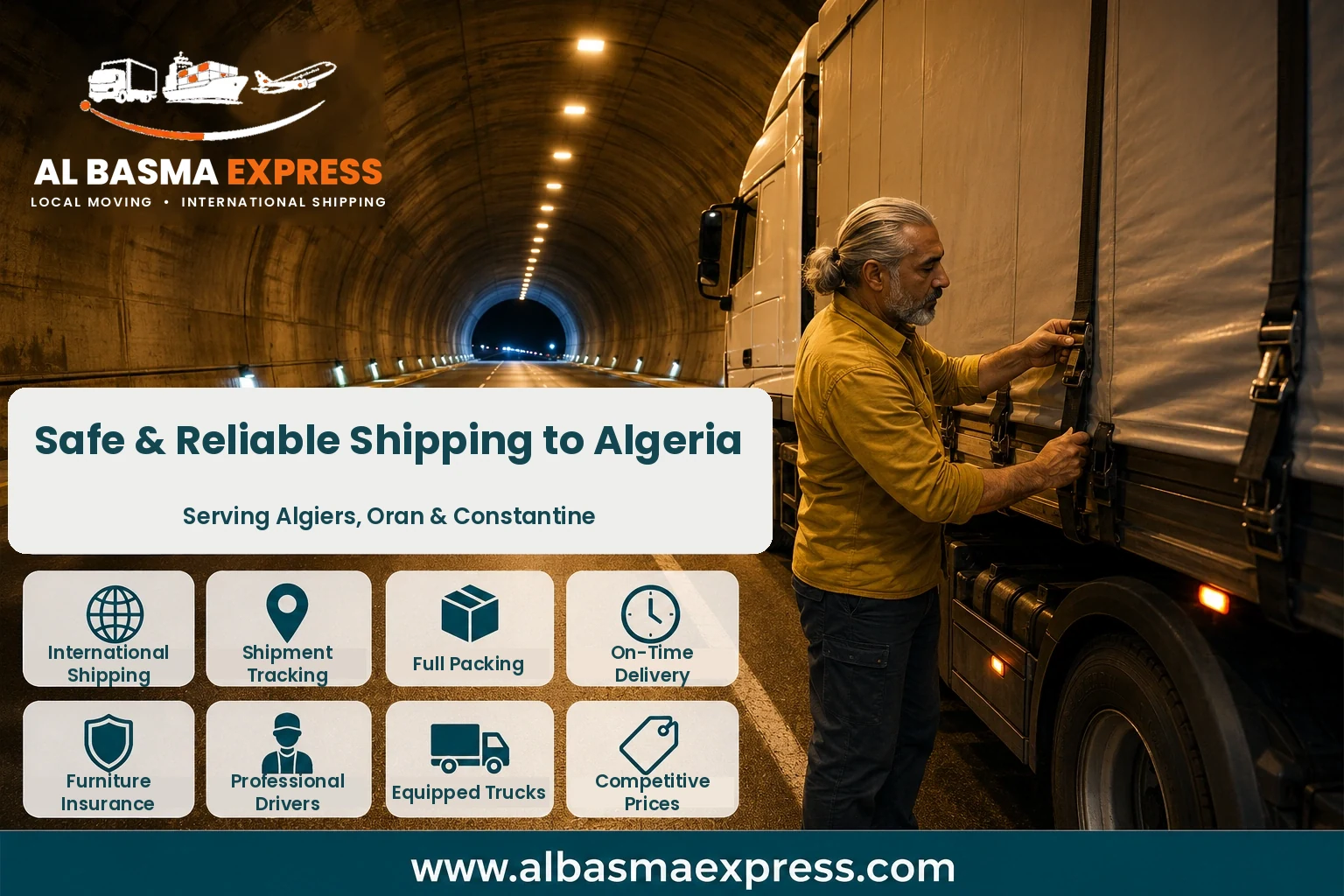
Al Basma Express operates as a shipping company from Saudi Arabia to Algeria for individuals, families and business owners, covering household goods, home and office furniture, appliances, cars, goods, equipment and parcels, with pickup from Riyadh, Jeddah, Dammam, Khobar, Al Ahsa, Makkah, Madinah, Qassim, Hail and other Saudi cities, and delivery coordinated to Algiers, Oran, Constantine, Annaba, Blida, Setif, Batna, Bejaia, Tlemcen, Chlef and other cities and provinces depending on the final address and operating plan.
For large loads, the route to Algeria relies mainly on sea planning, with land transport inside Saudi Arabia moving the load from the customer’s home or warehouse to the shipping point, and then a new land distribution stage after arrival in Algeria. Air freight can be used for suitable shipments when speed is a priority and the volume isn’t large.
The Port of Algiers is one of the country’s most important commercial sea gateways. According to the Port of Algiers Authority, it serves several provinces and includes areas for handling containers and goods, offering logistics, handling, receiving and shipping services — so it can be part of planning some shipments bound for Algiers, the central provinces and the surrounding area.
Service time varies by method: air freight for suitable shipments can take 24–48 hours depending on the flight, content acceptance and handling stages, while suitable supporting land transport stages may fall within a 2–5 day range depending on the pickup or distribution city and the nature of the service. The sea leg itself depends on the sailing schedule, type of booking, port, handling, clearance and distribution, so no uniform sea duration is set for all orders.
The cost doesn’t follow a fixed price: a whole household from Jeddah to Algiers differs from a few parcels from Riyadh to Oran, and a car, equipment or commercial goods differ from furniture. The cost depends on volume, weight, pickup city, Algerian city, shipping method, packing, disassembly and assembly, storage, lifting, property difficulty and any extra service.
The service starts with a free survey that helps determine what’s worth shipping, what needs disassembly and what needs extra protection, with GPS tracking in the land transport stages and order status updates as the load moves to international shipping, then arrival in Algeria and local distribution.
To request a survey or discuss your shipment, call +966553923364 and send your pickup city, Algerian destination, type of load and rough photos of the contents.
Start from the “last delivery point” instead of the first loading point
The traditional approach starts at the Saudi home: what needs packing? How does the item get out of the door? Where does the truck park? But the Algeria route benefits from the opposite approach: we start with the place the item will finally enter.
If delivery is to an apartment in Algiers, the floor, elevator and vehicle stopping point must be known. If it’s to a villa in Oran, the spaces and entry route are different. And if it’s to a warehouse in Constantine or Setif, we need to know the receiving gate and unloading method.
This information changes how the load is prepared from the start. A piece of furniture that will go up in a small elevator may need more disassembly than one going straight into a villa. And equipment arriving at a site without a forklift needs special arrangements before it leaves Saudi Arabia.
The final address also affects the choice of arrival gateway and the inland distribution plan: Algeria is a vast country, and reaching a port doesn’t mean the shipment is close to every city.
That’s why it’s best to send the final location early rather than just “to Algeria”. The city, province and type of property are part of the shipping service, not details for later.
Once the end point is set, step two follows: assessing what should leave Saudi Arabia at all. Every item must have a clear reason to make the trip — it will be used, it has practical value, or it’s hard to replace.
City apartment
- Floor.
- Elevator.
- Entrance width.
- Vehicle parking spot.
Villa or house
- Entry gate.
- Maneuvering space.
- Furniture positions.
- Assembly.
Warehouse or company
- Gate.
- Receiving time.
- Forklift.
- Unloading space.
◆ The best shipping plan knows the last meter before moving the first kilometer
If the arrival site won’t let a large vehicle in, that must factor into the distribution plan. And if the furniture won’t fit through the door of the new Algerian apartment, it’s better to know before packing it completely in Saudi Arabia.
Planning from the end reduces surprise decisions at delivery and builds each stage on the one after it.
The free survey: turning the home into a “space map”, not a furniture list
When a customer says they have a bedroom, living room, majlis and appliances, the picture is still incomplete — the shipment’s volume depends on how the furniture looks after disassembly and packing, not just on room names.
The survey first identifies bulky items that may shrink after disassembly, such as wardrobes, beds and large desks. Then it records items that grow after packing, such as mirrors, TVs and antiques that need crates and extra padding.
Next, belongings the customer won’t need in Algeria are separated out. There may be a large table that doesn’t suit the new home or old appliances not worth the cost of a long international trip.
Electrical appliances, fridges, washing machines, ovens and TVs are also reviewed to see what needs internal preparation and what only needs an outer wrap.
Building details factor into the assessment: a long staircase, a small elevator, a narrow corridor or a long distance between the door and the truck can increase working time even if the shipment is medium-sized.
By the end of the survey, the crew has a picture of the final volume, number of units, sensitive items, technical services and property location, which allows the transport method to be assessed more accurately.
▪ Don’t compare two homes by number of rooms — compare what they’ll take up once prepared
A small apartment may contain a lot of modular furniture and glass and need more time and volume than a spacious home with a few easy-to-move items.
That’s why the survey is more useful than relying on a general description like “medium furniture” or “three-bedroom home”.
Sea for the load, air for time: a different way to compare the two methods
When shipping to Algeria, sea and air are solutions to two different problems more than competing alternatives.
Sea solves the volume problem. When the customer has a whole household, a large number of cartons, goods or equipment, space becomes the key factor in the plan, and sea transport is one of the natural options to assess.
Air solves the time problem. When there’s a limited parcel the customer needs on arrival, non-original commercial documents, work tools or permitted small devices, air freight can be assessed.
Suitable air freight takes 24–48 hours depending on the flight, content acceptance and handling stages. Supporting land stages where applicable may fall within 2–5 days depending on the pickup or distribution location and the nature of the service.
The sea transit time is set by the actual service, sailing schedule, port and handling and clearance stages, so no single number is used for all containers or shipments.
The two methods can be combined. Furniture and cartons may travel by sea while a small set of essentials arrives by air, so the customer doesn’t have to wait for the large load to start their life or work.
Things shouldn’t be sent by air just because it’s faster — if there’s no clear time reason, adding them to the main load may make more sense.
| Question | If the answer is “yes” | The option worth assessing |
|---|---|---|
| Is the load large? | Furniture and many cartons | Sea |
| Is time more important than volume? | An urgent, limited parcel | Air |
| Do you have both? | Home + early needs | Split the load |
Packing by the principle “where could the item fail?”
Packing can be chosen better by thinking about each item’s likely point of failure, instead of using the same materials for everything.
Polished wood: can be damaged by friction and corners, so it needs separators, blankets and guards that prevent direct contact with other items.
Mirrors and glass: the main weak points are the edges and pressure, so they need padding, shock-absorbing materials, suitable reinforcement and possibly a more rigid crate depending on size.
TVs: the greatest risk is pressure on the screen or bending, so they’re never placed where weight can be stacked on top.
Appliances: the problem may be internal — leftover water, moving parts or doors — so the appliance is prepared first and then packed.
Upholstery and mattresses: the main risk is dirt and friction, so the focus is on the outer cover and edges.
Antiques: may need separate packaging and padding that leaves no gap for movement.
After packing comes a stage that’s just as important: arranging the item within the load. If the wrap is excellent but the item sits next to something that can knock into it on the move, the protection is still incomplete.
Scratches
Blankets, separators and guards for edges and surfaces.
Breakage
Bubble wrap, padding, reinforcement and a separate package.
Pressure
No stacking, and a safe position for the item.
Internal movement
Padding and securing parts before closing.
◆ Don’t look for the strongest wrap — look for the wrap that suits the weak point
Adding lots of layers to an item that doesn’t need them can add volume for nothing, while another item needs a more rigid crate rather than extra layers of plastic.
Choosing protection by risk helps strike a better balance between volume and safety.
Disassembly and assembly: use the rule “fewer pieces or more problems?”
Disassembly can reduce space clearly, but it can also increase the number of parts, screws and panels if used without need.
It’s best to dismantle an item when its dimensions stop it getting through the door or elevator, when its volume drops usefully after disassembly, or when packing it becomes easier and safer.
Small, stable items whose volume doesn’t benefit from disassembly may make more sense left whole.
Each dismantled item gets its own code — for example “Master bedroom – Wardrobe 2” — then the panels carry sub-numbers, and the bag of hinges and bolts is kept under the same code.
Complex furniture can also be photographed before disassembly, especially units with a shelf arrangement or similar parts.
Separators are placed between wooden panels after disassembly, because a panel’s surface is exposed to friction even if the weight is lower.
On arrival in Algeria, the whole set is gathered before assembly starts, and then the item’s final position in the room is confirmed.
▪ Successful disassembly is measured by how easy assembly is thousands of kilometers later
If all the panels arrive but no one knows which screw bags go where, the speed of disassembly in Saudi Arabia counts for nothing.
Photos, numbering and linking fittings to each item make the last stage a natural continuation of the first.
The Port of Algiers as an arrival gateway: why the port name isn’t enough for the delivery plan
The Port of Algiers is located to serve several provinces and has infrastructure for handling and storing goods and containers, making it one of Algeria’s main commercial ports. The port authority states that its logistics reach covers the central, central-east and central-west regions, making it an important point in commercial shipping traffic.
But the port isn’t the final address. A load going to Blida may have a different distribution stage from one going to Constantine, Setif or Oran.
That’s why, when comparing shipping quotes, you need to know whether the service ends at the port or includes delivery to the city and property.
You also need to know whether there’s temporary storage after arrival or direct transport to the consignee. These details affect handling time and the order in which the load comes out.
The arrival gateway shouldn’t be chosen by city name alone: the type of sea service, shipping line, inland destination and availability at the time of booking all factor into the decision.
It’s also useful for the inventory list to be ready in a form that lets units be matched after arrival in Algeria before they go out for distribution.
◆ Ask where the quote’s responsibility ends before asking about the number
A quote that ends at the port can’t be compared directly with one that includes distribution and unloading all the way to the consignee’s home.
Aligning the start and end points is the first condition for comparing prices fairly.
From Jeddah, Riyadh and Dammam to Algeria: four different trips before the sea
The customer’s city inside Saudi Arabia changes the first stage of the service, and with it the time, work and vehicle needed before the shipment enters its international route.
From Jeddah: furniture and cartons can be prepared and the load linked to a suitable sea plan, accounting for the property location, disassembly, packing and distance to the shipping point.
From Riyadh: the load needs inland land transport before entering the sea or air stage, so the furniture must be ready for a multi-stage trip from the moment it leaves the home.
From Dammam, Khobar and Dhahran: the consolidation route or international shipping point is chosen according to the type of service and load, with the inland road counted in the price and schedule.
From Makkah: disassembly and packing are organized before the items are taken out, then they’re moved to the right shipping point.
From Madinah: the inland transport stage is part of the schedule, and the international stage’s time isn’t counted alone.
From Qassim and Hail: the order needs the size of the consolidation vehicle set and whether an intermediate point is needed before reaching international shipping.
From Al Ahsa: furniture, goods, cars and equipment can be organized according to weight, volume and destination inside Algeria.
The further the customer’s city is from the shipping point, the more important good securing is from the first leg, because the load starts being exposed to movement before the sea stage even begins.
Jeddah
Focus on preparing the load and linking it to the right shipping line.
Riyadh
An inland land stage before entering international transport.
Eastern Province
Choosing the consolidation point according to the operating route and load.
Shipping cars to Algeria: don’t let transport come before verification
The first step in shipping a car isn’t booking transport, but making sure the vehicle’s file is ready for the process.
The car is photographed from all sides and existing visible marks documented, then running condition, tires, battery and any obvious leaks are checked.
If the car doesn’t run, this must be stated from the start, because loading it needs different equipment from a vehicle that can be driven.
Then the car, owner and consignee details are prepared separately from the household furniture list.
The cabin and trunk aren’t used as storage for belongings without a clear arrangement — mixing furniture into the car’s file makes the inventory and requirements more complicated.
Next, the customs and regulatory requirements in force in Algeria are reviewed according to the vehicle, the owner and the type of import at the time, without relying on an old experience or another car’s case.
The sea transport method or suitable service is chosen according to the operating route, and the car is inspected again on arrival.
▪ The car can move at the same time as the furniture without moving inside its file
The household inventory is kept separate from the vehicle data, so the photos, documents and tracking relate only to the car.
This makes delivery clearer for the customer, the crew and anyone dealing with the vehicle.
Commercial goods: turn each box into a “space figure”
In commercial shipping a package isn’t just a wrapper for the product — it’s a unit of space inside the truck or container, so its dimensions, weight and stackability must be known.
If you have twenty identical boxes that can be stacked, height can be used very differently from twenty boxes none of which can take weight on top.
That’s why the item, quantity, number of packages, dimensions, weight, packing method and handling instructions are recorded.
Important instructions such as “this way up” or “keep upright” are written visibly, and the handling crew isn’t expected to know the contents from the look of the box.
If the goods are on pallets, each pallet’s dimensions, weight and lifting method are recorded, and the boxes checked for stability on it.
The delivery location in Algeria must also be set: a warehouse in Algiers differs from a shop in Oran, a factory in Constantine or a facility in Setif.
Commercial goods and personal belongings must be kept separate if they’re in one order, so each category has a clear description and its own inventory.
| Information | What does it reveal? | Its effect |
|---|---|---|
| Dimensions | Space | Choosing the space |
| Weight | Handling requirements | Choosing lifting equipment |
| Stackability | Use of height | Load arrangement |
| Arrival address | Unloading method | Choosing the distribution vehicle |
Equipment to Algeria: design the “weight route”, not just the distance route
Heavy equipment needs a different set of questions. It isn’t just where it’s going, but how it will be lifted, secured and unloaded.
The individual weight of each piece of equipment is recorded rather than just the total weight, because lifting equipment deals with one piece at a time.
Then the dimensions, lifting points, correct transport orientation and center of gravity, if it matters, are recorded.
Next, the pickup site in Saudi Arabia is reviewed: is there a forklift? How wide is the gate? Can the vehicle get close to the equipment?
In Algeria, the same data is requested for the arrival site. If the factory or project has no forklift, the unloading method must be arranged before the shipment arrives.
It’s also determined whether some detachable parts could reduce the volume or make handling safer.
Straps aren’t fixed to the nearest available point, but to points that can bear the force without damaging the equipment.
◆ The biggest decision in shipping equipment may be at the delivery site, not the port
If there’s no space for a large vehicle or lifting equipment at the destination, the final-stage plan must change — and perhaps how the load is distributed from the start.
That’s why the last step is treated as part of the design, not a problem left until arrival.
Algiers, Oran and Constantine: three different distribution routes
Algeria’s size makes the final city a clear factor in the post-arrival stage, so planning shouldn’t stop at the port name.
Algiers: household shipments need the district, floor, elevator and vehicle parking spot specified, while offices need entry times and service elevators known.
Oran: furniture, cars and goods can be delivered to homes and warehouses according to location, with the distribution stage from the arrival point counted.
Constantine: the inland stage differs because of the city’s location, so it must be set before the final date is confirmed.
Annaba: residential and commercial shipments can be organized according to the consignee’s address and the unloading or assembly services.
Blida: the property, floor and vehicle access are set, especially when moving a whole household.
Setif: goods and equipment need the warehouse or factory location and handling method known.
Batna: the inland land distribution stage is part of the overall schedule.
Bejaia: the inland road and the type of property or business are assessed before the shipment goes out for distribution.
Tlemcen: needs a distribution plan different from central Algeria, and the city must be part of the assessment from the start.
Chlef and other cities: the delivery scope is set according to the operating route and final address.
Central provinces
Relatively close to major logistics hubs, with the property and city making the difference.
East
Constantine, Annaba, Setif and Batna need a clear inland distribution stage calculated.
West
Oran and Tlemcen need a distribution route suited to the arrival point and final address.
▪ One country doesn’t mean one delivery area
The distance between the arrival gateway and the final city can be an important part of the trip, especially when the destination is in the east or west.
That’s why the city name should appear in the price request from the start, not after the shipment reaches Algeria.
GPS tracking by “stations” instead of watching a single dot
The trip to Algeria has multiple stages, so it isn’t realistic for a single land vehicle’s tracking to represent the shipment all the time.
Tracking can be divided into stations: collected, then in preparation, then left the customer’s site, then reached the shipping point, then in international transit, and after arrival being received in Algeria, then out for distribution.
During the land stages, GPS tracking can help follow the vehicle’s movement, while order status is more useful once the load enters a sea or handling stage.
When the distribution vehicle heads out inside Algeria, location becomes useful again, especially for coordinating the consignee’s presence and preparing the property.
If the car moves under a different service from the furniture, each file must be tracked separately.
This system prevents the misunderstanding that happens when a customer sees the shipment “stationary” on an old map when it has actually moved to another method.
◆ Location answers “where?” and status answers “what’s happening?”
On multi-method trips the customer needs both: location alone doesn’t explain the load moving from a truck to a sea stage.
Staged updates make tracking a tool for understanding the trip, not just a point on a map.
The price of shipping to Algeria: use the formula “volume + complexity + inland distance”
Instead of looking for a uniform number, the price can be understood through three main axes that explain most differences between orders.
Volume and weight: furniture and cartons are assessed largely by space, while weight matters more for equipment, goods and air freight.
Service complexity: a home with mirrors, antiques and furniture needing extensive disassembly requires more materials, labor and time than a load of cartons and simple furniture.
Inland distance: the pickup city inside Saudi Arabia and the distance to the shipping point, then the distance from the arrival point in Algeria to the final city.
On top of these come a car, storage, lifting, multiple delivery points or special equipment.
The property at both ends matters too: the floor, elevator, vehicle position and furniture carrying distance all add to working time.
The best way to cut costs is to reduce unnecessary load, improve disassembly to save space when needed and specify the service required precisely — not to remove protection from sensitive items.
| Axis | What does it include? | How do you make the assessment more accurate? |
|---|---|---|
| Volume | Furniture, cartons and appliances | A survey and a final list |
| Complexity | Packing, disassembly, antiques and glass | Detailed photos |
| Distance | Starting city and destination | Both final addresses |
| Special services | Car, storage, lifting and equipment | Defining them before booking |
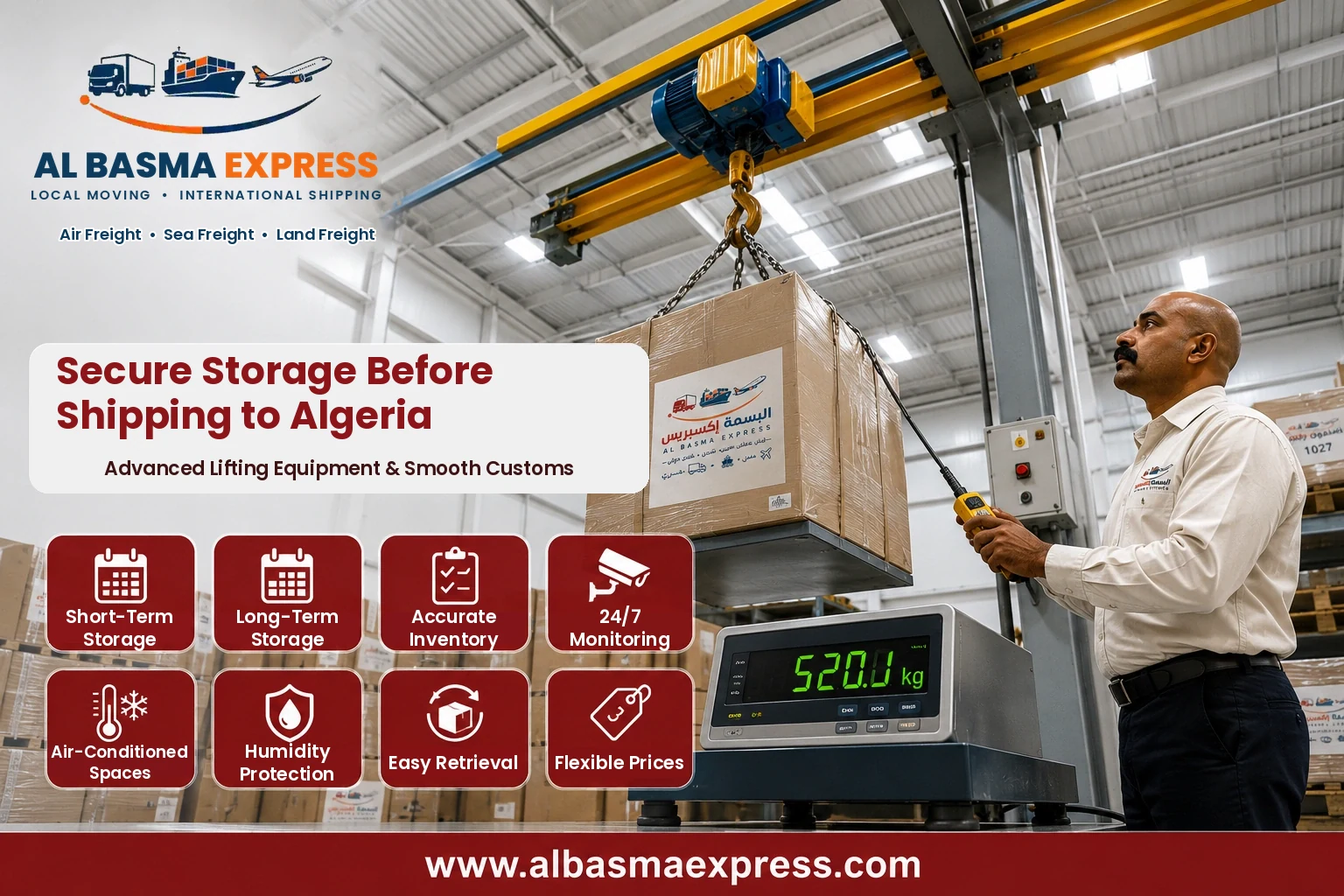
Temporary storage: when does it protect the schedule instead of delaying the shipment?
Your lease in Saudi Arabia may end before the home in Algeria is ready, or a company may need to vacate its office before receiving the new warehouse. In that case storage separates the move-out date from the delivery date.
If storage is expected, packages must be designed to stay sealed for an extra period.
Appliances are dried well, cartons sealed firmly, labels kept clear, and upholstery protected from dust and friction.
The inventory codes also continue: room boxes aren’t mixed and furniture parts aren’t separated from their screw bags.
Packages can be divided by priority, so things the customer may need first stay in an easier-to-reach spot.
When the property is ready, the shipment is reloaded in final delivery order, with the number of units matched before it leaves.
▪ If the shipment enters storage organized, it shouldn’t come out mixed up
The goal is for the same inventory to stay valid from the Saudi home to the Algerian home, even with a storeroom in between.
Every re-sort means extra handling that can be avoided if the original system is maintained.
Three days before pickup: use the “nothing left unknown” list
Before the moving crew arrives, every item in the home must carry a clear decision: ship, stay, sell or leave the home. There’s no room for gray-area decisions on loading day.
Passports, original documents, money, jewelry, essential medicines and travel bags go in an area the packing crew doesn’t enter.
Drawers and cabinets are emptied, large appliances prepared, and cables and accessories detached.
It’s best to photograph electronic connections before dismantling computers, TVs and sound systems.
The service elevator, truck position and building entry time are also confirmed, so the crew doesn’t arrive and then start coordinating from scratch.
In Algeria, the consignee’s name, province, city, address, phone number, floor, elevator and any special entry instructions must be confirmed.
If there’s a car, its file must be separate and reviewed before the date. If there are goods or equipment, their dimensions and weights should be known as far as possible.
Delivery day in Algeria: use the rule “big before many”
It’s a mistake to start by taking out dozens of small boxes just because they’re easy — they can fill the corridors and block wardrobes, beds and large appliances from coming in.
So the stage starts by matching the inventory during unloading and inspecting sensitive items, then large furniture goes into the main rooms.
Then the technician starts assembling items whose positions are set, gathering all the parts and fittings for each set.
Then the boxes move to their rooms according to their codes, instead of piling up in the living room.
Only priority boxes are opened at first — bedding, kitchen supplies and essential clothes — while books and décor can wait.
If the shipment has multiple addresses, each address must be separated before the distribution vehicle leaves, so sorting doesn’t happen in front of the customer.
At the end, the inventory and inspection are reviewed before delivery is completed.
◆ Less handling means faster, tidier delivery
If a box goes from the vehicle to the living room and then to another room, it has been handled twice for no reason.
Room-based numbering shortens each unit’s path from the property’s door to its final place.
Why Al Basma Express for shipping from Saudi Arabia to Algeria?
Shipping to Algeria needs management that doesn’t stop at the international booking, but links the home or warehouse in Saudi Arabia with the final city and property in Algeria.
Al Basma Express starts with a free survey to set the volume and what needs disassembly or special packing, then creates the inventory and prepares the load.
The service covers home and office furniture, cars, goods, equipment and parcels, with the option of dividing the order into separate categories according to each type’s needs.
Suitable air services are available within 24–48 hours for suitable and urgent shipments, some suitable land transport stages may fall within 2–5 days depending on the city and service, and the sea transit time is set according to the sailing schedule, port and actual service.
GPS tracking also helps in the land stages, while order status updates show the load moving from pickup to preparation, then international shipping, arrival in Algeria and dispatch for distribution.
The price is set according to volume, weight, transport method, packing, disassembly and assembly, starting city, Algerian city, type of property, storage, lifting, any car or equipment and extra services.
Delivery can be coordinated to Algiers, Oran, Constantine, Annaba, Blida, Setif, Batna, Bejaia, Tlemcen, Chlef and other cities and provinces according to the operating route and final address.
To get started, call +966553923364 or visit the official Al Basma Express website to arrange a survey and discuss the right service.
Frequently asked questions about shipping from Saudi Arabia to Algeria
What’s the best way to ship furniture from Saudi Arabia to Algeria?
It depends on the load volume, starting city, destination and time required. Sea solutions can be assessed for large household loads, while air suits limited parcels that need more speed.
How long does air freight from Saudi Arabia to Algeria take?
Suitable air services take 24 to 48 hours depending on the flight, content acceptance and handling stages, and a door-to-door service may need extra time for pickup, clearance and distribution.
Does sea freight to Algeria have a fixed transit time?
It’s best not to set one duration for all sea shipments, because the time varies with the sailing schedule, shipping point, arrival port, type of booking, handling, clearance and the final Algerian city.
Is the Port of Algiers suitable for receiving commercial shipments?
The Port of Algiers is one of the country’s main commercial ports, offering services for handling and receiving goods and containers and serving several provinces. Whether it or another gateway is used is decided by the shipping line, service and destination.
Can a whole household be moved from Saudi Arabia to Algiers or Oran?
A full household move can be organized after a survey and listing of furniture, appliances and cartons, then disassembly, packing and inventory are set and the transport and distribution method to the required city and property chosen.
Does Al Basma Express offer a free survey?
The free survey helps set the volume after preparation, the items that need disassembly, suitable packing materials, property difficulty and extra services before the quote is prepared.
Can a car be shipped from Saudi Arabia to Algeria?
Vehicle shipping can be assessed according to the available service, with the car documented, inspected and its file managed separately, and the current regulatory and customs requirements reviewed before confirming the booking.
What’s the best packing for furniture going to Algeria?
It varies by item: blankets, bubble wrap, reinforced cartons, corner guards, padding and covers can be used, with more rigid or wooden crates for some sensitive items when needed.
Can the shipment be tracked by GPS?
GPS tracking helps in the land stages inside Saudi Arabia and during distribution, while order status updates complement it during preparation, international transport and arrival in Algeria.
How is the price of shipping from Saudi Arabia to Algeria determined?
It depends on volume, weight, type of load, pickup city, Algerian city, transport method, packing, disassembly and assembly, storage, lifting, both properties and any additional car or equipment.
Can goods and equipment be shipped to Algeria?
Permitted goods and equipment can be assessed once the type, quantity, weight, dimensions, stackability, packing method, lifting points and delivery location are provided — then the right shipping and handling method is chosen.
Does the service reach Constantine, Annaba, Setif and Tlemcen?
Delivery can be organized to Algiers, Oran, Constantine, Annaba, Blida, Setif, Batna, Bejaia, Tlemcen, Chlef and other cities and provinces according to the operating route and final address.
To Algeria: let every stage know what it’s handing over to the next
Successful shipping to Algeria doesn’t depend on one method, but on an organized handover between pickup, preparation, international transport, arrival and distribution.
If the furniture leaves the home without an inventory, the problem shows up on arrival. If packing is done without knowing each item’s weak point, the problem shows up during handling. And if the service is chosen without knowing the final Algerian city, the problem shows up after the port.
That’s why Al Basma Express starts with the survey and setting the volume, then packing, disassembly and inventory, and then the right route for each category is chosen.
Sea services can be assessed for furniture and larger loads, suitable air services offer a 24 to 48 hour range for urgent shipments, and land transport stages are used for pickup and distribution, with suitable services among them falling within 2–5 days.
GPS tracking and status updates help follow the order as it moves from stage to stage, instead of trying to track a single vehicle for the whole trip.
Whether the destination is Algiers, Oran, Constantine, Annaba, Setif or another city, setting the final address from the start makes the shipping plan more accurate in time, cost and delivery method.
To get started, call +966553923364 and send your pickup city, type of load and Algerian destination, then the survey is arranged and the right transport method, packing and services chosen.