
When moving from Jeddah to Algeria, the real problem isn’t finding something to carry the furniture from one point to another, but taking dozens of small decisions in the right order. Is the bedroom dismantled completely or is separating some parts enough? Does the mirror need reinforced cardboard or its own protective crate? Do the clothes go with the soft furnishings or are they separated by room? Does the car come into the same plan or does it need an independent file? And is it better to send all the contents the same way or to split them between sea freight, air freight and supporting land transport? These questions are what make the difference between a random shipment and an organized move.
Topics in this guide39 topicsShowHide
Al Basma Express provides a furniture shipping and moving company from Jeddah to Algeria service to individuals, families and companies, able to handle household and office furniture, cars, goods, equipment and parcels under a plan starting with the free survey and setting the volume, the weight and the load’s nature, then choosing the packing level, the disassembly, the loading and the inventory, and after that setting the suitable shipping method and the coordination through to arriving in Algiers, Oran, Constantine, Annaba, Blida, Sétif, Batna, Tlemcen, Béjaïa, Mostaganem or another Algerian city.
The trip is treated as a connected chain: collection from Jeddah, preparation and protection, transport to the international shipping stage, transit through the suitable crossings, ports or airports according to the type of service, then arrival in Algeria, then inland distribution to the recipient’s address. And on the land parts of the trip GBS tracking can be used to know the vehicle’s movement, while the follow-up is completed with an update on the shipment’s status when it moves to a sea or air stage.
As for the duration, supporting land transport services can take 2 to 5 days depending on the distance, the stage and the delivery location, while express air freight services for suitable shipments can take 24 to 48 hours depending on the flight, the load’s acceptance and the handling. Sea freight from Jeddah to Algeria, meanwhile, has its timing set by the shipping line, the arrival port, the sailing schedule and the clearance, so no fixed sea duration is given that ignores the actual booking’s conditions.
And the shipping cost doesn’t rest on one flat figure; the shipment’s volume and weight, the furniture’s nature, the packing level, the shipping method, the final city, the difficulty of reaching the property, the disassembly, assembly, storage and lifting services, and shipping the car or the equipment are all factors affecting the quote. You can call 0553923364 to request the free survey and set the shipment’s needs before the execution begins.
The different idea: treat the home as a shipping project, not a room full of furniture
What confuses the customer most is trying to deal with the whole house at once. They look at the furniture and see a large mass that needs to leave Jeddah, but the shipping company needs a different view: a wooden load, appliances, glass, parcels, soft furnishings, sensitive pieces, and perhaps a car or equipment. As soon as the home is split into these categories it becomes easy to set the method, the materials and the risks for each part.
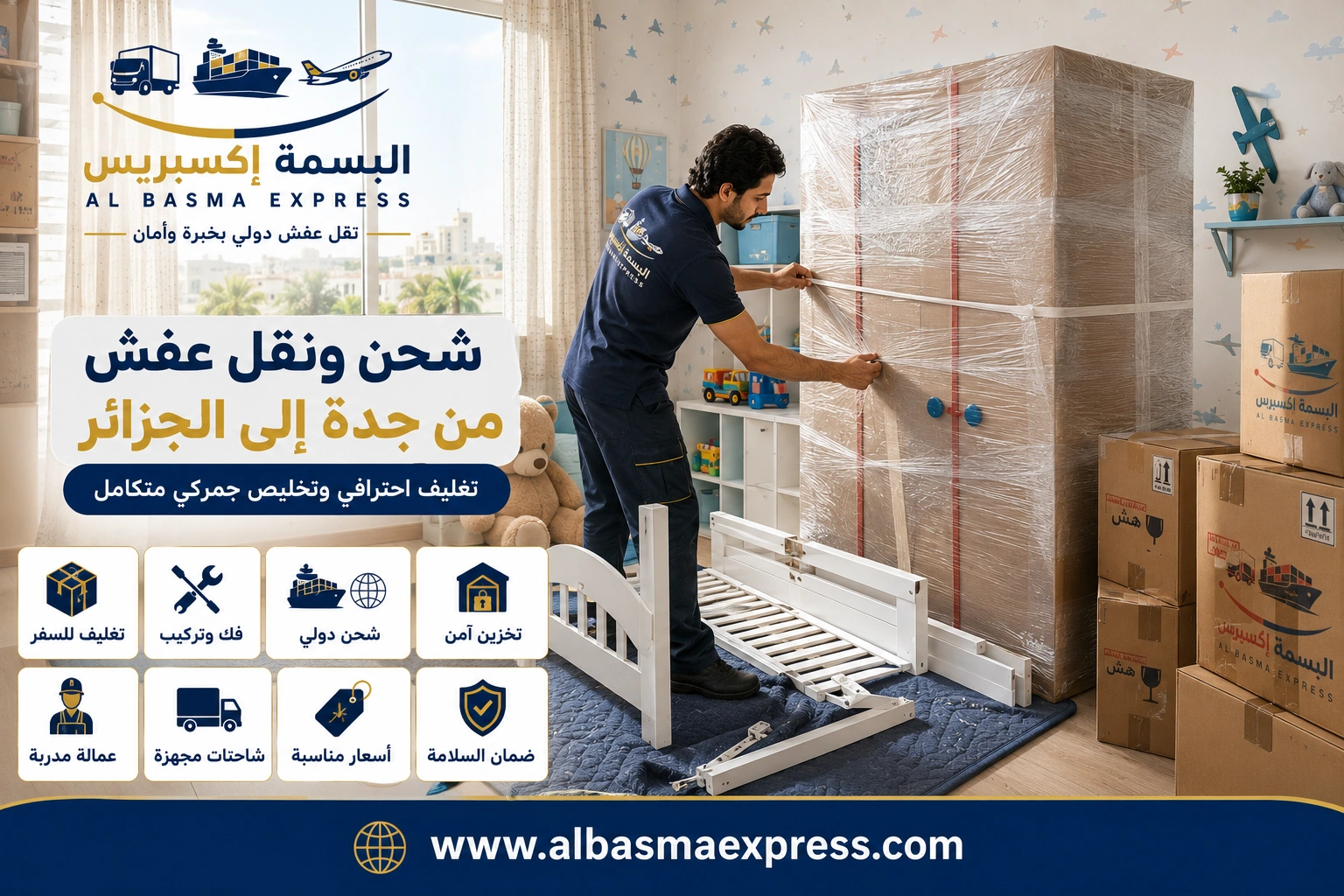
Inside the same home you can find a large wardrobe needing dismantling, a mirror needing reinforcement, a rug needing tight rolling, books needing small cartons, a sofa needing layers protecting the fabric, and a fridge needing drying and securing. Using one method for all these items doesn’t shorten the work; it moves the problem to the road stage.
So the planning starts with a clear split. The large furniture is measured and whether it can be dismantled is set. The appliances’ condition and how they’re secured are reviewed. The fragile pieces are recorded separately. The cartons are split by room and type of contents. The car, the goods and the equipment, meanwhile, have independent preparation tracks even when they’re in one order.
This approach’s advantage is that it also makes the price clearer; the customer knows why a particular piece needs extra materials, why the equipment affects the handling, and why moving a whole home differs from sending a few parcels.
◆ Six categories that prevent the move getting mixed up
Any large household shipment can be split into furniture, appliances, glass and antiques, personal cartons, the car, and goods or equipment. Some customers won’t need all six categories, but having the classification makes every item appear in its natural place within the plan.
And instead of the customer saying “I have a whole apartment”, the description becomes far more useful: two rooms needing dismantling, three large appliances, four glass pieces, a number of boxes, and a car. This data is what lets the company estimate the real work.
The free survey: when general information turns into an operating plan
The free survey isn’t just a way of establishing the price. It’s a dress rehearsal for the working day, revealing the things that don’t show on a phone call. The customer may say they have a majlis, but the survey reveals it’s made of several large units and that some of them won’t fit through the home’s door. They may mention a screen, but its actual size means it needs its own protection.
The supervisor starts by reviewing the pieces that will take the most space, then the sensitive items. After that he looks at the route the furniture takes out of its position: is there an elevator? Are the stairs straight or narrow? Are there sharp corridors? Can the packing materials be laid out inside the home? Does the transport vehicle reach the entrance directly?
These points affect the number of workers, the time and the tools. A ground-floor home with a wide entrance doesn’t need the same arrangement as a home on a high floor with no elevator or on a street where parking is hard.
The survey is also used to set the protection level. Not every piece needs a wooden crate, and not every piece suits light packing. The supervisor sets what needs a protective blanket, what needs bubble wrap, what needs reinforced cardboard, and what needs padding or a solid crate.
And during the survey the customer can remove the things they won’t need in Algeria. This decision matters; every unnecessary piece excluded before the packing saves materials, space, loading, unloading and distribution at the destination.
What’s measured
- The large furniture after disassembly.
- The screens and the mirrors.
- The appliances and the equipment.
- The expected number of boxes.
What’s inspected
- The entrances and the stairs.
- The elevator and the floor.
- The vehicle’s parking spot.
- The need for lifting equipment.
What’s set
- The shipping method.
- The packing level.
- The extra services.
- The delivery plan in Algeria.
▪ The survey prevents the price rising because of incomplete information
When the load’s description is incomplete, a space smaller than needed or an unsuitable number of workers may be chosen. And when extra contents appear on execution day the scope of work changes.
So the more precise the survey or the photos and measurements, the closer the quote is to the final service, and the better the customer can know the reason for every item rather than dealing with a general figure.
From Jeddah to Algeria by sea: how does a home turn into a shippable load?
For furniture, appliances and large loads, sea freight is one of the main options studied. The reason isn’t that the sea suits everything, but that furniture is large relative to many kinds of parcels, so it needs space allowing it to be organized rather than relying on air freight for every piece.
The sea stage starts before the port. The furniture is first prepared in Jeddah, then loaded onto the consolidation vehicle or taken to the shipping point according to the plan. And when the load is arranged the aim mustn’t be simply getting in as many pieces as possible; it’s using the space while keeping the weight distributed and the sensitive items protected.
The heavy, stable pieces go in suitable positions, then the rest of the load is built around them. The mirrors, the glass and the screens, meanwhile, aren’t left in areas taking direct pressure, and boxes of books aren’t put on light cartons that can’t take their weight.
After arriving in Algeria the shipment isn’t considered complete simply because it reached the entry point. The collection and clearance stage begins then the inland transport to the wilaya, the city and the property set, which is why the destination must be known from the start of the booking so the distribution stage enters the plan.
The port, the shipping line and the type of booking are set at execution by the shipment and the service available, with the documents required reviewed. And no port’s name or fixed route is used as suitable for every shipment without confirming the actual booking.
● The container is arranged by weight before volume
A small gap can be used by putting a box in it, but that isn’t useful if it leads to pressure on a sensitive piece or excess weight in an unsuitable area. Arranging the load is a balance between using the space and keeping the shipment stable.
And when the inventory is clear the loading crew knows every unit’s contents, so they can set what goes at the bottom and what needs protection at the top or in its own space.
Air freight in 24 to 48 hours for the items that deserve the speed
Not everything in the home has to wait for the main load. The customer may need a work device, files, clothes, things for the children or small parcels before the furniture arrives, and here separating them into an air shipment becomes a practical option.
Express air freight services for suitable shipments can take 24 to 48 hours depending on the flight, the contents’ acceptance and the handling method. And the air transit time itself must be told apart from the full door-to-door service duration, because the collection, the preparation, the clearance and the inland distribution may add time case by case.
The volumetric weight must also be taken into account, since the volume matters even if the shipment is light. A large box holding something light may be less worthwhile by air than a smaller box that matters more to the customer.
So the move’s needs can be split into three levels: what travels with the customer, what needs air freight, and what goes into the large furniture shipment. This approach reduces the reliance on one method and allows the speed to be used only where it’s useful.
| The comparison | Sea freight | Air freight |
|---|---|---|
| Best for | Furniture, appliances and large loads | Small, urgent parcels |
| The most important factor | The volume and the sailing schedule | The volumetric weight and the speed |
| The preparation | Securing and protection for the long trip | Packs suited to air handling |
| The duration stated | By the actual shipping line | 24–48 hours for the suitable service |
Packing furniture by the four risks: scratching, pressure, vibration, moisture
The packing process can be simplified into four main risks. The first is scratching, which affects wood and glossy surfaces. The second is pressure, which threatens glass, screens and some décor. The third is vibration and movement inside the pack or the vehicle. And the fourth is moisture or dirt, which matters especially for soft furnishings and some materials.
Polished wood needs a soft contact layer then a blanket or protection absorbing friction, with corner guards if the piece is exposed to knocks. And adhesive material shouldn’t be used directly on sensitive surfaces.
Mirrors and glass need more than an outer wrap. Both faces and the edges must be protected, padding placed that prevents movement, and reinforced cardboard or a solid crate used when the sensitivity calls for it.
Majlis seating and sofas need the fabric protected from dust and friction, and the removable cushions can be separated and packed individually. The legs and protruding corners, meanwhile, need extra protection because they’re the first to knock during the carrying.
Electrical appliances need emptying, drying and their doors and moving parts secured. No water should stay inside the washing machine, the fridge must be cleaned and dried, and the screens need their faces protected with no weights on top.
Books, meanwhile, go into small or medium boxes so a box doesn’t become too heavy to carry, while larger boxes are used for clothes and light soft furnishings.
Against scratching
Blankets, soft layers and corner guards for the wooden and polished surfaces.
Against pressure
Reinforced cardboard, reinforcement and special crates for the mirrors and the glass.
Against vibration
Padding inside the pack, straps and securing for the load.
Against dirt
Sealed wraps for the soft furnishings, the clothes and the fabric pieces.
★ Thicker packing isn’t always better packing
Adding unsuitable layers may increase the shipment’s volume without real protection. It’s better to know the piece’s weak point then use the materials that address it.
A piece of glass needs pressure and movement prevented, while a fabric sofa needs protection from friction and dirt. Using the same method just because both pieces are large makes no sense.

Numbering that isn’t limited to numbers: make every box explain itself
If you have forty boxes numbered 1 to 40, you can count them, but you don’t know where they’ll go inside the home. So the best inventory system is the one combining the number with the room, the type of contents and how sensitive they are.
The kitchen boxes can carry their own code, then a short phrase is added such as “metal pots” or “glass” or “small appliances”. And the bedroom carries another code with a description like “clothes” or “soft furnishings” or “accessories”.
Dismantled furniture, meanwhile, must carry the piece’s own code on all its parts. If a wardrobe is dismantled into several panels, the wardrobe’s code is clear on every part, and the bag of screws and hinges carries the same code.
And an “open first” mark can be added to the boxes the customer needs on the first day, such as the sleeping supplies, the kitchen items and the everyday clothes. This way the inventory becomes useful after the arrival, not just a record before the departure.
| The type of code | A practical example | The benefit |
|---|---|---|
| The room code | Kitchen, living room or master bedroom | Direct distribution on arrival |
| The piece number | Bed 1 or wardrobe 2 | Linking the parts and the fittings |
| The content description | Books, glass or clothes | Choosing the handling method |
| A priority mark | Open first | An easier first day in the home |
◆ A good inventory reduces how many times the furniture is touched
If the worker knows a box belongs to a particular room, he puts it there the first time. An unidentified box, meanwhile, may travel from the entrance to the living room then to another room.
Every extra movement means time, effort and a new chance of friction, so the inventory helps the safety as much as it helps the organization.
Car shipping from Jeddah to Algeria: a separate file within the project
Shipping the car can be coordinated with the home’s furniture, but the car needs completely different preparation. The first step is recording the vehicle’s, the owner’s and the recipient’s details and confirming the documents required for the particular case before the transport.
Then the car is photographed from the different sides to document its exterior condition before the handover. It’s better for the photos of the body, the glass, the rims and any existing marks to be clear so there’s a reference to go back to.
After that the personal items, devices and unnecessary documents are removed from the cabin and the boot. The car isn’t extra storage space for the furniture, and its contents shouldn’t be mixed with the furniture list without clear agreement on that.
The battery’s state, the tires and the absence of leaks are reviewed, and the company must be told if the car doesn’t run or needs a special towing or lifting means.
The requirements and procedures in force for bringing the vehicle into Algeria at the time of shipping must also be checked before the operation is approved, because the requirements for cars differ from furniture and may change with the car’s and the owner’s status and the purpose of the transport.
And at the handover it’s better to carry out a quick inspection and compare the condition with the earlier photos before completing the collection, keeping copies of the documents and the condition record.
Shipping goods and equipment: when every centimeter and every kilo matters
In commercial shipping it isn’t enough for the customer to state the number of boxes. The dimensions, the weight, the type of contents, whether it can be stacked and whether there are special handling instructions must all be known. This data is what sets the space, the loading means and the packing.
Light goods in large boxes differ from heavy metal parts in small boxes, even if the number of packs is the same. So the volume and the weight are two separate factors that must be recorded.
If the goods can be gathered on pallets, that may help organize a large number of cartons, but a pallet isn’t the right solution for every product. Some packs need to stay separate, and some can’t take the pressure of stacking.
Equipment, meanwhile, needs the centre of gravity, the lifting points and the way it’s positioned known. A small but heavy device may need a forklift, while a relatively large piece may be light but need a large space and different securing.
And the commercial contents’ description must be clear and match the documents. Using general descriptions such as “assorted items” doesn’t help the planning; it makes assessing the shipment less accurate.
▪ The four pieces of data the goods’ owner should know before calling
The type, the count, the weight and the dimensions. And if there are special instructions such as not turning over or not stacking, they’re stated with them.
Having this data shortens the assessment time and helps in choosing the transport method and the tools rather than relying on photos that may not show the real weight or volume.
Algiers isn’t the only destination: planning the distribution inside Algeria
Algeria is a wide country, so setting the wilaya, the city and the address is an essential step before calculating the delivery stage. The shipment reaching the country doesn’t mean the inland distance has become simple or the same for every customer.
Algiers: delivery of furniture, parcels and offices can be coordinated by the district, the property’s nature, the floor, the elevator and the vehicle’s parking spot.
Oran: household and commercial shipments are served with the recipient’s and the property’s location set, and the distribution plan may differ with the shipment’s entry point into Algeria.
Constantine: the home’s location, the streets’ nature and the inland distance must be taken into account, especially for large shipments needing a suitable vehicle.
Annaba: delivery of furniture, cars and goods can be arranged according to the order’s nature and the final address.
Blida: the delivery stage is coordinated with the recipient in advance so the property is ready for unloading the furniture and distributing the cartons.
Sétif: the inland distance enters the arrival plan, especially if the shipment is a whole home needing time for the unloading and the assembly.
Batna: the distribution date is set once the shipment’s route, the arrival point and the load’s nature are known.
Tlemcen: delivery of furniture, parcels and goods can be organized by the address and the recipient’s location.
Béjaïa: the delivery stage needs a clear location and information about the property, especially if reaching the home requires a smaller vehicle.
Mostaganem, Chlef, Tizi Ouzou, Bouira and other cities: the delivery plan is set by the distance, the address, the road’s nature and whether the vehicle can get there.
The wilaya and the city
They set the length of the distribution stage after the shipment reaches Algeria.
The property
The floor, the elevator and the entrance set the workers and the unloading method.
The recipient
The contact details and when they’ll be there are two essential elements in the handover.
GBS tracking: a multi-stage trip needs a clear status
When the transport method changes during the trip, the idea of tracking becomes wider than seeing a vehicle on a map. On the land parts GBS can be used to know the vehicle’s movement, while the sea or air stage needs the shipment’s own status followed.
The trip can be split into clear statuses: collected from Jeddah, prepared, loaded, moved to the international shipping stage, arrived in Algeria, then the inland distribution started, then out for delivery.
This way the customer knows what’s happening even when the shipment isn’t on a land truck at that moment. The status tells them whether it’s waiting on a sailing, has reached the entry point, or has moved to the distribution.
And GBS matters again when the vehicle moves inside Algeria through to the recipient’s address, especially when the destination is outside the main entry city.
The tracking’s practical advantage isn’t curiosity but planning. When the recipient knows the shipment is close, they can prepare the entrance, the elevator and the unloading space and arrange to be on site.
◆ The location tells you where, and the status tells you what’s happening
The vehicle may be stationary because of a normal procedure, and the shipment may be at a sea stage where no vehicle location appears at all. So the two must be combined to understand the trip.
Good follow-up reduces the need for repeated calls because it gives the customer an explanation of the stage rather than just an unclear point.
Eight factors that make the shipping price from Jeddah to Algeria
Instead of looking for “the price of shipping furniture to Algeria” as one figure, the cost can be understood through the factors that make it. The first is the volume. Furniture takes space, and its volume may fall after the disassembly or rise after the protection, so it’s measured once its final shape is pictured.
The second factor is the weight. Its effect shows clearly with equipment, goods and air freight, and a shipment may be small in volume but heavy and so need different handling.
The third factor is the type of load. Furniture isn’t treated like a car, a car isn’t treated like equipment, and parcels don’t need the same scope of disassembly and loading.
The fourth factor is the shipping method. Sea, air and supporting land transport each have a different operating method, and a consolidated booking differs from an independent space.
The fifth factor is the packing level. A home holding only wood and fabrics differs from a shipment holding marble, screens, glass and antiques needing special protection.
The sixth factor is the disassembly and assembly. If the home needs carpenters or technicians to dismantle several units and reassemble them, the scope of work becomes larger than moving ready cartons.
The seventh factor is the location. A high floor, no elevator, and the vehicle’s parking spot being far from the entrance all add time and handling.
The eighth factor is the inland destination and the extra services. Delivering in Algiers differs from a farther city, and storage, shipping the car or special lifting change the scope of service.
| The factor | What must be known? | Its effect on the plan |
|---|---|---|
| The volume | The pieces’ dimensions after preparation | Setting the shipping space |
| The weight | The actual or volumetric weight | The handling and the transport method |
| The packing | The number of sensitive pieces | The quantity and type of materials |
| The services | Disassembly, assembly, storage and lifting | The workers and the equipment |
| The destination | The wilaya, the city and the property | The inland distribution stage |
● To cut the cost start from the list of things, not from the protective materials
Cancelling a piece you don’t need saves on the volume, the packing, the loading, the unloading and the distribution, while reducing a sensitive piece’s protection saves only on packing material and raises the chance of damage.
So the sorting is the first practical way of controlling the cost before thinking about cutting the necessary service level.
A plan for preparing the home the “close each file before opening the next” way
The preparation becomes easier when the tasks aren’t all done together. Start with the sorting file first. Go through every room and set what will move, what will stay and what will be done without. Don’t start packing things before finishing these decisions.
After that close the personal documents file. Gather the passports, the original documents, the cash, the jewelry, the medicines and the devices you need daily into a bag that doesn’t enter the shipment.
Then open the appliances file. Use up the fridge’s contents, clean and dry it, prepare the washing machine, photograph the connections behind the TV and the computer, and gather each device’s cables.
After that review the file of furniture needing dismantling. Set the pieces that can be dismantled on moving day and the pieces needing preparation or their contents emptied before the technicians arrive.
Then prepare the site itself: telling the guard or the management, booking the elevator if necessary, clearing the corridors, setting a place for the vehicle, and keeping children and pets away from the work area.
And finally review the recipient’s address in Algeria and the way to contact them. The more complete the destination’s details before leaving Jeddah, the easier the final coordination.
Temporary storage when the furniture arrives before the home is ready
In some moves the date of leaving the home in Jeddah is fixed while the home in Algeria isn’t ready to be taken. And the opposite may happen; the customer reaches Algeria before the shipment can arrive. Here storage must be seen as a planned stage rather than an emergency solution.
If storage is expected, the pieces are prepared allowing for them staying sealed an extra period. The appliances must be dry, the soft furnishings protected, the boxes well sealed, and the labels firm.
The rooms’ groups must also stay in order. There’s no point organizing the bedroom’s shipment in Jeddah then spreading its parts across more than one corner inside the store without recording it, because that brings back the chaos that was removed.
And the fewer times the pieces are moved inside the store the better. So it’s better to arrange them by their exit date or delivery destination in a way that allows them to be reached without moving many units from place to place.
◆ Storage doesn’t mean stopping the inventory system
The codes put on in Jeddah must stay until the furniture reaches the home. The storage is just a stop on the trip, not the start of a new operation.
And when the shipment leaves the store the numbers are reviewed and the vehicle arranged by delivery area and room, which makes the last stage faster.

The handover inside Algeria: start with the matching before unwrapping anything
The first step when the shipment arrives isn’t opening the cartons, but confirming the count and the groups. The inventory list is reviewed and the pieces’ and parcels’ numbers matched, then each group’s place inside the home is set.
After that the sensitive items that can be seen directly are inspected, such as the mirrors, the glass, the screens, the large wooden surfaces and the appliances. Recording any remark at collection time is better than putting the inspection off.
Then the large pieces go into their places before the rooms get crowded with boxes. Where the bed, the wardrobe and the desk go must be known before the assembly starts, so the piece isn’t dismantled or moved again once it’s finished.
After that the cartons are distributed by the room codes, then only the priority boxes are opened. This way the bedroom and the kitchen are ready first, while the books, the décor and the less important items are opened later.
This approach makes the handover a continuation of the organizing that started in Jeddah, rather than the shipment’s arrival being the start of new chaos.
▪ The first day’s order: count, inspect, distribute, assemble, then open
This sequence keeps the inventory clear and prevents the opened cartons getting mixed with the sealed ones before every unit is confirmed as having arrived.
It also lets the customer get the essential places ready quickly then complete the rest of the arranging without rushing.
Why Al Basma Express for the Jeddah–Algeria line?
A long trip like Jeddah–Algeria needs management more than it needs merely a means of transport. The service’s value shows in linking the survey to the disassembly, the disassembly to the packing, the packing to the inventory, the inventory to the loading, then linking all of that to the shipping and distribution stage.
Al Basma Express handles household and office furniture, appliances, cars, goods, equipment and parcels, and sets how each category is handled rather than using one template for every shipment.
Sea freight is chosen when it suits a large load, while air freight in 24 to 48 hours can be used for suitable urgent shipments, and supporting land transport services that may take 2 to 5 days come into the collection, consolidation and distribution stages depending on the distance and the destination.
GBS follow-up is available on the land stages, alongside updating the shipment’s status through the rest, so the customer knows where the operation has reached and what the next step is.
The free survey also helps set the packing level and the services the shipment actually needs, while the price is calculated by the volume, the weight, the method, the destination and the work required rather than putting out figures unconnected to the case.
Delivery can be coordinated to Algiers, Oran, Constantine, Annaba, Blida, Sétif, Batna, Tlemcen, Béjaïa, Mostaganem, Chlef and other cities and wilayas according to the address and the distribution plan.
To start you can call 0553923364 and give a description of the load and the destination, or visit the official Al Basma Express website to see the company’s information and the ways to get in touch.
Frequently asked questions about a furniture shipping and moving company from Jeddah to Algeria
What’s the best way to ship a whole home’s furniture from Jeddah to Algeria?
Sea freight is usually assessed for furniture and large loads because it suits the space better than air freight in many cases, with land transport used at the collection and distribution stages. The final choice is set after the survey and knowing the shipment’s volume and the delivery city.
Does Al Basma Express provide a free survey before the price is set?
Yes, the free survey helps establish the volume, the type of furniture, the site’s difficulty, the packing level and the disassembly, assembly or storage services, then prepare a quote suited to the actual load.
How long does air freight from Jeddah to Algeria take?
Express air freight services for suitable shipments can take 24 to 48 hours depending on the flight and the contents’ acceptance, with time possibly added for the collection, the clearance, the handling and the inland distribution.
Where does the 2 to 5 day land transport time fit in?
The land stages come into the collection, the consolidation, moving the shipment to the international shipping stage, and the distribution inside Algeria, and some of these services may take 2 to 5 days depending on the distance, the city and the operating schedule.
Can the furniture be dismantled and assembled within the service?
The service can cover dismantling the bedrooms, the wardrobes, the desks and the suitable pieces in Jeddah, numbering the parts and keeping the fittings then reassembling them in Algeria within the scope agreed.
Can the car be shipped with the home’s furniture?
Shipping the car and the furniture can be coordinated in the same order, but the car has an independent file for its details, its documents, its inspection and its transport and handover method.
What are the best kinds of packing for furniture on the Algeria trip?
Protective blankets, bubble wrap, reinforced cardboard, corner guards and padding are used, and some mirrors, antiques and sensitive appliances may need a solid or wooden crate depending on their nature.
Can the shipment be tracked during the trip?
GBS tracking is available for the land stages, alongside updates on the shipment’s status through the international transport stages then the distribution inside Algeria until it reaches the recipient.
How is the price of moving furniture from Jeddah to Algeria set?
The price is set by the shipment’s volume and weight, the transport method, the final city, the packing level, the disassembly, assembly, storage and lifting services, and whether there’s a car, goods or equipment, so there’s no flat price for every customer.
Can goods and equipment be shipped to Algeria?
Shipping permitted goods and equipment can be arranged once clear data on the type, the count, the weight, the dimensions, the lifting, stacking and handling requirements and the documents required is given.
Does the service reach Oran, Constantine and Annaba?
Delivery can be coordinated to Algiers, Oran, Constantine, Annaba, Blida, Sétif, Batna, Tlemcen, Béjaïa and other cities and wilayas according to the final address and the distribution plan.
How do I book the furniture moving service from Jeddah to Algeria?
You can contact Al Basma Express on 0553923364 and send the collection site in Jeddah, the wilaya or city required in Algeria and a description of the load, then the free survey is arranged and the suitable shipping plan chosen.
A long trip becomes simpler when things don’t travel at random
The distance between Jeddah and Algeria is large, but that doesn’t mean the operation has to be complicated at every stage. The real difficulty appears when the information is incomplete, or when nobody knows what’s inside the cartons, or when the pieces are dismantled without numbering, or when the furniture reaches Algeria before how it will be distributed is set.
Start by sorting the home, then identify the sensitive pieces, then request the survey. After that the packing, the disassembly, the space and the shipping method can be chosen, along with whether there are urgent parcels needing air or a car and equipment needing an independent file.
Al Basma Express provides a furniture shipping and moving company from Jeddah to Algeria service for furniture, cars, goods, equipment and parcels, with a free survey, an inventory and numbering, multi-level packing, sea and air shipping options, supporting land transport, GBS follow-up on the land stages, and the distribution coordinated to Algeria’s different cities.
If your destination is Algiers, Oran, Constantine, Annaba, Sétif or any other city, prepare a real description of your contents and the final address then call 0553923364. When the data is clear before the first piece leaves the home, taking the rest of the decisions becomes easier and more accurate.