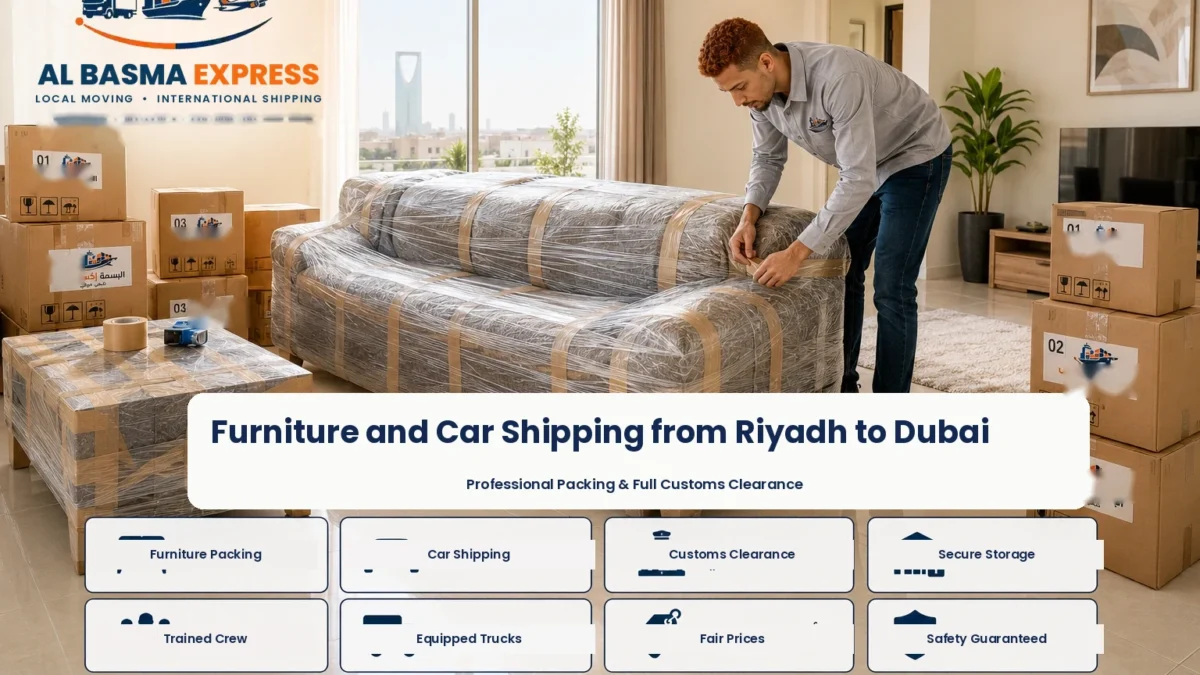

Moving from Jeddah to Libya doesn’t start when the shipment moves, but when its owner takes a clear decision about everything that will leave the home. A piece of furniture needing dismantling, a screen needing its own protection, cartons that can be consolidated, a car with a different file, goods needing precise data, and small items whose fast arrival may matter more than waiting for the rest of the home’s contents. So the more organized approach isn’t looking first for the largest vehicle or the fastest trip, but building a clear “passport” for the shipment setting out its contents, how it’s prepared, its route and its final destination inside Libya.
In its furniture shipping and moving company from Jeddah to Libya service, Al Basma Express relies on managing the trip as connected stages, starting with the free survey inside Jeddah, then sorting and measuring the load, choosing the disassembly and packing method, creating the inventory, preparing the furniture, cars, goods, equipment and parcels each according to its nature, then moving to the suitable international shipping method, and ending with the coordination for the handover in Tripoli, Benghazi, Misrata, Zawiya, Khoms, Sabha, Sirte, Tobruk, Al Bayda, Derna or another Libyan city or area the operating plan allows reaching.
What you'll find in this guide39 topicsShowHide
And given the nature of the distance between Jeddah and Libya, a large load can rely on sea solutions within the international trip, while air freight can be used for small urgent shipments, with land transport stages to collect the furniture in Saudi Arabia, move it between operating points then distribute it inside Libya. Supporting land transport services usually take 2 to 5 days depending on the stage’s scope and the distance, while express air freight services for suitable shipments can take 24 to 48 hours depending on the flight, the shipment’s acceptance and the handling; the sea duration, meanwhile, is set by the shipping line, the arrival port, the sailing schedule and the shipment’s actual procedures.
The follow-up covers the GBS system on the land transport stages, alongside updates on the shipment’s status when it moves to a sea or air stage or to the inland distribution. The price, meanwhile, isn’t built on a fixed figure, because moving a few boxes differs fundamentally from moving a villa, shipping a car differs from shipping equipment, and a piece of glass needs protection clothes don’t. So the cost rests on the volume, the weight, the type of load, the transport method, the packing level, the collection site, the final Libyan city, and the disassembly, assembly, storage, lifting and special services.
You can call 0553923364 to request the free survey and send the load’s details, the collection site in Jeddah and the city required inside Libya, so the plan is built on the real shipment rather than on a quick guess.

The shipment’s passport: an idea that makes the Jeddah–Libya trip clearer
On this line especially it helps if the inventory isn’t just a list of numbers but a complete file answering the questions that will come up at every stage of the trip. What’s in the shipment? What’s the nature of each item? Which pieces are dismantled? Where are the fittings? Which pieces are fragile? Is there a car? Which Libyan city is required? And who is responsible for receiving it? The clearer the answers at the start, the less anyone has to rely on memory or improvisation later.
The file can start by splitting the home into zones. The master bedroom has a code, the children’s room a different one, and the kitchen, the living room and the office each have a code. Then the large furniture pieces inside each zone are recorded, and after them the cartons and the appliances. This organization turns every room into an independent shipping group whose contents can easily be followed.
But the organization doesn’t stop at the rooms. There’s also an “attribute” for every piece: wood, glass, appliance, textile, fragile content, heavy load, or an ordinary box. This attribute helps set the piece’s place within the load and how it’s packed, and it prevents a box of glass being put somewhere only suitable for clothes just because it carries a sequential number.
Added to that is the priority level. Some boxes must stay sealed even after the arrival, while the customer needs others immediately, such as some kitchen tools, clothes and sleeping supplies. So the “first day boxes” can be marked so they’re loaded and handed over in a way that makes reaching them easy.
If there’s a car, goods or equipment, they aren’t merged into the household list at random. Each category has its own file, documents and data, but they all stay tied to the customer’s main order, so they don’t have to manage the furniture’s trip apart from the rest of the elements.
◆ Four pieces of data that must never be missing from any piece
The room it belongs to, the nature of the contents, the sensitivity level, and the inventory number. And if the piece is dismantled the part number is added, and if it needs opening quickly the priority mark is added.
This system is more useful than settling for sequential numbers, because it helps with the packing, the loading, the storage, the handover and the reassembly — in other words it accompanies the piece from the first moment to its final place.
The free survey doesn’t only measure the home; it tests the route the furniture takes out
A piece of furniture may be relatively small but hard to move because of where it is, while a larger piece is easy if the home is on the ground floor with a wide entrance. So the shipment mustn’t be assessed from photos of the furniture alone; the piece’s route from the room to the vehicle is part of the work exactly as its size is.
During the survey the doors, the corridors, the turns, the stairs and the elevator are reviewed. If the wardrobe can’t come out whole, the level of dismantling required is set. If a marble table needs its top separated, the workers and the tools are prepared for that. And if the screen is large and its original box isn’t available, the need for a suitable pack is recorded.
Then the vehicle’s position is checked. Having a parking spot in front of the door differs from needing to carry the furniture a long distance along a corridor or a street. And some buildings may set a particular time for using the elevator or need coordination with the management, and these matters must be finished before moving day so the crew’s time doesn’t turn into waiting.
After that the contents outside the main rooms are reviewed. The storerooms, the balconies, the service rooms and the roofs may hold boxes, tools or small furniture the customer forgets when giving a quick description. Bringing them into the survey prevents unplanned extra volume appearing.
And finally the arrival city in Libya is discussed. It isn’t only the country’s name that’s needed, but the city, the area, the property, the floor and the type of entrance where possible. A shipment heading to Tripoli has a distribution stage different from one travelling on inside Libya to Sabha, Tobruk or another city far from the arrival point.
The piece test
- Does it need dismantling?
- Does it hold glass?
- Does it have moving parts?
- Does it need a special crate?
The route test
- The doors’ width.
- The stairs and the elevator.
- The corridors and the turns.
- The distance to the vehicle.
The destination test
- The Libyan city.
- The property and the floor.
- The recipient’s details.
- How easily the distribution vehicle can get in.
▪ Why does the survey affect the cost before it affects the execution?
Because the price needs the volume, the materials, the number of workers, the services and the collection place known. If this information is incomplete the quote is built on assumptions, and any difference on execution day may change the scope of work.
A good survey, meanwhile, lets the customer know in advance whether they need a carpenter, special packing, lifting equipment or extra space, and so comparing quotes becomes fairer and clearer.
Two routes that don’t compete: the sea for volume and the air for time
One common mistake is comparing sea and air freight as though one must always win. In reality each solves a different problem. The sea suits better when the matter is moving a large volume of furniture, appliances and goods, while air becomes logical when the priority is limited parcels needing to arrive quickly.
If the customer is moving a whole home, sending all its contents by air isn’t usually the natural solution because of the large volume. But if they’re moving to Libya before the furniture arrives and need work devices, clothes or some supplies, this group can be separated from the main shipment.
The sea shipment itself needs a precise plan for the packing and the securing, because the furniture may pass through several handling stages. The air shipment, meanwhile, needs tighter control of the dimensions, the volumetric weight and the type of content accepted on the flight.
And there’s nothing stopping the customer using both within one operation. They send the essentials by air, move the large furniture by sea, while land vehicles are used for the collection in Jeddah and the distribution inside Libya. This way each method becomes part of a system rather than a complete substitute for everything.
| The point | Sea freight | Air freight |
|---|---|---|
| The load it suits | Furniture, appliances and large goods | Parcels and urgent contents |
| The most important factor | The volume and the shipping line | The volumetric weight and the speed |
| The service time | By the booking and the sailing schedule | 24 to 48 hours for suitable shipments |
| The aim | Moving a large volume efficiently | Getting the essential things there quickly |
Land transport in 2 to 5 days: the stage linking the trip’s points together
Although the international route to Libya may rely on the sea or the air for the main part, land transport is present at more than one stage: collecting the furniture from the home in Jeddah, moving the load to the consolidation or operating point, moving between shipping facilities where needed, then receiving it inside Libya and distributing it to the city and the final address.
Some of these land services can take 2 to 5 days depending on the stage’s scope, the distance, the city, the load’s nature and the operating schedule. So the duration shouldn’t be understood as a promise that the furniture will cover the full international trip from Jeddah to Libya by land within that time; it’s a duration used for the suitable land services within the route.
And these stages need vehicles suited to the type of load. Packed furniture needs a clean space and an arrangement preventing friction, while equipment needs bases and securing suited to the weight. And the last stage inside the city may need a smaller vehicle if the street or the entrance doesn’t allow a large one in.
GBS follow-up is also used on these stages to know the vehicle’s movement, which helps the customer and the recipient get ready for the collection or the handover, especially when the final city is far from the arrival point.
◆ Don’t look at international shipping as one method
The shipment may start on a vehicle inside Jeddah, then move to the sea, then return to a vehicle in Libya. And there may be a separate air shipment for some parcels. This isn’t a problem as long as every transfer has a clear record and inventory.
The aim is that the responsibility isn’t lost between the stages; every transfer point must receive the same information about the number of units, their nature, their sensitivity and their destination.
Packing the “inside out” way
Instead of thinking about packing through the materials, you can think about it from inside the piece outward. What moves inside it? Which surface could get scratched? Which corners could knock? What happens if it takes pressure? These questions set the layers better than starting by wrapping the cover around it directly.
With wardrobes and furniture holding drawers, the contents are emptied first and the parts that will stay are secured. Then the surfaces are protected with a layer that doesn’t cause scratches, after that come the blankets, the bubble wrap or the cardboard according to the piece’s nature, and finally the wrap is secured without pressure harming the corners or the doors.
Sofas and majlis seating need different attention. The fabric needs protection from dust and friction, the legs need separate protection because they protrude, and the removable cushions can be wrapped or gathered in a way that prevents them being lost.
Mirrors and glass, meanwhile, aren’t sufficiently served by covering the surface. The edges must be protected and internal movement prevented, padding and suitable reinforcement used, and the item may need a solid or wooden crate if the sensitivity and the size call for it.
Screens need direct pressure on the face prevented, and no weights loaded on them. And if the original box is available with suitable padding, using it can be assessed; otherwise an alternative solution is prepared that keeps the device stable.
Fridges and freezers need emptying, cleaning and drying, and washing machines need the water removed and the hoses and the parts that could move secured. The aim is that liquids or internal movement don’t turn into a source of damage during the trip.
Books, meanwhile, are spread across smaller boxes to avoid reaching an impractical weight, while larger boxes can be used for fabrics, clothes and soft furnishings. And no wide gaps should remain that let the contents move inside the box.
The wood
- Protecting the surface.
- Reinforcing the edges.
- Preventing direct sticking.
- Securing the doors and the drawers.
The glass
- Bubble wrap.
- Protecting the edges.
- Internal padding.
- A crate where needed.
The appliances
- Drying.
- Securing the doors.
- Protecting the face.
- Preventing movement.
The cartons
- A size suited to the weight.
- Filling the gaps.
- Describing the contents.
- Marking the fragile.
▪ Packing doesn’t end when the furniture disappears under the wrap
After the packing comes the more important question: where will the piece be put? If it moves inside the container or the vehicle, it can hit what’s around it however good the wrap is.
So the packing must be completed with a weight distribution, securing for the load, and straps, barriers or padding as needed, without excess pressure on the sensitive items.

Disassembly and assembly: don’t dismantle more than you need and don’t leave more than is hard to carry
There’s a belief that full dismantling is always better for international shipping, but that isn’t true for every piece. Some furniture benefits from the volume being reduced, and some may be damaged at its fixing points if it’s dismantled without need. So the decision is taken by the piece’s structure, the home’s corridors and the transport method.
A large wardrobe may need dismantling because getting it through the door isn’t possible, while a small table can move whole if it’s stable. A bed is usually easier to move once its parts are separated, while some décor units may be safer left as they are once the glass and the edges are protected.
At the disassembly the fittings mustn’t get mixed. Each piece has its own bag for the bolts, the handles and the hinges, and the bag carries the piece’s code. And all the screws aren’t put in one box even if it looks faster at first.
Some pieces can also be photographed before the disassembly, especially desks, assembled units or furniture holding similar parts. And the photo serves as a reference at the reassembly in Libya.
And on arrival, the technician doesn’t start before the piece’s final place is set. Assembling the wardrobe then discovering the customer wants it moved to the other wall leads to a new disassembly or heavy movement that a simple decision before starting can avoid.
★ A three-question test before dismantling furniture
Does it fit through the entrance? Does the shipment’s volume fall usefully when it’s dismantled? And can it be reassembled safely? If the answers to these questions support dismantling it’s carried out and the parts numbered, but if the dismantling would raise the risks with no benefit it isn’t an aim in itself.
This makes the disassembly a technical decision tied to the piece, not an automatic step applied to everything in the home.
Car shipping from Jeddah to Libya: the documents and the inspection before the carrier
If the car is moving with the home’s furniture, its file must start early. Don’t wait until the furniture’s packing is finished then start thinking about the vehicle’s documents or how it will be shipped, because the car isn’t an extra item that can be loaded into the space left over.
The car’s, the owner’s and the recipient’s details are reviewed, then its exterior condition is documented with photos. It’s better to photograph the front, the back, the sides, the roof, the rims and the glass, recording any clear mark present before the collection.
After that the cabin and the boot are emptied of personal items unless there’s a clear arrangement allowing particular contents. The car shouldn’t be used as a moving cardboard box, because that may mix the vehicle’s file with the furniture’s and complicate the inspection and the handover.
The battery, the tires and the absence of leaks are reviewed, and the crew is told if the car doesn’t run. A non-running vehicle needs loading preparation different from a car that can be driven onto the carrier.
And the procedures and requirements in force for bringing vehicles into Libya must be reviewed for the particular case before shipping, rather than relying on an old experience or papers someone else used, because the procedures may differ with the vehicle’s type and condition, its owner and the purpose of bringing it in.
And at the handover stage the recipient compares the visible condition with the photos and documents the collection, keeping copies of the papers and the photos until the file is closed.
Shipping goods and equipment to Libya starts from one data sheet
A homeowner can say “these are the bedroom’s cartons”, but the goods’ owner needs a more precise description. In commercial shipping the number of parcels, the weight, the dimensions, the type of contents, whether it can be stacked and the handling instructions become a core part of the planning.
If there are several kinds of goods, it’s better to prepare a declaration holding the item, the count and the packing method. This helps establish what can be gathered on a pallet, what must stay separate, and what needs putting on top or taking no weight above it.
Equipment needs extra data. The real weight must be known as far as possible, along with the device’s dimensions, the lifting points, and the centre of gravity if it matters, and whether the equipment may be turned over or must stay in a particular orientation.
A piece may look small yet need a forklift because of its weight, while a large piece of equipment can be relatively light but need a large space. So the plan isn’t built from photos alone.
The documents and the load’s description must also match its real nature. Commercial goods aren’t described as household items to simplify the file, because the correct description helps in choosing the procedure, the packing method and the handling.
| The type | The data required | What does it set? |
|---|---|---|
| Cartoned goods | The count, the weight, the dimensions and whether they stack | The space and the loading order |
| Equipment | The weight, the centre of gravity and the lifting points | The handling and securing means |
| Electronic devices | The size, the weight and the sensitivity | The packing and the loading position |
| Urgent parcels | The contents, the weight and the dimensions | Suitability for air freight |
◆ Goods speak in numbers more than in photos
A photo of the carton shows its shape, but it doesn’t say it weighs forty kilos, for example, nor whether another box can go on top of it. So the data becomes part of the safety rather than merely administrative information.
The closer the information is to the reality, the more precisely the space, the vehicle and the loading tools can be set before the crew reaches the site.
From Tripoli to Benghazi and Sabha: Libya isn’t one delivery point
One mistake is planning the shipment only as far as reaching Libya then leaving the distribution to the last stage. In a wide country like Libya, the distance inside the country can be an important part of the trip, so the final city must be set at the start of the booking.
Tripoli: shipping furniture, parcels and offices to the city can be coordinated by the district, the address and the property’s nature. It’s better to know the floor, the elevator and the vehicle’s parking spot before the handover.
Benghazi: the shipment needs a distribution plan by the entry point and the inland distance, especially if it’s a whole home or holds equipment or a car.
Misrata: household and commercial shipments can be arranged, with the warehouse’s or the home’s location and the vehicle suited to the final stage set.
Zawiya: the coordination with the recipient runs by the property’s location, the load’s nature and the vehicle’s arrival time.
Khoms: delivery of furniture, parcels and goods can be organized by the operating route and the final address.
Sirte: the inland distance enters the delivery time, so it must be included in the plan from the booking and reaching another coastal city mustn’t be treated as the end of the trip.
Sabha: the southern destinations need extra planning for the inland land stage, with the address and the recipient’s details confirmed before the shipment goes out for distribution.
Tobruk: the delivery method is set by the shipment’s position after entering Libya and the suitable inland route.
Al Bayda and Derna: delivery can be coordinated by the operating capability, the property’s location and the road’s nature, with the plan reviewed at booking.
Other cities and areas: whether delivery is possible is set by the route, the service available and the operating conditions, so it’s better to send the final location rather than settling for the governorate’s or the general area’s name.
A clear city
From them the inland distance, the distribution vehicle and the date plan are set.
A clear address
The district, the street, the property, the floor, the elevator and the parking spot.
A clear recipient
A name and phone number available at the arrival time with the date confirmed in advance.
GBS tracking: don’t only watch the shipment, understand which stage it has reached
The customer may see the shipping vehicle has stopped somewhere, but without knowing the stage they won’t understand whether that’s normal or needs following up. So good tracking is a mix of the location and the operating status.
At the trip’s start the status is “collected” then “being prepared”, and after that “loading complete”. When the vehicle moves GBS can be used on the land stages, then the follow-up changes when the shipment moves to another international method.
On the sea stage, for example, the important information becomes tied to the load’s acceptance, the booking, the departure and the arrival, not to the location of the truck that delivered it to the shipping point. And after entering Libya the land follow-up returns when the shipment goes out for distribution.
This system helps the customer prepare the home. When they know the furniture has gone out for delivery they can clear the place, tell the guard or the building management and get the elevator ready, rather than waiting all day without knowing the approximate time.
It also helps with the coordination if there’s more than one recipient, such as the furniture reaching the home while goods or equipment head to another warehouse. When each category has a clear reference these operations can be managed without mixing.
— Six statuses are enough to understand a long trip
Collection, preparation, loading, international shipping, arrival in Libya, then distribution and handover. Each status can hold details, but this split gives the customer a quick picture of where the shipment is within the operation.
And the aim of the tracking is taking the decision at the right time, not keeping the map open all day for no reason.
The price isn’t a distance between two countries: what are you actually paying for?
When someone asks about the price of shipping furniture from Jeddah to Libya, they may expect an answer like a ticket price or a fixed service. But household shipping doesn’t work that way; every home produces a different shipment in space, weight, pieces and services.
The space: it’s one of the most important elements with furniture. A large wardrobe may not be very heavy but it takes a volume, while its size falls after the disassembly. Conversely, a mirror’s dimensions can grow once it’s put inside a protective crate.
The weight: it becomes more important with equipment, goods and air freight. A small box of metal parts may need more handling than several cartons of clothes.
The shipping method: the sea trip’s cost differs from the air’s, and a consolidated shipment differs from a booking needing an independent space. The solution is chosen by the load’s size and how urgent it is.
The packing: the number and type of sensitive pieces changes the quantity of materials and the time. Soft furnishings don’t need the same crate a glass antique or a large screen needs.
The disassembly and assembly: a home holding several rooms, wardrobes and assembled furniture needs more technicians than a shipment of ready cartons.
The location in Jeddah: having an elevator and a nearby spot for the truck differs from a high floor or a street that’s hard to reach.
The Libyan destination: delivering in Tripoli differs from distributing to a distant area or a city needing a long land stage after the arrival.
The car and the equipment: having items needing their own file and handling adds services that don’t exist in an ordinary household shipment.
The storage: if the new home isn’t ready the shipment may need a storage stage, and that affects the packing, the handling and the scope of service.
| The cost factor | The question to ask | Its effect |
|---|---|---|
| The volume | How much will the shipment take after packing? | The transport space and the booking |
| The weight | Are there heavy goods or equipment? | The handling and the shipping method |
| The protection | How many sensitive pieces are there? | The packing materials and the time |
| The services | Is there disassembly, assembly or storage? | The technicians and the workers |
| The destination | Where is the delivery address? | The inland distribution stage |
◆ Cutting the cost starts with the question: do I really need to ship this piece?
Cancelling an unnecessary piece saves space, packing, carrying time, unloading and distribution. Reducing the protection on a piece you’ve already decided to ship, meanwhile, may save only material and raise the chance of damage.
So the best economical step is the sorting before the survey, then buying the scope of service the shipment actually needs.
Temporary storage: when the date arrives before the home does
Sometimes the customer has to vacate their home in Jeddah on a set date while the home in Libya isn’t ready, or their travel date differs from the furniture’s arrival. In these cases the storage mustn’t be left to the last moment.
If the storage is known in advance, the pieces can be prepared in a way suited to staying sealed an extra period. The appliances need cleaning and drying, the soft furnishings need protection from dust, the boxes need clear, strong sealing, and the inventory must stay fixed.
And the store is arranged in a way that reduces movement. Putting a piece somewhere then moving it several times increases the handling, so it’s better to know the group, its exit date and its position so it can be reached without moving half the shipment.
The furniture’s fittings mustn’t be separated from its parts either. A wardrobe’s bag of screws must stay linked to the wardrobe even if it enters storage, and the room codes stay as they are until the arrival at the home.
When the delivery site becomes ready, the load is brought out against the inventory and loaded for the final distribution, so the storage is just a stop within the same operation rather than the start of a new file.
Before shipping day: don’t write a long task list, just close six files
The first file: the sorting. Go through the whole home and decide what will move, what will stay and what will be sold or donated. Don’t make this decision while the packing crew is there, because hesitating on execution day holds up the work and keeps the inventory changing.
The second file: the documents. Gather the passports, the original papers, the cash, the jewelry, the essential medicines and the devices you use daily, and put them in a separate bag that doesn’t enter the shipment.
The third file: the appliances. Use up the fridge’s and the freezer’s contents, then disconnect the appliances, clean them and dry them. Photograph the connections behind the TV and the computer, and gather each device’s wires and fittings.
The fourth file: the furniture. Empty the drawers and the wardrobes, identify the items fixed to the walls, and tell the supervisor about any piece with sentimental value or particular sensitivity so it’s handled separately.
The fifth file: the building. Coordinate with the guard or the management, book the elevator if necessary, set a place for the vehicle to park, and clear the corridors so the workers can move without knocking into obstacles.
The sixth file: Libya. Confirm the recipient’s name and phone number, the city, the area, the property, the floor and the elevator. If the site is hard to reach, send photos of the entrance or a clear description before the distribution stage starts.
When these six files are closed, shipping day becomes closer to carrying out known steps than to taking dozens of decisions at the same time.
▪ The things staying in Jeddah need a place, not just a label
If there are pieces that won’t be shipped, gather them in a separate room or area. A label may fall off or go unseen, while a clear separation reduces the chance of them being loaded by mistake.
And likewise an area can be set aside for the personal items travelling with you, so they’re completely away from the packing process.

The handover: receive the home before you receive the boxes
Before the vehicle reaches the Libyan address, it’s better to prepare the home itself. The corridors must be clear, the recipient must know where the large pieces go, the elevator must be ready if there is one, and there must be space allowing some packing to be opened and the sensitive pieces inspected.
When the unloading starts the cartons aren’t opened straight away. The process starts by reviewing the numbers and the groups, and confirming the main furniture pieces and the parcels have arrived against the list.
After that the mirrors, the glass, the screens, the appliances and the sensitive surfaces that can be assessed immediately are inspected. If a remark appears it’s recorded before moving to the following stages.
Then the large pieces go into their places. It’s better to put the bed, the wardrobe, the majlis seating and the tables in before the rooms get crowded with cartons, because moving the furniture after that becomes harder.
If the assembly service is included, the technician starts once the piece’s position is confirmed. Then the cartons are distributed to the rooms by their codes, and they aren’t all put in one room just because unloading them there is faster.
And finally the priority boxes are opened, such as the sleeping supplies, the kitchen essentials and the everyday clothes. The books, the décor and the non-urgent items stay for the later arranging stages.
★ A correct handover runs almost in reverse of the packing
In Jeddah you start from the rooms’ contents then turn them into shipping units. And in Libya you start from the shipping units then redistribute them to the rooms. That’s why the room code and the inventory are a thread linking the trip’s start to its end.
The clearer this thread, the fewer times the boxes are moved inside the home and the faster the assembly and the opening become.
Why Al Basma Express for shipping furniture from Jeddah to Libya?
A long international trip needs the details managed more than it needs one big step. Any operation can start with a truck, but the real organization shows in knowing what goes into the truck, how it was packed, how it was numbered, what documents go with it, what the next stage is, and who will receive it at the end.
Al Basma Express provides a complete service covering household and office furniture, appliances, cars, goods, equipment and parcels, with the shipping method chosen by the type of each part of the load.
The process starts with a free survey allowing the things to be listed and their volume and protection level set, then the disassembly, the numbering, the packing, the inventory and the loading. These stages help reduce the sudden decisions on execution day.
On the land transport stages GBS follow-up is used, while the follow-up is completed by updating the shipment’s status when it moves between transport methods, reaches Libya or starts the inland distribution.
Air freight in 24 to 48 hours can be used for suitable shipments needing the speed, while supporting land transport services that may take 2 to 5 days come into the collection, consolidation and distribution stages depending on the distance and the service. Sea freight, meanwhile, has its duration set by the booking and the actual shipping line.
The cost is calculated by the volume, the weight, the shipping method, the delivery city, the type of packing, the disassembly, assembly, storage and lifting services, and any car, equipment or goods needing separate treatment, which keeps the quote tied to what the customer actually needs.
Delivery can be coordinated to Tripoli, Benghazi, Misrata, Zawiya, Khoms, Sirte, Sabha, Tobruk, Al Bayda, Derna and others according to the operating plan and the final address.
To order or request the survey you can call 0553923364, or visit the official Al Basma Express website to see the company’s services and the ways to get in touch.
Frequently asked questions about a furniture shipping and moving company from Jeddah to Libya
What’s the suitable way to ship a whole home’s furniture from Jeddah to Libya?
The shipment’s volume and the furniture’s nature are assessed first, and sea solutions are usually among the important options for large loads, with land transport for the collection and the distribution. The final route is set after the survey and knowing the Libyan city required and the service available at the time of execution.
Does Al Basma Express provide a free survey before the shipping?
Yes, the survey is used to list the furniture, the appliances and the sensitive pieces and measure what needs dismantling, review the entrances, the elevator and the vehicle’s place, then set the packing level and the services required before the quote is prepared.
How long does air freight from Jeddah to Libya take?
Express air freight services for suitable shipments can take 24 to 48 hours depending on the flight, the contents’ acceptance and the handling, with time possibly added for the collection, the preparation, the clearance and the inland distribution.
Where is the 2 to 5 day land transport time used?
The land transport services come into the collection, the consolidation, the movement between operating points and the distribution inside Libya, and some of these stages can take 2 to 5 days depending on the distance, the city, the load’s nature and the operating schedule.
Can the furniture be dismantled and assembled within the service?
The service can cover dismantling the suitable furniture in Jeddah, numbering its parts, keeping its fittings and packing it, then reassembling it in Libya as agreed within the scope of service.
Can a car be shipped with the home’s furniture?
The car and the furniture can be coordinated in one order, but the car is treated as an independent file for the documents, the inspection, the photography and the transport and handover method, and it isn’t merged with the household furniture list.
What are the best packing materials for the Jeddah–Libya trip?
The materials depend on the piece’s nature, and they cover protective blankets, bubble wrap, reinforced cardboard, corner guards, padding and outer wraps, while mirrors, antiques and sensitive appliances may need a solid or wooden crate where required.
Can the shipment be tracked with the GBS system?
GBS follow-up is available for the trip’s land stages, alongside updates on the shipment’s status when it enters a sea or air stage then at the arrival and the inland distribution through to the handover.
How is the price of shipping furniture from Jeddah to Libya set?
The price is set by the shipment’s volume and weight, the type of contents, the shipping method, the delivery city, the packing level, the disassembly, assembly, storage and lifting services, the difficulty of the collection site, and whether there’s a car, goods or equipment.
Can goods and equipment be shipped from Jeddah to Libya?
Shipping permitted goods and equipment can be arranged once their type, count, weight, dimensions, handling method, lifting points, stacking ability and the documents required are known, then the suitable packing and route chosen.
Does the service reach Benghazi, Misrata and Sabha?
Delivery can be coordinated to Tripoli, Benghazi, Misrata, Zawiya, Khoms, Sirte, Sabha, Tobruk, Al Bayda, Derna and other cities according to the operating capability, the route and the final address at the time the order is carried out.
How do I book a furniture shipping and moving company from Jeddah to Libya?
You can contact Al Basma Express on 0553923364 and send the collection site in Jeddah, the Libyan city required and a description of the furniture, the car or the goods if there are any, then arrange the free survey and set the execution plan.
From Jeddah to Libya: let every decision come before the stage that needs it
The trip’s success doesn’t require the customer to know every detail of international shipping, but it does need their decisions taken at the right time. The sorting before the survey, the survey before choosing the space, the disassembly before the packing, the numbering before the loading, reviewing the documents before entering the shipping stage, and preparing the recipient’s address before the load reaches Libya.
With this order the operation doesn’t rest on memory or on-the-spot solutions. Every box knows its room, every piece its parts, every sensitive item how it’s handled, every car its file, and every consignment of goods its data.
Al Basma Express provides a furniture shipping and moving company from Jeddah to Libya service for furniture, cars, goods, equipment and parcels, with a free survey, packing, disassembly, numbering and inventory, sea and air shipping options, supporting land transport, GBS follow-up on the land stages, and the handover coordinated inside Libya’s cities.
If you’re preparing to move to Tripoli, Benghazi, Misrata, Sabha or any other destination, start with the contents list and the final address then call 0553923364. Every piece of information settled before a piece is packed shortens a decision that could otherwise have come up at a harder moment later.