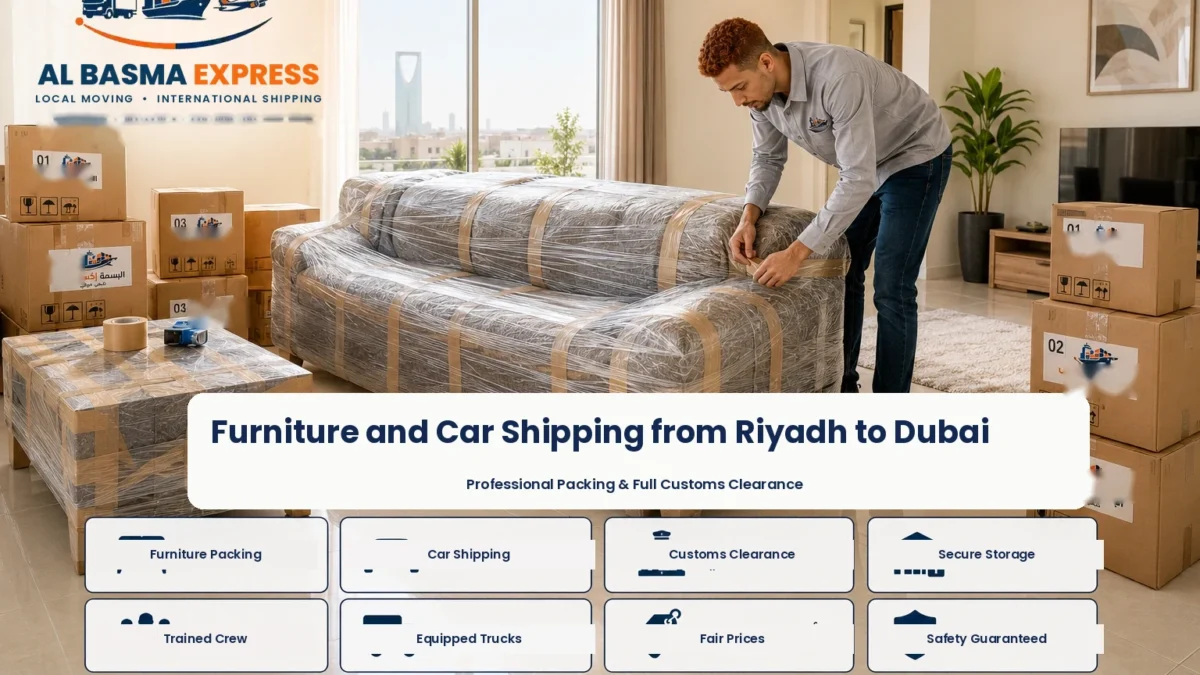

The hardest decision when moving from Jeddah to Tunisia isn’t choosing the shipping company, but knowing how each group of your contents should travel. The bedroom and the majlis aren’t like an urgent parcel, the car isn’t treated like a box of clothes, and commercial equipment isn’t an extension of the furniture list. And the more the customer tries to put these different elements into one identical plan, the more problems appear in the packing, the space, the documents, the handling and the handover.
Your guide inside this article39 topicsShowHide
That’s why the furniture shipping and moving company from Jeddah to Tunisia service at Al Basma Express rests on splitting the shipment first then bringing it back together within one plan. The furniture, the appliances, the parcels, the car, the goods and the equipment are identified, then how each category is handled is chosen, with all the stages tied to a clear inventory starting at the customer’s site in Jeddah and continuing to the recipient’s address in Tunis, Sfax, Sousse, Bizerte, Nabeul, Monastir, Kairouan, Gabès, Ariana, Ben Arous or another Tunisian city or area.
The service starts with the free survey, then listing the volume, the weight and the nature of the pieces, and choosing the best protective materials from protective blankets, bubble wrap, reinforced cardboard, corner guards, padding and wooden crates where needed. After that comes the disassembly, the numbering, the loading and preparing the shipment for the suitable method, whether sea for large volumes or air for urgent parcels, with land transport used at the collection, consolidation and inland distribution stages.
As for the duration, supporting land transport services can take 2 to 5 days depending on the distance, the city and the operating schedule, while express air freight services for suitable shipments take 24 to 48 hours depending on the flight, the contents’ acceptance and the handling. The international sea trip’s duration to Tunisia, meanwhile, is set by the shipping line, the arrival port, the sailing schedule and the procedures, so no fixed duration is invented that ignores the actual trip.
Al Basma Express tracks the shipments through the GBS system on the land transport stages alongside updates on the trip’s status, while the price is set by the shipment’s volume and weight, the transport method, the type of packing, the delivery city, the difficulty of the collection site, and the disassembly, assembly, storage or lifting services, rather than by one flat price for every customer. To request the survey or discuss the shipment’s details you can call 0553923364.

Five categories inside the home that shape the trip to Tunisia
Instead of starting the planning with the number of rooms, you can start with the type of content. This simple change makes the shipping far more precise, because one room may hold wooden furniture, glass, clothes, appliances and personal pieces, and each kind needs a different level of protection and handling.
The first category is the furniture: the bedrooms, the wardrobes, the beds, the majlis seating, the sofas, the tables, the desks, the chairs and the shelving. This category is affected by volume more than any other and usually needs a survey to establish which pieces must be dismantled and which can move whole.
The second category is the household and electronic appliances. It covers fridges, washing machines, screens, ovens, computers and more. These items need preparation before the packing, such as drying, securing, and protecting the doors, the faces and the moving parts.
The third category is the parcels and personal items. It covers clothes, books, household tools, décor and small belongings. Organizing this category with cartons and numbering matters so it doesn’t turn into dozens of identical boxes nobody knows the contents of on arrival.
The fourth category is the cars. A car has its own details, inspection, follow-up, documents and loading method, so it isn’t treated as a large piece of furniture and its interior isn’t automatically used to fill with personal items.
The fifth category is the goods and equipment. These need the type, the count, the weight, the dimensions, whether they can be stacked and the lifting points known, and they may require packs, pallets or loading tools different from household furniture.
- Dismantling the right pieces.
- Protecting the wood and the corners.
- Reducing the gaps after disassembly.
- Numbering the parts.
- Drying and securing.
- Protecting the faces.
- Securing the cables.
- Preventing movement.
- Choosing a suitable carton size.
- Describing the contents.
- Distributing the weight.
- Marking the fragile and the urgent.
- An independent file.
- An inspection before the transport.
- Weight and dimension data.
- A dedicated loading means.
◆ Why don’t we use one plan for all the contents?
Because the best way to protect a box of clothes isn’t the best way to protect a screen, and the way a wooden table is loaded doesn’t suit an engine or a heavy piece of equipment. The difference in material, weight and shape imposes a difference in the pack, the loading position and the handling method.
Splitting the shipment doesn’t make the service complicated; quite the opposite — it allows one clear plan holding the right instructions for each category rather than treating the whole house as a single block.
The free survey works as a dress rehearsal for moving day
Most of moving day’s problems can be discovered before they happen. The wardrobe that won’t fit through the door can be known in advance, the mirror needing a special crate can be measured, the heavy piece needing extra workers can be identified, and the small elevator can be taken into account before the working date.
So the survey doesn’t focus on the furniture alone, but on the route the piece will take from its position inside the room through to the vehicle. The width of the doors, the corridors, the stairs, the elevator, the manoeuvring space, the parking spot and how close the vehicle can get to the entrance are all looked at.
Then the shipment’s real volume is reviewed. Some furniture shrinks noticeably after being dismantled, some pieces don’t benefit from it, while other pieces grow after multi-layer packing. So an estimate built on the furniture’s shape before the preparation is less accurate than one taking the final shape into account.
The survey also helps discover the contents that don’t usually appear in the customer’s initial description: storeroom cartons, balcony furniture, equipment inside a service room, bicycles, spare appliances, or things on top of the wardrobes. And every extra item affects the inventory’s size and the space required.
And at the survey’s end the customer can know the suitable scope of service: do they need full packing? Do they want to prepare some cartons themselves? Do they need a carpenter? Is there temporary storage? Will some parcels be separated for air freight? That way they don’t buy services they don’t need and aren’t surprised by gaps on execution day.
▪ The survey turns the phrase “a whole house” into a volume that can be planned
The number of rooms doesn’t set the shipment’s size on its own. There are small apartments packed with furniture, and larger homes with limited fittings. So the pieces themselves are looked at rather than the number of doors and rooms.
The survey also allows the things that won’t be shipped to be set aside before the space is calculated, so the customer doesn’t pay to move things they’ll do without after arriving in Tunisia.
The sea route: when a bedroom becomes an international load
For complete furniture and large loads, sea freight is one of the main options studied on the Jeddah–Tunisia trip. A whole home needs space allowing the furniture, the cartons and the appliances to be gathered practically, while the cost of moving these volumes by air becomes unsuitable in many cases.
But the sea isn’t simply a stage between two ports. Before reaching the port there’s a consolidation and land transport process inside Saudi Arabia, then the final packing, arrangement and loading. And after arriving in Tunisia there are the collection procedures then the inland transport through to the city and the home.
So the service is built door to door rather than treating the port as the end point. If the customer is in Jeddah and the recipient in Sfax, for example, the real trip starts at the apartment in Jeddah and ends at the Sfax address, while the port is a transition point along the route.
The type of sea arrangement is set by the shipment’s size. Some orders may suit consolidated shipping, while larger loads need an independent space or a more tailored solution. And that can’t be set precisely before the volume after the disassembly and packing is known.
The sea duration also depends on the trip’s schedule, the port, the shipping line and the procedures, so no unrealistic fixed duration is given. The customer is told the estimate tied to the actual booking when the order is prepared.
● When does sea freight become more suitable?
When the load is large, or covers several rooms and appliances, or when the customer’s priority is moving the home in an organized way more than arriving in the shortest possible time.
It also suits many commercial shipments and equipment needing space and better securing solutions than sending them as separate parcels.
Air freight 24–48 hours: use it for what you can’t wait for
If you reach Tunisia before the furniture, what will you actually need? Perhaps a computer for work, or files, or some clothes, or things a child needs, or small pieces tied to setting up the home. This is the category to think about for air freight.
Express air freight services for suitable shipments take 24 to 48 hours depending on the flight, the contents’ acceptance and the handling procedures, bearing in mind that the collection, the preparation, the clearance and the final delivery may add time to the full service duration.
The mistake is seeing air as a faster version of sea furniture shipping. It’s actually a completely different tool, suited to limited volumes that deserve the speed. A whole majlis, a bedroom or a large fridge, meanwhile, isn’t naturally sent by air in most cases.
The family can split its needs into three layers: a personal bag travelling with them, a small air shipment arriving quickly, and the main furniture shipment. This arrangement balances the speed against the volume rather than paying more to make everything arrive at the same time.
| The choice | Suits | The decision depends on |
|---|---|---|
| Sea freight | Furniture, appliances and large loads | The volume, the sailing schedule and the destination |
| Air freight | Urgent, limited parcels | The volumetric weight and the speed |
| Supporting land transport | The collection, the consolidation and the inland handover | The distance, the type of vehicle and the address |
| Temporary storage | The travel date differing from the home’s readiness | The period and the furniture’s nature |
Packing as functional layers rather than wrapping a piece at random
Professional packing doesn’t mean the piece is simply covered in many layers. Every layer must serve a clear function, or it becomes nothing but added volume without a matching rise in protection.
The first layer protects the surface. It matters for wood, paint, fabrics and glossy surfaces, and it mustn’t be a material that could scratch or leave a mark on prolonged contact.
The second layer absorbs part of the shock. Here the protective blankets, the bubble wrap or the padding come in according to the piece’s nature. Glass needs a greater ability to absorb shocks than a box of clothes.
The third layer protects the structure or the edges. Reinforced cardboard and corner guards can be used, while some antiques and delicate belongings need a solid or wooden crate preventing outside pressure.
The fourth function is the securing. Even an excellently packed piece can be damaged if it moves inside the vehicle or the container and hits another piece. So the packing doesn’t end when the wrap is closed; it continues in how the piece is placed and tied within the load.
A soft layer preventing direct friction and scratches.
Blankets, bubble wrap and padding for the sensitive pieces.
Strong cardboard, guards and a special crate where needed.
Securing, tying and an arrangement preventing sliding within the load.
◆ Why isn’t plastic used directly on everything?
Some surfaces need a soft separating layer before the outer wrap, because packing’s aim isn’t only sealing the piece but preserving its surface throughout the trip.
And the type of layer is set by the material; what suits a sofa’s fabric isn’t necessarily used the same way on polished wood or an electronic screen.

The inventory system that makes the home rearrange itself on arrival
Everything can arrive undamaged and the customer still spend days looking for things if the inventory isn’t clear. So the organization must be designed for the handover, not for the collection in Jeddah alone.
Each room is given a code, then the cartons and pieces inside it are numbered. For example the kitchen may have a code, the master bedroom another, and the living room a different one. The content category is also written on the box rather than relying on the number alone.
When the furniture is dismantled the same code is used on all the piece’s parts, and on the bag of screws, hinges and handles. And if the piece is complex its form can be documented with a photo before the disassembly to use at the reassembly.
Then two practical marks are added: “fragile” for the items needing special handling, and “priority” for the boxes that should be opened on the first day. That way the inventory becomes part of the living plan after the arrival, not just a means of counting boxes.
| The data | Put on | The benefit |
|---|---|---|
| The room code | The furniture and the cartons | Direct distribution at the handover |
| The piece number | The dismantled furniture and the fittings | Reassembly without mixing |
| The content description | The cartons | Setting the loading and opening method |
| A fragile mark | The glass and the sensitive appliances | Preventing pressure and wrong handling |
| A priority mark | The first day’s boxes | Fast access to the essentials |
▪ Box number 17 means nothing without context
Sequential numbering is useful for counting, but it doesn’t tell the delivery crew where to put the box. Adding the room code and a short description of the contents turns the number into practical information.
And that reduces how many times the boxes are moved inside the home; every unit goes from the start to the room where it will be opened.
Shipping the car from Jeddah to Tunisia: don’t make it an extra furniture box
When the customer moves their home and their car together it’s easy to think of the car as a space that can be filled with cartons. But that mixes two different files, and it may make inspecting the vehicle and reviewing its contents more complicated.
It’s better to prepare the car independently. The process starts by recording its details and the owner’s and the recipient’s, then photographing the body from every side and documenting the existing scratches or marks.
After that the personal items, devices and unnecessary documents are removed, and the battery, the tires and the absence of leaks reviewed. And if the vehicle doesn’t run or needs a special lifting method, the company must be told before the carrier arrives.
The car’s shipping method is set by the transport plan available, the type of vehicle and the procedures applied at the time of execution. The requirements for bringing the car into Tunisia must also be reviewed before shipping rather than relying on an old experience or conditions relating to a different case.
At the handover it’s better to inspect the car with the recipient present and compare its condition with the earlier photos and remarks, then document the collection once the details are confirmed.
Sfax for commercial shipping and Tunis for distribution… but the data is the same
Whether the goods are heading to a company in Tunis or to a customer in Sfax or Sousse, the first step is turning the shipment into data that can be understood before it’s seen: the item, the count, the weight, the dimensions, the type of pack, and whether it can be stacked.
This information allows the space, the materials and the handling to be set. A product may need double cardboard, while other equipment needs a wooden base, a crate or independent securing.
And if there are many goods they can be organized into groups or onto pallets by their nature, keeping the labels and the unit list intact. One grouping shouldn’t be used if it would expose some products to pressure or damage.
Equipment needs more care with the weight, the centre of gravity and the lifting points. One piece may need a forklift even if it doesn’t look huge, while another needs a fixed orientation kept throughout the handling.
And commercial shipping must be separated from the description of personal items. Precision in the declaration helps in choosing the suitable shipping method and documents and handling the load correctly.
★ Don’t just say “I have 15 cartons”
Fifteen boxes of clothes differ from fifteen boxes of metal parts or devices. The count reveals neither the weight, nor the dimensions, nor whether the box can take stacking.
Add the weight, the dimensions and the type of contents to the count, and the company becomes able to assess the shipment far better before loading day.
From Tunis to Gabès: the distribution stage isn’t a small detail
Tunisia isn’t one city, so the delivery address affects the trip’s plan. The distance between the arrival point and the final city, the type of road and the home’s location all enter the inland distribution’s timing and the vehicle used.
Tunis: shipping furniture, parcels and offices to the capital’s areas can be coordinated with the district, the street, the floor, the elevator and the vehicle’s parking spot set.
Sfax: household and commercial shipments are served, and it’s better to state whether the destination is a home, an office or a warehouse because the unloading arrangements differ.
Sousse: delivery of furniture, cars and parcels can be organized according to the address, the property’s location and the nature of the entrance.
Bizerte: the delivery stage is set by the recipient’s location, the shipment’s entry point and the distribution plan.
Nabeul and Hammamet: the shipments need a clear location and an agreed date, especially in the areas where how easily vehicles can get in differs.
Monastir: transport to homes, offices and facilities can be arranged according to the type of load.
Kairouan: the inland distance is counted within the delivery plan, and the shipment reaching Tunisia’s entry point isn’t treated as the end of the work.
Gabès: the southern destinations need the land distribution time built into the plan from the start.
Ariana and Ben Arous: delivery can be coordinated within the Greater Tunis areas according to the recipient’s location and the building’s nature.
Mahdia, Gafsa and others: the service is assessed by the address, the distance, the type of load and the access, with the details confirmed before the shipment goes out for distribution.
It sets the distribution stage’s distance and the expected arrival date.
It sets the elevator, the stairs and the furniture’s carrying distance inside the site.
It sets the parking spot and whether a large or a smaller vehicle can be used.
GBS tracking on a trip combining more than one stage
When the shipment moves by land then by sea then by land again, the whole trip can’t be shown in one way. On the land stages GBS tracking helps in knowing the vehicle’s movement, while the other international stage relies on updates on the shipment’s and the booking’s status.
So the tracking is treated as a line of statuses. The trip starts at “collected”, then “being prepared”, then “loading complete”, then “moved to the international shipping stage”, then “arrived in Tunisia”, and finally “out for delivery”.
This system lets the customer understand what’s happening rather than seeing a static point or hearing a general phrase. If the shipment is at a sea stage, the status update matters more than the location of the vehicle that was carrying it before the port.
And when the distribution stage inside Tunisia begins, the land location matters again, and the recipient can get ready to receive the furniture and prepare the entrances, the elevator and the vehicle’s parking spot.
The follow-up also helps the customer organize their own time, especially if they’ve reached Tunisia before the shipment and want to coordinate the assembly day or collecting the car or the equipment.
— Tracking isn’t only a map, but a sequence of responsibilities
With every move from one stage to the next the customer must know the shipment has passed from one operational responsibility to the following stage, and that the inventory and the accompanying data have moved with it.
This sequence makes following a multimodal trip far clearer than trying to present it as one truck trip from start to finish.
How is the price of shipping furniture from Jeddah to Tunisia set?
A fixed figure can’t be used for a service this varied. One customer may want only a few parcels moved, while another moves a whole apartment, a third sends a car with the furniture, and a company needs to send equipment or goods. Each case has a different volume, weight and services.
The volume is the first factor with furniture. It isn’t the number of rooms that’s looked at, but the space the pieces will take after the disassembly and packing. And the furniture may be light yet large.
The weight matters especially with equipment, goods and air freight. And some shipping methods rely on comparing the parcels’ actual weight with their volumetric weight.
The transport method changes the cost’s shape. Sea freight has a model different from air, while land transport comes into the collection and the distribution, and there may be consolidation services or a dedicated space depending on the shipment’s size.
The packing is a core factor. Having large mirrors, antiques, screens, marble or sensitive appliances means needing more materials and time compared with simple items.
The disassembly and assembly set the number of technicians and the time, especially with bedrooms, wardrobes, desks and assembled furniture.
The two addresses have an effect too. A high floor with no elevator or a street far from the vehicle’s parking spot means more time and handling than a ground-floor home that’s easy to reach.
The final city in Tunisia enters the distribution stage’s calculation, because delivering to the capital differs from heading to a farther city.
The extra services such as storage, special crates, shipping the car or the equipment, or lifting enter the quote only as the customer needs them.
| The pricing factor | What must be provided? | What changes? |
|---|---|---|
| The volume | The number of pieces and the dimensions | The shipping space |
| The weight | The parcels’ and the equipment’s weights | The handling and the type of transport |
| The method | How urgent it is and the type of load | Sea, air or supporting land |
| The packing | The number of sensitive pieces | The quantity and type of protective materials |
| The address | The floor, the city and the location | The delivery’s time and equipment |
| The services | Disassembly, assembly, storage and lifting | The final scope of work |
◆ The cheapest shipment is the one holding nothing unnecessary
Before looking for a reduction in the packing materials or the workers, start with what you can remove from the shipping list. A piece of furniture you won’t use in Tunisia consumes cost in the disassembly, the packing, the space, the handling and the delivery.
As for the pieces you’ve decided to move, it’s better to give them suitable protection rather than cutting it in a way that raises the chance of damage.
Before the moving date: a preparation plan by task rather than by day
Instead of tying the preparation to Saturday and Sunday, for example, it can be split into tasks each finished completely before moving to the next. The first task is the sorting. Don’t start packing before you know what’s being packed at all.
The second task is separating the things that will stay with you. The passports, the original documents, the jewelry, the cash, the medicines and the devices you need daily don’t go into the furniture shipment.
The third task is preparing the appliances. The food is used up, the fridge and the freezer emptied, cleaned and dried, the washing machine emptied of water, and the hoses and moving parts secured.
The fourth task is documenting the connections and the complex furniture. Take photos behind the appliances, and photograph the furniture units before the disassembly if their assembly isn’t simple.
The fifth task is preparing the site. Tell the building management the workers’ date, book the elevator where needed, set the vehicle’s parking spot, and clear the obstacles from the corridors.
The sixth task is reviewing the recipient in Tunisia. Confirm the phone number, the address, the city, the floor and when collection is possible, and send a precise location rather than relying on a verbal description alone.
Temporary storage if leaving Jeddah comes before the housing in Tunisia is ready
You may have to vacate the home in Jeddah while you haven’t taken your housing in Tunisia yet. In that case storage is part of the plan rather than a solution hunted for after the shipment arrives.
Knowing the furniture will be stored allows it to be prepared in a way suited to the sealed period. The appliances must be dry, the soft furnishings protected, the boxes well sealed, and the labels firm and clear.
The inventory’s order must also be kept inside the store. If the bedroom’s group carries one code, it shouldn’t be spread across different places without being recorded, so the crew doesn’t have to rebuild the shipment when it comes out.
And it’s better to reduce the number of handlings, because every time a piece is lifted or moved between two positions it adds a new chance of friction. Organized storage places the pieces so they can be brought out at the right time without moving many parts around them.
● Storage doesn’t cancel the room’s identity
Even if the furniture stays in the store for a period, the room and piece codes must stay clear. These codes will be used later in arranging the delivery vehicle and distributing the contents inside the home.
That way a new inventory doesn’t start after the storage; the same list continues from Jeddah through to the final address in Tunisia.

Delivery day: let the home receive the shipment rather than the boxes receiving chaos
The best handover starts before the vehicle arrives. The recipient must be available, the entrance clear, the elevator ready if it’s necessary, and the vehicle’s parking spot known as far as possible.
When the load is opened, don’t start taking everything out without order. The groups’ numbers are reviewed first, then the large pieces whose positions must be set before the rooms fill with boxes.
The mirrors, the screens, the appliances and the sensitive surfaces are inspected while the crew is there. After that the cartons are distributed by room, and the assembly starts as agreed once each piece’s place is confirmed.
Then only the priority boxes are opened: the kitchen essentials, the sleeping supplies, some clothes and the everyday things. The rest of the boxes can be opened gradually without turning arrival day into a race.
This method is especially useful for families; it makes part of the home usable quickly, while the arranging continues without all the contents being spread through every room.
▪ A successful collection has an order: check, distribute, assemble, then open
The checking comes first so the inventory stays clear, then distributing the groups, then assembling the large furniture, then opening the boxes by priority.
Opening the cartons before the matching may mix the packs and make confirming their number harder, especially with a large shipment.
Why Al Basma Express for the Jeddah–Tunisia trip?
An international service’s value shows when the different stages treat each other as one operation. Al Basma Express starts from surveying the load, then setting the protective materials, the disassembly and the inventory, and after that organizing the shipping, the follow-up and the delivery.
The service covers household and office furniture, appliances, cars, goods, equipment and parcels, with the transport method chosen by each category’s nature rather than forcing all the contents into one way.
Sea freight is used where it suits large volumes, air freight in 24 to 48 hours for suitable urgent shipments, with supporting land transport services that may take 2 to 5 days depending on the stage, the distance, the city and the operating conditions.
GBS follow-up also helps on the land stages, completed with updates on the trip’s status so the customer knows which stage the shipment has reached and what comes next.
And no fixed price is set that ignores the difference between one home and another; the volume, the weight, the packing, the location, the destination, the transport method and the services required are assessed, with the free survey provided before the execution.
Delivery can be coordinated to Tunis, Sfax, Sousse, Bizerte, Nabeul, Monastir, Kairouan, Gabès, Ariana, Ben Arous and other cities and areas according to the distribution plan and the final address.
To book or request the survey you can call 0553923364 or visit the official Al Basma Express website to see the company’s information and the ways to get in touch.
Frequently asked questions about a furniture shipping and moving company from Jeddah to Tunisia
What’s the most suitable way to ship a whole home from Jeddah to Tunisia?
Sea freight is usually assessed for furniture and large loads because it suits the space better, with land transport at the collection and distribution stages. The final choice is set after the survey and knowing the shipment’s volume, the delivery city and the date required.
Does Al Basma Express provide a free survey before the shipping?
Yes, the free survey helps set the load’s volume, the pieces needing dismantling, the packing level, the site’s difficulty and the services required before the quote is prepared.
How long does air freight from Jeddah to Tunisia take?
Express air freight services for suitable shipments take 24 to 48 hours depending on the flight and the contents’ acceptance, with time possibly added for the collection, the handling, the clearance and the distribution to the final address.
Where does the 2 to 5 day land shipping time fit into the Tunisia trip?
The land stages are used at the collection, the consolidation and the inland distribution, and some of these services can take 2 to 5 days depending on the distance, the city and the operating schedule. The main international trip for furniture to Tunisia, meanwhile, is planned by sea or air depending on the type of shipment.
Can the furniture be dismantled and assembled within the service?
The service can cover dismantling the wardrobes, the beds, the desks and the suitable pieces in Jeddah, numbering their parts and keeping their fittings then reassembling them in Tunisia as agreed.
Can the car be shipped with the home’s furniture?
Shipping the car and the furniture can be coordinated in one order, but the car has an independent file covering its details, its inspection, its documents and its loading and handover method.
What are the best packing materials for a long trip to Tunisia?
The materials are chosen by the piece, and they cover protective blankets, bubble wrap, reinforced cardboard, corner guards and padding, with a wooden crate or special protection used for some mirrors, antiques and sensitive appliances where needed.
Can the shipment be tracked during the trip?
GBS tracking is available for the land stages, alongside updates on the shipment’s status through the international transport stages then the inland distribution until it reaches the recipient.
How is the shipping price from Jeddah to Tunisia calculated?
The price is set by the volume, the weight, the transport method, the packing level, the collection site, the delivery city, the disassembly, assembly, storage and lifting services, and shipping the car or the equipment if there is any, so there’s no fixed price for every shipment.
Can goods and equipment be shipped to Tunisia?
Shipping permitted goods and equipment can be arranged once the item, the count, the weight, the dimensions, the handling method and the documents required are known, then the packing and the suitable transport method set.
Does the service reach Sfax, Sousse and cities outside the capital?
Delivery can be coordinated to Tunis, Sfax, Sousse, Bizerte, Nabeul, Monastir, Kairouan, Gabès, Ariana, Ben Arous and other cities according to the final address and the distribution plan.
How do I book the furniture moving service from Jeddah to Tunisia?
You can contact Al Basma Express on 0553923364 and give the collection site in Jeddah, the Tunisian city and a description of the load, then arrange the free survey and build the suitable transport plan.
The Jeddah–Tunisia trip becomes clearer when every piece travels the way that suits it
The aim isn’t for everything to travel the same way, but for everything to arrive within one plan. The furniture may be in a sea shipment, the urgent parcels by air, the car under an independent arrangement, while land vehicles work at the start and the end. These aren’t separate trips for the customer if the inventory, the coordination and the follow-up link them.
Start by sorting the home into categories, then request the survey. After that you can know what needs dismantling, what needs a special crate, what should stay with you, what suits air freight, and what goes into the main load.
Al Basma Express provides a furniture shipping and moving company from Jeddah to Tunisia service for furniture, cars, goods, equipment and parcels, with a free survey, layered packing, numbering and inventory, GBS follow-up on the land stages, and the handover organized to Tunisia’s different cities.
If your destination is Tunis, Sfax, Sousse, Bizerte, Nabeul, Monastir, Kairouan, Gabès or any other city, start by sending a real description of the shipment and the final address, then call 0553923364. When the picture is clear before the packing, the rest of the trip becomes far easier.