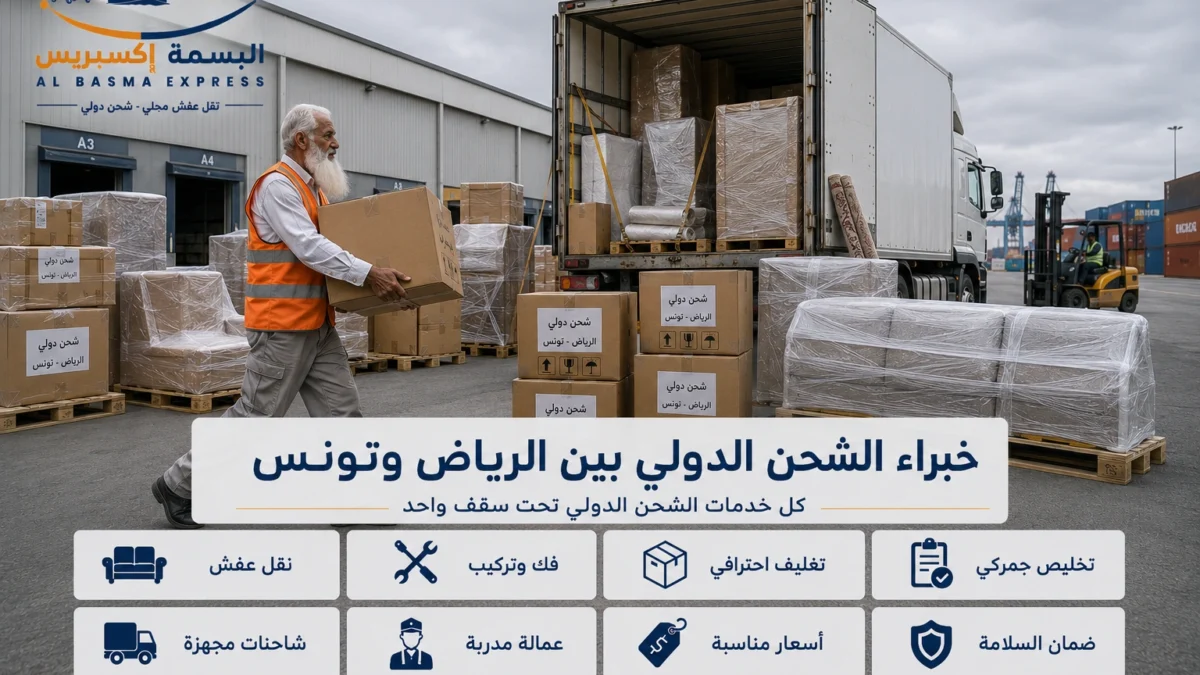

Moving from Riyadh to Libya needs planning that links the inland transport in Saudi Arabia with the international shipping method, the clearance and then the distribution inside Libya. Large furniture usually suits sea freight or containers, while air trips suit parcels and urgent items, and land transport may be part of the trip inside either country or within a multi-stage route.
Guide sections208 topicsShowHide
Al Basma Express provides a furniture shipping and moving company from Riyadh to Libya service that starts with listing the furniture, appliances and cartons, then choosing the packing and the transport method, preparing the packing list, organizing the disassembly and loading, and ending with the clearance, the distribution and the assembly according to the package. This guide is arranged to set out the services, the routes, the cities and the pricing factors in a practical sequence the customer can follow easily.

🧰 The main services inside the package
The most requested
Moving a whole home
Disassembly, numbering, packing, loading, booking a container, delivery and basic assembly.
Shipping cartons and bags
A suitable solution for students, expatriates and small shipments.
Moving offices and companies
An inventory by department, moving devices and files and reducing the downtime.
Car shipping
Independent coordination for the vehicle with the condition, the documents and the handover documented.
🧭 Start from the result you want on delivery day
Do you want to receive the furniture at the building’s door or inside the unit? Does the agreement include reassembling the bedrooms and wardrobes? Do you need storage before the housing is ready? These details set the real service scope.
A lower quote may end at the port or the warehouse, so the delivery, the assembly and where the responsibility ends must be written down.
🧭 Sorting the furniture before the survey
Compare the piece’s value, condition and suitability for the new home with the cost of dismantling, packing and shipping it. Some pieces deserve moving, while selling a huge worn piece may be more logical.
Split the contents into essential, high-value, replaceable and unused.
🧭 An on-site or a video survey
A video survey works for small apartments, while villas, offices and custom-made pieces need an on-site visit. The supervisor records the dimensions, the entrances, the elevator and the sensitive pieces.
Anything not visible may change the container type and the protective materials.
🧭 The volumetric size
Furniture isn’t priced by weight alone; the space it takes inside the container is a main factor. A large wardrobe may cost more space than a heavy appliance.
Calculating by volume helps in choosing between a full container, partial or air shipping.
🧭 The service levels
The basic service may cover the transport only, the complete service adds the disassembly, packing, inventory and assembly, while the managed move adds storage, special protection and extended follow-up.
Choosing the right level is tied to the customer’s time, experience and the sensitivity of their belongings.
| Service level | What it usually covers | Who it suits |
|---|---|---|
| Basic transport | Loading, transport, shipping and unloading to the delivery point | Cartons and pieces prepared in advance. |
| Complete service | Disassembly, packing, inventory, shipping, delivery and basic assembly | Apartments and villas moving in full. |
| Managed move | Storage, coordination, special protection and extended follow-up | Offices, luxury pieces and sensitive dates. |
⚖️ Sea, air or multi-stage transport?
🚢 Sea freight
Usually the best fit for large furniture, containers and whole-home shipments, with the port, the handling, the storage and the distribution necessarily counted in.
✈️ Air freight
Suitable for parcels, urgent items and small high-value devices, but it costs more for large volumes.
🚚 Multi-stage transport
It combines a vehicle inside Saudi Arabia, sea or air freight, then a distribution vehicle inside Libya to reach the final address.
📦 Packing by the nature of the piece
Wood is affected by scratches, glass by pressure on the edges, fabrics by dust and moisture, and appliances by movement and the wrong position.
Layers of felt, cardboard, bubble wrap, corners, stretch film and wooden crates are used.
📦 Bedrooms and wardrobes
The wardrobes and beds are photographed before the disassembly, the panels numbered, and the screws and hinges kept inside bags carrying the same code.
The piece’s dimensions must be compared with the entrances of the new Libyan home.
📦 Sofas and majlis seating
The cushions and removable legs are separated, and a clean layer placed over the fabric before the outer wrap.
No weights are placed on long majlis pieces.
📦 Glass, mirrors and marble
The protection starts at the edges, then the piece is wrapped and secured upright. Marble needs support that prevents bending.
Large mirrors and paintings may need a wooden crate.
📦 Electrical appliances
Fridges are emptied, cleaned and dried, washing machines prepared per the manufacturer’s instructions, and screens moved upright.
It’s better to photograph the appliance working and record its serial number.
📦 Antiques, chandeliers and paintings
The separable parts are dismantled and wrapped individually, with dividers used inside the crates.
High-value pieces need photos, an estimated value and a dedicated crate.

🛣️ The shipment’s journey step by step
The survey and approving the scope
Setting the contents, the volume, the shipping method and the services required.
Disassembly, packing and inventory
Numbering the pieces, preparing a packing list and documenting the sensitive items.
Transport to the shipping point
Loading the shipment into a suitable vehicle and moving it to the port or the airport.
The international shipping
Carrying out the sea or air booking according to the documents and the available schedule.
Clearance and collection
Reviewing the documents and completing the procedures according to the shipment’s status.
Distribution inside Libya
Moving the shipment from the port or the airport to the city and the final address.
Assembly and inspection
Matching the inventory, opening the sensitive pieces and recording the remarks.
🚢 Sea freight to Libya
Sea freight is the practical option for large furniture, containers and whole-home shipments on the Saudi–Libyan route, with the shipment moving from a Saudi port toward the Libyan ports, most often Tripoli port and Khoms port in the west, Misrata port in the centre, and Benghazi port in the east.
And the port is set by the city where the furniture will be delivered rather than the price alone; the distance between Tripoli and Benghazi is large, and choosing a port far from the destination adds a long inland transport stage to both the duration and the cost. So the Libyan city is set before the sea space is booked, not after.
🚢 A full container and partial shipping
A full container gives the customer dedicated space and suits villas and large homes. Partial shipping suits small quantities.
In partial shipping the separation system, the number of handling stages and the consolidation date must be known.
🚢 Air freight to Libya
It suits documents, urgent parcels, small devices and high-value items. The volumetric weight matters in the pricing.
The permitted materials, the packing method and the collection point must be reviewed.
🚢 Land transport as part of the trip
Land transport may be part of the trip inside Saudi Arabia or Libya, but it isn’t necessarily the only method for the whole distance.
A good quote sets out every stage rather than using the phrase “land shipping” in a general way.
| Shipping method | Most suitable for | The advantage | What to review |
|---|---|---|---|
| Sea — a full container | A home, a villa or a large office | Dedicated space and high capacity | The port, the handling and the storage. |
| Sea — partial | Cartons and limited pieces | Lower cost | The consolidation, the separation and the number of handlings. |
| Air | Parcels and urgent items | Higher speed | The volumetric weight and the permitted materials. |
| Multi-stage transport | Inland destinations | Door-to-door arrival | The vehicles, the handling and the distribution. |
🧾 The packing list and the documents
The file needs the sender’s and consignee’s details, a packing list, identity documents and papers that differ with the shipping method and the nature of the contents.
The descriptions must be clear, avoiding writing “assorted items” on every box.
🧾 Used furniture and exemptions
An automatic promise of exemption for used furniture shouldn’t be relied on. The treatment relates to the importer’s status, the contents, the documents and the regulations in force.
Separate the new or commercial pieces from the personal furniture.
🧾 Prohibited and restricted materials
Don’t include medicines, foods, chemicals, liquids, batteries or special devices without reviewing the conditions.
Declaring early protects the whole shipment.
🧾 Insurance and documentation
Ask for a policy explaining the cover, the exclusions, how the pieces are valued and the claim period.
Photograph the high-value pieces before the packing and link the photos to the inventory codes.
📍 Coverage inside Libya
Tripoli and Zliten
Towers and crowded districts needing an elevator, a parking spot and a suitable vehicle.
Misrata, Benghazi and Khoms
Coastal delivery needing protection from the humidity and the last mile organized.
Zawiya
Counting the port, the handling and the distribution inside the north.
Sabha and the southern Libyan cities
A longer distribution stage needing a realistic schedule and suitable protection from the heat.
📍 Delivery to Tripoli
The capital has districts, towers and busy roads. The full address, the floor, the geographic location and the entry instructions must be sent.
A smaller vehicle may be used for the last mile.
📍 Delivery to Zliten
The destinations differ between apartments, houses and commercial areas. The gate, the parking spot and the distance to the unit must be known.
Photos of the entrance help in choosing the vehicle.
📍 Delivery to Misrata
The shipment needs a distribution stage after the port or the airport. The district, the building and the parking spot must be known.
A realistic date and a substitute person to receive are set.
📍 Delivery to Benghazi and Khoms
The coastal areas need good protection for fabrics and wood from the humidity, especially in storage.
The type of building, the floor and the elevator are checked.
📍 Delivery to Zawiya
Some shipments may benefit from the northern location, but that doesn’t remove the clearance, the handling and the distribution.
The final address and the delivery point are set.
📍 Delivery to Sabha and the southern Libyan cities
They need a separate schedule for the last mile after the arrival point. The farther the destination, the more important setting a realistic date becomes.
The final city’s name must appear in the quote.
🔸 Moving offices and companies
It starts with an inventory by department, numbering the desks, devices and files and setting what must work first. The servers and networks are coordinated with the IT team.
The commercial documents are separated from the personal belongings.
🔸 Shipping the archive and documents
The files are packed in small numbered boxes, and the people authorized to receive them named.
Urgent documents may need air freight.
🔸 Moving shops and showrooms
The shelving, display fronts and point-of-sale devices are arranged by the installation sequence.
The shipment may be split into a fitting-out stage and a goods stage.
🔸 Temporary storage
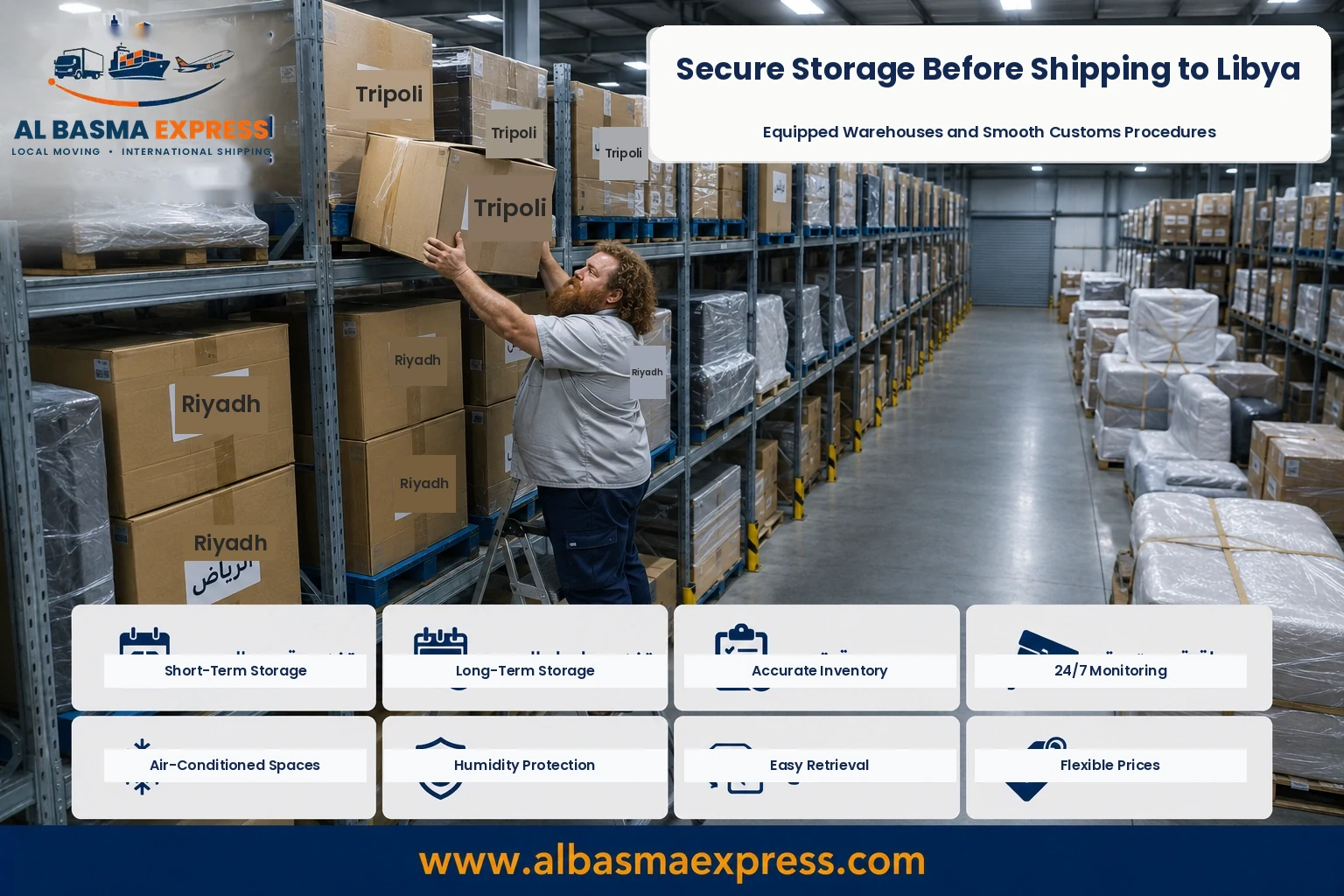
The customer may need to store the furniture before the housing is ready. The warehouse’s nature, the period and the fees must be known.
Documents, medicines and daily needs aren’t stored.
🔸 The execution day’s plan
The supervisor confirms the list of what will move, and the customer sets aside an area for the documents, medicines and jewelry.
Having one person authorized to give instructions prevents conflicts.
🔸 The first days’ box
It holds clothes, chargers, bedding, cleaning supplies, essential medicines and some eating utensils.
The passports, documents and keys stay with the customer.
🔸 Measuring the furniture and the entrances
Record the dimensions of the wardrobes, sofas and tables and compare them with the unit’s door, the elevator and the stairs in Libya.
Spotting the conflict early allows extra dismantling.
🔸 Organizing the clothes and bags
Clothes travel in dry boxes, and wardrobe boxes are used for formal wear.
Split the boxes by family member and room.
🔸 Kitchen tools
Cups and plates are wrapped individually, and heavy pots go at the bottom.
Open containers or liquids aren’t shipped.
🔸 Books and bookcases
Books are packed in small boxes so they don’t become heavy. The bookcase’s parts are numbered.
Delicate books need protection from moisture.
🔸 Pianos and heavy pieces
They need trolleys, lifting means and enough workers.
The entrances are measured and the need for a hoist identified.
🔸 Furniture that has been repaired before
The supervisor is told about any weak point or previous repair in the tables, wardrobes and glass.
The condition is photographed before the move.
🔸 Protecting the floors and walls
Protection runs and covers for the corners and elevators are used.
Heavy pieces mustn’t be dragged directly along the ground.
🔸 Handling a change of address
If the delivery address inside Libya changes, the company must be told immediately.
The price and the schedule are reviewed in writing.
🔸 The customer’s absence at the handover
An authorized person is appointed who knows the inventory list, the room plan and the limits of the signing authority.
Having no one to receive may lead to storage.
🔸 Delivery inside the unit
Delivery at the building’s entrance differs from bringing the furniture in via the elevator or the stairs.
The quote must state where the company’s responsibility ends.
🔸 Managing the packing waste
After the pieces are unwrapped, quantities of cardboard, plastic and felt pile up.
Collecting the materials as you go keeps the corridors clear.
🔸 Inspecting the appliances
The packing, the visible condition, the fittings and the serial numbers are reviewed.
Any noise, warning or remark is documented.
🔸 Assessing the assembly’s quality
The wardrobes, beds and desks are tested after assembly.
Any remark is recorded before the crew leaves.
🔸 Commercial shipping kept separate
Goods for sale shouldn’t be mixed with personal furniture. Each category has different documents and treatment.
A separate list is prepared for the commercial goods.
🔸 Car shipping
The car is photographed from all sides with the odometer, the fuel and the scratches recorded.
The car’s route and documents are set separately.
🔸 Shipping in peak seasons
Requests rise in the summer and at the end of leases.
Booking early gives better options for containers.
🔸 Handling delays
A delay may come from the ships’ or flights’ schedules, an inspection or storage.
The customer should get a clear update.
🔸 The bill of lading
It sets out the sender’s and consignee’s details, the shipment’s nature and the port or airport.
The customer keeps a digital copy.
🔸 Documenting any change
Adding boxes, changing the date, or adding storage or assembly must be written down.
The latest written version of the quote is the reference.
🔸 Building a realistic timeline
Start from the date you take over the housing in Libya then work backwards.
Leave a margin for the port or the airport.
🔸 Unusually low quotes
A low quote may exclude the packing, the handling or the port fees.
Compare the items rather than the figure alone.
🔸 The review before the container is closed
The count, the codes, the bags of screws and the keys are reviewed.
A general photo of the load is taken.
🔸 The after-delivery service
The service doesn’t end when the last box is put down.
There must be a channel for recording remarks.
🔸 Signs of a professional crew
Professionalism shows in having a supervisor, using codes and protecting the place.
It also shows in reviewing the inventory before closing.
🔸 Using wooden crates
They’re used for highly sensitive pieces such as large mirrors, paintings and screens.
They must have a lining and internal securing.
🔸 Organizing the keys and remotes
The wardrobe keys, remotes and screws are gathered in a labeled fittings box.
They aren’t left inside the drawers.
🔸 The condition of the boxes
The boxes must be clean, dry and strong.
The room and the contents are written on more than one side.
🔸 Arranging the priority boxes
The first days’ boxes are placed somewhere easy to reach.
They’re marked with a clear code.
🔸 Opening the boxes
It’s agreed which pieces will be opened with the supervisor present.
Priority is given to the sensitive pieces.
🔸 The 72-hour list
Confirm the addresses, the documents, the elevator, the parking spot, the photos and the number of boxes.
Tell the company about any increase.
🔸 The final handover
Match the count and the codes, open the sensitive pieces and test the assembly.
Record any remark with photos and a written record.
✅ A checklist before shipping
❓ Frequently asked questions
What’s the best way to ship furniture to Libya?
Usually sea freight for large furniture and containers, while air suits urgent parcels.
Can a single carton be shipped?
Yes, through partial or air shipping according to the weight and the volume.
Is the price by the kilo?
Parcels may be priced by weight, but furniture depends on the volume, the handling and the packing.
Does the price include the clearance?
It depends on the quote, and what’s included and what remains the customer’s must be specified.
Is used furniture exempt?
There’s no automatic promise; the treatment is set according to the documents and the contents.
Can the furniture be stored?
Yes, once the warehouse, the period, the fees and the redelivery are agreed.
Is the assembly done in Libya?
It can be included depending on the package, with the pieces and the work specified.
Does the service reach Sabha?
Distribution to Sabha and the other cities can be arranged according to the address.
Is removing the packing included?
That must be stated in the quote because it isn’t automatic in every package.
How long does the trip take?
It depends on the shipping method, the booking, the port or the airport, the clearance and the distribution.
Can a car be shipped with the furniture?
The two services can be coordinated, but the car has its own route, documents and cost.
How do I choose the company?
Compare the clarity of the quote, the packing, the handling, the insurance and the delivery, not the price alone.
🧩 Different worked examples
An apartment to Tripoli
A family moving a bedroom, a sofa, appliances and cartons. A video survey is done, partial sea shipping is chosen, and the elevator doors measured.
A villa to Benghazi
The villa has several rooms, a majlis and glass tables. An on-site survey is carried out and the packing split over two days.
A student’s cartons to Misrata
The shipment is books, clothes and a computer. Small boxes are used for the books, and the computer is protected inside a solid crate.
An office to Zliten
The furniture and devices are numbered by department, and the servers moved in coordination with the IT team.
🧩 Furniture to Sabha
The shipment needs a schedule for the last mile after the port. A substitute person to receive is named.
🧩 Temporary storage
Taking over the housing in Libya is delayed, so the shipment is split into urgent needs and a storage unit.
🔹 Choosing what genuinely deserves shipping
Review every piece from the angle of use, value and space. Some pieces deserve moving for their value or because they’re hard to replace, while others are huge and don’t suit the new home.
🔹 Checking the new home’s dimensions
Measuring the doors, corridors, elevator and stairs in Libya is an essential step before shipping wardrobes, sofas and large tables.
🔹 Preparing the clothes and bags
Clothes travel inside clean, dry boxes, and wardrobe boxes are used for formal wear. Shoes are separated and perfumes aren’t placed with the clothes.
🔹 Packing the kitchen tools
Cups and plates are wrapped individually, and heavy tools go at the bottom. Knives are protected inside a solid wrap.
🔹 Books and bookcases
Books are packed inside small or medium boxes. The bookcase’s parts and shelves are numbered, and the screws and supports kept in a bag carrying the same code.
🔹 Custom-made furniture
Wall wardrobes, kitchens and desks designed for a specific space need their own review, because installing them at the new site may need altering.
🔹 Pieces that have been repaired before
Any piece that has had a previous repair must be treated as more sensitive. The supervisor should be told about the weak point before it’s lifted.
🔹 Pianos and heavy pieces
They need more workers, lifting equipment and suitable trolleys. The planning starts with measuring the entrances, the elevator and the parking point.
🔹 Air conditioners and fitted appliances
They need a qualified technician for the dismantling, and it must be set whether the quote covers handling the gas, the connections and reinstalling them.
🔹 Rugs and carpets
The rug is cleaned and dried completely then wrapped in a layer protecting it from dust and moisture.
🔹 Mattresses and soft furnishings
Mattresses are covered with clean bags, and aren’t folded or compressed for long periods.
🔹 Shipping in two batches
Splitting the shipment may make sense when the customer wants to send the non-essential furniture early then the daily needs later.
🔹 Older buildings
Some buildings may have narrow stairs and small elevators or no elevator at all. The entrances must be measured and the need for a hoist identified.
🔹 Booking the elevator and the parking spot
In towers, booking the service elevator may be a basic requirement. The permitted hours and the booking period must be known.
🔹 Protecting the floors and walls
Floor protection runs and corner covers are used, and the elevator doors and walls protected.
🔹 Preparing the delivery address in detail
The address isn’t limited to the city’s name; the street, the building, the floor and the geographic location are all recorded.
🔹 Narrow or rural roads
A large truck may only reach a nearby point, then a smaller vehicle is used for the final stage.
🔹 A change in the delivery address
If the address changes after the shipment has departed, the company must be told immediately because the distance and the vehicle may change.
🔹 The home not being ready in time
If the painting or the flooring isn’t finished, temporary storage may be better than bringing the furniture into a place exposed to damage.
🔹 The customer’s absence at the handover
An authorized person is appointed who knows the inventory list, the room plan and the limits of the signing authority.
🔹 Delivery at the door or inside the unit
Delivery at the entrance differs from bringing the furniture in and distributing the boxes, and both differ from the assembly.
🔹 Managing the packing waste
After the pieces are unwrapped, quantities of cardboard and plastic pile up. It must be agreed who collects them.
🔹 Planning the order for opening the boxes
All the boxes shouldn’t be opened at once. Start with the beds, the bedding and the essential bathroom and kitchen tools.
🔹 Reviewing the appliances after arrival
The appliances aren’t switched on immediately before their position is confirmed and the manufacturer’s instructions followed.
🔹 Assessing the assembly’s quality
After the wardrobes and beds are assembled, the doors, drawers, stability and alignment are tested.
🔹 Commercial shipping kept separate
Goods for sale shouldn’t be mixed with personal household furniture under one description.
🔹 Moving cars along with the furniture
The vehicle is its own project within the order: full documentation with photos from all four sides, and the odometer, the fuel level and the tire condition recorded before it goes onto the carrier or into the container.
And vehicles move to Libya either inside a container or through roll-on/roll-off services depending on the available operating line, and the decision differs with the car’s value and how much it needs protecting from the weather. As for the entry and registration conditions, they’re checked with the official authorities before booking, because being able to ship is one thing and being able to use it there is another.
🔹 Moving bicycles and sports equipment
The protruding parts are removed, the tires and frames protected, and the bolts kept in labeled bags.
🔹 Handling plants
Live plants may be subject to restrictions and may not suit international shipping.
🔹 Peak seasons
Demand on the Libyan route rises in the summer with the return season for those living abroad, and at the end of housing contracts when the vacating dates fall close together.
And booking early doesn’t only save money; it gives you a choice of sailing date and arrival port instead of accepting the first available space, which shows directly in when you receive the furniture in Tripoli, Misrata or Benghazi.
🔹 Delays at the port
Sea freight may be affected by the ships’ schedules, the inspection dates and the congestion at the Libyan ports, and the operating lines themselves may change from one period to another with the operating conditions.
So the schedule is built on a range of weeks rather than a fixed date, and it’s better to confirm the routing and the arrival port at booking rather than at sailing, with a margin left between the expected arrival and the housing handover so a delay doesn’t turn into unplanned storage.
🔹 The bill of lading
It sets out the sender’s and consignee’s details, the shipment’s nature and its route.
🔹 Handling the insurance
It must be known whether the policy covers the loading, the unloading and the storage.
🔹 The after-delivery service
The service doesn’t end when the last box is put down. There must be a channel for recording remarks.
🔹 Signs of a professional crew
Professionalism shows in having a supervisor, using codes and protecting the place.
🔹 Documenting any change
Adding boxes, changing the date or adding storage must be written down.
🔹 Building a realistic timeline
Start from the date you take over the housing in Libya then work backwards.
🔹 Very low quotes
A low quote may exclude the packing, the port fees or the delivery.
🔹 The review before the container is closed
The count, the codes, the bags of screws and the keys are reviewed.
🔹 Keeping moving day calm
Name one person for the communication and keep children and pets away.
🔹 Choosing the type of container
The practical difference between a full and a shared container isn’t only the price: the full one is sealed with your own seal and moves on its own schedule, while the shared one waits for other shipments to fill the space before sailing to Libya.
And on the Libyan route it helps to ask the broker about the container’s free allowance period at the port after arrival, because exceeding it incurs daily demurrage. It also helps to know whether the shipping line serves the destination port directly or passes through an intermediate port, because the extra handling means a longer time and more handling of the load.
🔹 Handling the container seal
Once it’s closed a seal may be fitted carrying a number recorded in the documents.
🔹 Distributing the weights inside the container
The heavy pieces go at the base and are spread across both sides.
🔹 Moisture and condensation
The temperature inside the container shifts across the long sea trip, so water vapor forms then condenses on the surfaces, and that leaves its mark on wood, leather, books and soft furnishings if they aren’t well prepared.
So moisture-absorbing bags are used inside the container, and no piece goes in before it’s completely dry. It matters more if the container waits days at the Libyan port before unloading, because waiting under the sun raises the internal temperature noticeably.
🔹 Partial shipping
In partial shipping each customer’s shipment is separated with codes and lists.
🔹 The first days’ box
It holds bedding, clothes, cleaning supplies and chargers.
🔹 Reviewing the number of pieces at the handover
The boxes and separate pieces are matched against the list.
🔹 Furniture that needs a carpenter
Some wardrobes and kitchens need a carpenter for the disassembly and assembly.
🔹 The electrical work
Installing chandeliers, air conditioners and ovens needs a specialist technician.
🔹 Shipping to villages and remote areas
Outside the large cities, a precise description of the road, photos and a landmark matter more than the written address, because the driver may reach the area then not be able to identify the house itself.
And in cities far from the arrival port such as Sabha and the Libyan south, the inland transport stage is counted within the plan from the start, along with setting whether the large truck will reach the address or the load will move onto a smaller vehicle in the final stage.
🔹 Monitoring the service quality
The customer can follow the work through the supervisor, the photos and the inventory.
🔹 Rescheduling
If the travel or housing date changes, the container, the booking and the delivery are reviewed.
🔹 Keeping the documents
The customer keeps digital copies of the ID, the contract and the packing list.
🔹 Following up after 24 hours
A day after the handover, review the appliances, the drawers and the fittings.
🔹 Handling missing pieces
The inventory list, the room codes and the fittings box are reviewed.
🔹 Handling visible damage
The packing is photographed before it’s opened, then the piece is photographed.
🔹 Handling hidden damage
A fault may appear in a drawer or a device after the assembly.
🔹 Choosing when to open the boxes
Opening every box in one day causes chaos.
🔹 Arranging the packing materials
The cartons are folded and the protective materials gathered in one area.
🔹 Making sure the furniture is clean
Before the packing the furniture is cleaned and dried.
🔹 Making sure the drawers are empty
The drawers are emptied, because leaving things inside adds weight.
🔹 Securing the doors and drawers
Once emptied they’re locked or secured in a way that doesn’t harm the paint.
🔹 Choosing suitable adhesives
Some tapes leave a mark or remove the paint.
🔹 Setting the assembly order
The beds and main wardrobes are assembled first, then the desks and tables.
🔹 Handling weak walls
If a piece needs fixing to the wall, the wall type must be known.
🔶 Assessing whether the furniture needs cleaning before shipping
Cleaning the furniture before the packing helps when dust has built up or there are surface marks that can be treated easily. But the cleaning must leave enough time for drying, because sealing moisture inside the wrap may cause odors or marks on wood and fabric. It’s better to use methods suited to each material, and not to try strong products just before the travel. Fridges, washing machines, air conditioners and any appliance holding water or moisture must also be dried. This step leaves the furniture ready to use on arrival and reduces the chance of damage during the storage or the sea trip.
And a dirty or damp piece is cleaned and dried before the packing, because the sea trip to Libya is long enough to turn a small stain into a lasting odor.
🔶 Choosing the right boxes for each content
Not every box suits every item. Books and metal tools need small strong boxes, while clothes and soft furnishings can go into larger, lighter boxes. Glass needs dividers and internal protection, and small appliances benefit from their original boxes if they’re intact. The base is sealed with strong tape, and the box’s weight doesn’t exceed what a worker can carry safely. The room, the contents and the box number are also written on more than one side so the information stays visible however the stacking is arranged.
And a box of books doesn’t exceed half the size of a clothes box, because paper gets heavy fast and tears the cardboard from its base.
🔶 Setting aside a box for the small fittings
Screws, keys, remotes and small cables hold up the assembly if they’re put anywhere. So a central fittings box is set aside holding separate bags carrying each piece’s code. Each bag’s contents can be photographed before it’s sealed and recorded in the inventory list. On arrival the box is handed directly to the assembly supervisor rather than being put with the ordinary cartons. This step reduces the searching and prevents unsuitable substitute parts being used or the assembly being postponed.
And the fittings box is handed to the assembly supervisor by hand on arrival, not placed within the general load.
🔶 Handling smart devices
Smart devices such as modern screens, network equipment and smart-home systems need their accounts and data disconnected before the move where necessary. The connections are photographed, and the cables, adapters and remotes kept in labeled bags. Some devices hold batteries whose shipping conditions must be reviewed, especially in air freight. The compatibility of the apps, accounts and connections with the new site must also be confirmed, and passwords mustn’t be stored inside the shipment’s box.
And smart devices are disconnected from the network and their details recorded before the disassembly, because reconnecting them in Libya needs the same passwords.
🔶 Preparing the computer and work devices
The important content is backed up before the computer is disconnected, the sensitive accounts closed, and the storage units and screens protected inside suitable crates. The cables are separated and numbered, and the fittings kept with the device. It may be better to carry critical work devices or send them by air rather than putting them with the furniture, especially if the customer needs them immediately on arrival. Devices also mustn’t be put inside unlined boxes or under heavy weights.
And work devices and the computer stay with their owner during the travel if possible, because their failure stops the work rather than just delaying it.
🔶 Shipping home medical equipment
Home medical devices need the manufacturer’s instructions, the permitted materials and the temperature and humidity conditions reviewed. Some devices shouldn’t go into the ordinary furniture shipment, and may need specialized shipping or to be carried directly with the traveler. The prescriptions, documents and fittings are kept with the device, and a temporary alternative planned if the trip is long. The user’s safety matters more than trying to lower the shipping cost.
And home medical equipment is listed in the packing list explicitly, because some of it may need a document or an approval on arrival.
🔶 Managing the family’s needs while waiting for the shipment
The family may reach Libya before the furniture, so a temporary plan for sleeping, eating and working must be prepared. Light mattresses or basic tools can be kept, or short-term needs rented. This plan prevents pressuring the shipping company for an unrealistic date, and gives the customer flexibility if the clearance or the distribution is delayed. It also helps in choosing what goes into the first days’ box and what stays with the traveler.
And waiting for a sea shipment runs into weeks, so the family’s basic needs are prepared as for travel rather than for a few days.
🔶 Choosing an alternative collection point
If the final home isn’t ready, a warehouse or an alternative address can be agreed, but the change must be written down and specified. An alternative address may change the distance, the vehicle, the permits and the cost. It must also be confirmed the place is safe, dry and able to take the shipment’s size. Using an unequipped temporary site then moving the furniture again with no plan isn’t advisable, because every extra handling increases the risks.
And the alternative collection point is set in the quote in advance, not when the container reaches the port.
🔶 Handling shared family shipments
More than one family may share a container or a single shipment. In that case a separate list is prepared for each family, different codes and colors used, and the delivery point and order set. The families’ fittings mustn’t be put in one box, and it must be known how the separation will happen on arrival. The organization prevents a piece reaching a different city or home, and makes calculating the space and the cost fairer.
And in shared family shipments a separate list is prepared for each family, because mixing them makes matching at the handover nearly impossible.
🔶 Choosing the right customs broker
Clearance in Libya needs an understanding of the shipment’s classification, the packing list, the valuation and the possible fees. You must know who the responsible broker is, how he contacts you, and what documents he’ll ask for before the ship arrives rather than after. And on this route especially it’s important to confirm the broker actually works at the specified arrival port; a broker experienced in Tripoli isn’t necessarily able to complete the procedures for a shipment arriving at Benghazi or Misrata. Answering that before booking saves days of waiting after the arrival.
🔶 Reviewing the invoices for new pieces
If the shipment holds new appliances or furniture, invoices or purchase documents may be requested. A new piece mustn’t be described as used if that isn’t true. The invoices are gathered in a digital and paper file, and this content separated from the old personal furniture in the list. An accurate declaration reduces the chance of the shipment being revalued or delayed.
And the invoices for the new pieces are kept together, because they may be requested at the customs valuation in Libya.
🔶 Handling gifts and repeated quantities
Having several similar or newly wrapped pieces may make them look commercial. So their nature and purpose must be explained, and the documents kept where needed. Gifts in large quantities aren’t mixed with the personal furniture without a description. If the quantity genuinely is commercial, it’s treated as separate goods with its own documents.
And gifts and repeated quantities of one item may be read as commercial, so they’re explained in the list precisely.
🔶 Choosing the shipping date relative to the travel
It’s better for the shipment not to be loaded on the same day the customer travels, because any delay or review may cause confusion. Leave a day or more to review the home, the documents and the keys. The handover date also mustn’t be tied to a flight or a commitment that can’t slip. A flexible schedule makes the move calmer and prevents signing quickly without an inspection.
And the shipping date is chosen before the travel date rather than after, because the loading needs the shipment’s owner or their representative present.
🔶 Handling the end of the housing contract in Riyadh
Before leaving the home, what belongs to the landlord is separated from the personal furniture, and the condition of the walls and floors photographed once the pieces are out. The crew mustn’t take a built-in piece or an appliance belonging to the property. The cleaning time and the key handover after the loading are also set, with cleaning supplies and essential items left outside the shipment.
And the end of the housing contract in Riyadh is coordinated with the loading date, so the shipment isn’t left with nowhere to go for a day or two.
🔶 Checking the home in Libya before the shipment arrives
Visiting the new home before the shipment arrives saves a whole day later: measuring the doors, the elevator and the rooms, and drawing a simple plan setting where each large piece goes before the container is opened. It also helps to know the state of the power supply in the area and the hours it cuts out if it does, because the assembly and testing the appliances need a stable current for several consecutive hours. Setting the unloading day for a period when power is available prevents the appliance installation being put off to another day.
🔶 Handling furniture pieces that don’t fit
A piece may arrive and turn out not to suit the space or the design. It’s better to discover that before shipping through the measurements, but if it happens after arrival it mustn’t be forced into a tight space. It can be stored temporarily, sold or altered by a carpenter. Forcing the piece or the building may cause damage worth more than the transport.
And a piece that doesn’t suit the new home is excluded before loading rather than after it arrives, because disposing of it in Libya is harder.
🔶 Managing two crews in two countries
Between the Riyadh crew that dismantles and packs and the Libya crew that unloads and assembles lies a whole sea trip, and nothing crosses it but the information: photos before the disassembly, the piece numbering, each piece’s fittings in its own bag, and one inventory that stays fixed from start to finish. Added to that, the communication may rely on messaging apps more than international calls, so it’s better to create one group holding the customer, the operations contact and the delivery representative, so the photos and updates reach everyone at the same time rather than explaining to each party separately.
🔶 The criteria for choosing the assembly crew
The assembly crew must be able to read the codes and the photos and handle the different types of furniture. Not every mover is a carpenter or an appliance technician. The pieces needing a specialist must be identified, and they mustn’t be assembled with unsuitable tools. The assembly quality is part of the moving quality, because disorganized disassembly usually shows its effect at this stage.
And the assembly crew is asked about its experience with custom-made furniture rather than the number of jobs alone, because one complex wardrobe can take half a day.
🔶 Checking the appliances’ electrical compatibility
Before shipping large appliances, confirm the plugs and connections suit the new site. The socket used in Libya is mostly a European two-pin, while many Saudi appliances use the British three-pin plug. Beyond that, it helps to think about the power stability when choosing what to ship; sensitive appliances such as modern fridges and screens may need a voltage regulator at the new site. Counting that cost in advance is better than discovering it after the shipment arrives.
🔶 Handling the appliances’ original warranties
Some appliances may lose their warranty when moved to another country or dismantled by an unapproved technician. Check the warranty terms before the move, and keep the invoices and the manuals. Selling the appliance and buying a local replacement may be more logical in some cases. The decision must bring together the shipping cost, the warranty, the servicing and the availability of spare parts.
And the appliances’ original warranties are kept with their invoices, because some may remain valid in another country or with an approved agent.
🔶 Shipping spare parts and fittings
If a piece of furniture or an appliance uses a part that isn’t easily available, small spare fittings can be kept, provided they’re described and placed with the piece. The spare parts aren’t scattered across several boxes. Restricted materials or parts also mustn’t be shipped without checking.
And spare parts and fittings are attached to their appliance in the same box rather than in a general toolbox.
🔶 Handling leather materials
Leather sofas and bags need light cleaning, drying and protection that doesn’t stick to the surface. The wrap isn’t pulled tight and the piece isn’t left under heat or prolonged pressure. A soft layer can be used then an outer wrap, while preventing the leather rubbing against metal or rough wood.
And leather materials need ventilation rather than a tight seal, because trapped moisture leaves stains that are hard to treat.
🔶 Handling natural wood
Natural wood may be affected by moisture, dryness and temperature change. It’s covered in a way that protects without trapping moisture, and knocks to the joints and edges prevented. On arrival the piece is left to settle before any adjustment or firm tightening if that suits its type.
And natural wood expands and contracts with the difference in humidity between Riyadh and Libya, so it’s left to acclimatize before the final assembly.
🔶 Handling painted furniture
Glossy or modern paint may react with some tapes or plastics. A separating layer is used, and tape isn’t stuck directly to the surface. Any old scratches are photographed, and the corners and protruding parts protected. Stacking that puts continuous pressure on one surface must also be avoided.
And painted furniture needs a separator that stops the wrap sticking to the paint, especially with the container’s heat during the voyage.
🔶 Packing decorated glassware
Decorated or thin glass needs each piece separated and materials used that don’t press on the engraving or the edges. The gaps inside the crate are filled, and the contents prevented from shifting when the crate is moved. Many pieces aren’t gathered into one large box even if they’re light.
And decorated glassware is wrapped piece by piece, because the raised engraving is the first thing to break on contact.
🔶 Shipping artworks
Artworks need a separate valuation, high-quality photos, a description, measurements and a value. They may need a dedicated crate or shipping at a particular temperature and humidity. An expensive painting isn’t treated like an ordinary frame, and it must be confirmed the insurance covers its value and its shipping method.
And artworks are valued and documented before loading, because proving their value after damage is far harder than protecting them beforehand.
🔶 Handling family documents
Birth certificates, contracts, academic certificates and original documents aren’t put inside the container. They’re carried with the family or sent separately by a safe route. Scanned copies can be placed in the shipment’s file where needed, but the original stays under the customer’s control.
And family documents and original certificates don’t enter the sea shipment; they stay with the customer in their travel bag.
🔶 Managing the utility accounts in Riyadh
Before travelling, the electricity, internet and water services are closed or transferred as agreed, and the router or the provider’s equipment returned. Equipment that isn’t the customer’s property isn’t shipped. The invoices and cancellation confirmations are also kept.
And the electricity, water and internet accounts in Riyadh are closed after the loading rather than before, so the power doesn’t cut out during the work.
🔶 Setting up the utilities in Libya
The electricity, water and internet must be working before unloading day, because installing and testing the appliances isn’t done on a promise of connection, and the crew can’t hand over incomplete work then come back to it days later. It’s advisable to arrange a local phone number inside Libya for the delivery crew, because the final coordination on unloading day usually happens through a direct call with the driver. It also helps to send a clear landmark near the home, because relying on the street name alone may not be enough to get there in many districts.
🔶 Choosing the shipping method by priority
The needs can be split between air and sea: the documents and essential devices are sent by air, and the furniture arrives by sea. This option costs more than a single shipment but gives the family flexibility. The cost of splitting must be compared with the value of the time and the actual need.
And choosing the shipping method starts from one question: what do I need in the first two weeks? And what can wait a month?
🔶 Preparing a small air shipment
In air freight strong light boxes are used, and the dimensions calculated precisely because the volumetric weight matters. The batteries, liquids and restricted materials are reviewed, and a clear description written. It’s also set whether the service is door-to-door or airport-to-airport.
And a small air shipment is prepared in its own box with its own list, because mixing it with the sea shipment loses it the advantage of speed.
📍 Delivery to Tobruk and the western cities
Tobruk, Misrata, Zuwara and Tarhuna need the sea or air arrival point set then the inland distribution stage calculated. The city, the municipality, the district, photos of the road and the parking spot must be sent, because a large truck may only reach a nearby point then a smaller vehicle is used for the last mile. The clearer the final address, the more accurately the number of workers, the time and the type of vehicle can be estimated.
📍 Delivery to Zliten, Derna and Sabratha
Being close to Tripoli doesn’t mean the delivery conditions are the same. The roads, the entrances, the towers, the villas and the permitted unloading times all differ, so the elevator and the parking spot must be booked and the consignee’s details sent before the date. If the shipment is shared, the distribution window is set clearly, and it’s confirmed there’s an authorized person who can match the inventory and record the remarks.
📍 Delivery to Sirte, Gharyan and Nalut
The inland or mountain areas need the road, the slopes, the gates’ width and the vehicle’s turning point reviewed. Using a smaller truck may be safer than trying to bring a large vehicle onto a narrow road. The weather and the date are also reviewed, and the appliances, wood and fabrics protected where there’s a waiting or storage stage before the final delivery.
⚓ Choosing the arrival port in Libya
The choice of port is affected by the shipping line, the final city and the handling, storage and distribution fees, and ports such as Tripoli, Misrata, Benghazi, Khoms or Zawiya may suit depending on the booking and the plan. A port being close to the city doesn’t always make it the cheapest option, because the sea trip, the fees and the service’s availability are interlinked. The quote must make clear the arrival point, who handles the clearance, and when the inland stage begins.
🧾 Separating personal furniture from commercial goods
Mixing a family’s used furniture with goods meant for sale or a repeated number of new appliances isn’t advisable. Each category has a different description, documents and valuation, and mixing them may delay the clearance or change the fees. A separate list is prepared for the commercial goods with the necessary invoices and documents, while the home’s contents are described clearly to match the boxes and the large pieces.
🚚 Organizing the last mile inside the Libyan cities
The last mile is the stage from the port, the airport or the warehouse to the customer’s door, and it may be more complex than the international trip itself. The distance, the road, the floor, the elevator and the parking spot all affect the number of workers, the vehicle and the duration. Good planning sets in advance whether the shipment will move from a container to a truck then to a small vehicle, and keeps the codes and the inventory through every handling.
🌡️ Protecting the furniture in the coastal and inland areas
The coastal humidity in Tripoli, Misrata and Khoms differs from the heat and dryness in some inland and southern areas. So the packing and storage materials are chosen by the destination and the trip’s length, not by the type of piece alone. Wood and fabrics must be dry before sealing, and suitable moisture-absorbing materials used where needed, while avoiding trapping moisture inside plastic.
📋 The final review of the shipment’s file
Before the loading, the sender’s and consignee’s names, the city and the area, the packing list, the box numbers, the photos of the sensitive pieces, the insurance details and the communication method are all reviewed. Any small error in a name or an address may turn into a delay after the shipment arrives. The customer keeps a digital and paper copy of the latest version of the documents, and doesn’t rely on scattered messages or an old copy of the list.
⚓ Choosing the arrival port in Libya
The choice of arrival port is affected by the delivery city, the shipping line, the handling and storage fees and the availability of the sailing. Among the ports appearing in the shipping services in circulation are Tripoli, Misrata, Benghazi and Khoms, but the most suitable port isn’t set by the name alone; it’s set by the total of the sea cost, the clearance and the inland transport. The quote must make clear the arrival point, who handles the clearance, and when the inland stage begins.
📍 Delivery to Tripoli and its suburbs
Tripoli has residential districts, older buildings, towers and busy roads, so the geographic location, the floor, the elevator, photos of the entrance and the vehicle’s parking spot must be sent. The container may reach the port then the shipment move onto a distribution truck suited to the district. If the building sets specific unloading hours or needs an elevator booking, that must be coordinated before the crew arrives so waiting fees or a rescheduling don’t appear.
📍 Delivery to Misrata and Zliten
Misrata may be a suitable arrival or distribution point for some sea shipments, but the service doesn’t end at the port. The handling, the clearance, the distance to the home, the floor and the assembly are all counted. It’s also reviewed whether a large vehicle can reach the final site. For Zliten and the surrounding areas, a description of the road and photos of the gate help in choosing the last-mile vehicle and the number of workers.
📍 Delivery to Benghazi and the eastern region
Shipments heading to Benghazi, Al Marj, Al Bayda, Derna and Tobruk need the final city set from the beginning of the quote. The distribution distance, the arrival point and the type of vehicle all differ, and the shipment may pass through a warehouse or a consolidation point before the delivery. A substitute person to receive is named, the road’s and the building’s condition reviewed, and a realistic time window given rather than a fixed long-range promise.
📍 Delivery to Khoms, Zawiya and Sabratha
The conditions of the entrances, roads, villas and apartments differ between the western coastal cities. The address, the building, the floor and the parking spot must be set, along with knowing whether there’s handling between two vehicles. Wood and fabrics need suitable protection if there’s a coastal storage period, with the pieces confirmed dry before the packing is sealed.
☀️ Delivery to Sabha and the southern cities
Distribution to Sabha, Murzuq, Ubari, Ghat and the southern cities needs a longer schedule than a coastal delivery, taking the heat, the distance and the availability of a suitable vehicle into account. This last mile must appear in the quote and not be left as a detail after the shipment arrives. It’s better to appoint a substitute consignee and prepare a precise address and a clear arrival point, with the appliances and heat- and dust-sensitive furniture protected.
🚗 Car shipping to Libya
The car is handled on a track independent of the furniture. It’s photographed from all sides with the odometer, the fuel and the scratches recorded, and emptied of personal items. It may be shipped inside a container or through a service suited to vehicles depending on the available line, the port and the documents. The import, registration, model and document requirements must be checked at the time of booking, because these requirements aren’t assumed from a general article or a marketing promise.
🧾 Reviewing the Libyan customs requirements
The Libyan Customs Authority makes clear that the movement of goods is subject to legislation, decisions, a tariff and regulatory procedures, so the type of shipment, the documents and the restricted materials must be checked at the time of execution. Used personal furniture differs from new appliances or goods intended for sale. Don’t rely on a phrase like «full exemption» or «immediate clearance» without a clear file. The commercial content is separated from the personal belongings.
🛣️ Organizing the multi-stage trip
The trip usually starts with a vehicle from the customer’s home in Riyadh to the shipping point, then a sea or air stage, then the clearance and a distribution vehicle inside Libya. There may be extra handling at the warehouse or when moving onto a smaller vehicle. A professional quote explains every stage, the number of handlings and where the responsibility ends, rather than using the phrase «door to door» with no details.
⚠️ Managing changing operating conditions
The ships’, flights’, ports’ and distribution schedules may change, and some cities may be affected by operating conditions, roads or different working hours. So a realistic time window is used along with updates tied to the actual stages. The customer must have one operations contact, a substitute person to receive, and a temporary storage plan if the address isn’t ready.
🇱🇾 In summary
The success of the furniture shipping and moving from Riyadh to Libya rests on linking the survey and the packing with the shipping method, the documents, the clearance and the final distribution. With Al Basma Express the service can be designed by the shipment’s size, the city and the level of protection required, starting at the home’s door in Riyadh through to the handover inside Tripoli, Misrata, Benghazi, Khoms, Zawiya, Sabha and the rest of Libya’s cities.