
There’s an important truth about shipping from Saudi Arabia to Libya: a single load may need more than one plan within the same trip. Large furniture needs space and protection, a car has different preparation and documents, urgent parcels may not make sense kept with a whole household load, and goods and equipment are affected by weights, dimensions and handling. So treating all the contents as a set of identical boxes can make the service more complicated rather than simpler.
Topics in this guide44 topicsShowHide
That’s why Al Basma Express, as a shipping company from Saudi Arabia to Libya, works on a different idea: creating a “travel file” for each category within the order. The furniture gets a file setting out the rooms, disassembly and packing; the car gets a separate file; the goods get package data; the equipment gets dimension and lifting information; and the parcels get their weight, volume and urgency. These files are then brought together in one plan that starts at the customer’s home or company in the Kingdom and ends at the consignee’s address in Libya.
The service includes pickup from Riyadh, Jeddah, Dammam, Khobar, Al Ahsa, Makkah, Madinah, Qassim, Hail and other Saudi cities, with delivery coordinated to Tripoli, Benghazi, Misrata, Zawiya, Al Khums, Zliten, Al Bayda, Tobruk, Sabha, Sirte and other cities and areas according to the operating route and final address.
The shipping method depends on the nature of the load. Sea solutions suited to large household loads, goods and equipment can be assessed according to the operating route, while air freight can be used for parcels and suitable shipments that need more speed. Land vehicles play an important role in consolidating the load inside Saudi Arabia and then distributing it from the arrival point inside Libya to the required city and property.
Air freight takes 24 to 48 hours for suitable shipments depending on the flight, content acceptance and handling procedures, while suitable land services and stages take 2 to 5 days depending on the city, distance and service scope. The sea stage has no uniform duration, because it depends on sailing dates, the available service, handling and clearance stages and the distribution city inside Libya.
The shipping cost isn’t a fixed number: it changes with volume, weight, type of contents, shipping method, pickup city and Libyan destination, as well as packing, disassembly and assembly, floor, elevator, vehicle position, storage, lifting, car or equipment shipping and any extra services the customer requests.
The free survey helps establish these details before booking, and GPS tracking in the land stages together with order status updates helps follow the shipment between pickup, preparation, international transport, arrival in Libya and final distribution.
Send your shipment details or request a survey on +966553923364 with your pickup city, destination inside Libya and type of load, so the assessment starts from real data rather than a general description.

Idea one: don’t create one shipment if you have five different needs
A customer may say they want to “ship the house to Libya”, but that sentence can hide five different types of work. There may be room furniture, electrical appliances, small parcels, a car and equipment linked to a job or business. Grouping all of that under one name doesn’t help find the best method for each part.
You can start by separating the load into functional units. Unit one is furniture: beds, wardrobes, tables, sofas, majlis seating and desks. Unit two is appliances, such as fridges, washing machines, TVs and home appliances.
Unit three is cartons and personal belongings, which need an inventory by room, sensitivity and priority. Unit four may be the car, which doesn’t enter the furniture system even if it’s moved at the same time. Unit five covers goods or equipment if the order combines a personal move with a business.
This separation doesn’t mean the customer needs five companies; it means the shipping company can manage each category the way that suits it and then bring their stages together under one order where possible.
The value of this system shows when choosing the transport method. Sea may suit the large furniture while a small parcel needs air, and the car may move under a different arrangement. If every category is clearly recorded, one category’s plan can change without reorganizing the rest of the home.
The quote also becomes clearer: the customer knows that a higher cost came from, say, a car, equipment or sensitive boxes, rather than getting a total figure with no idea what drives it.
Furniture file
- The room.
- Disassembly.
- Type of packing.
- Assembly.
Parcels file
- Weight.
- Dimensions.
- Priority.
- Land or air.
Vehicle file
- Data.
- Photos.
- Condition.
- Transport method.
Goods and equipment file
- Dimensions.
- Weights.
- Stacking.
- Handling.
◆ One shipment doesn’t mean one method
Furniture, a car and parcels can belong to the same customer, but each has different risks, documents, loading method and tracking.
An organized separation between categories allows the right transport method for each part while keeping communication and management clearer.
The free survey using “decide before measuring”
Before measuring the shipment’s volume, what goes into it must be settled. There’s no point estimating the space of a wardrobe or appliance only for the customer to decide the next day not to ship it. So the survey can start with a decision walk-through, then a measuring walk-through.
In the first walk-through, every item is placed under one of three statuses: ship, don’t ship, or needs a decision before the date. That way unsettled items don’t inflate the final estimate needlessly.
Then the second walk-through begins. Each item’s volume after preparation is considered, not just before. Some wardrobes and beds shrink after disassembly, while mirrors and antiques grow once a crate and padding are added.
Then the amount of work is set. An item may be small but need complex disassembly, or large but easy to carry and wrap. So the service’s difficulty isn’t calculated from load volume alone.
The property is also reviewed: is there an elevator? How wide is the door? Are there narrow stairs? Can the transport vehicle park in front of the building? All this factors into the number of workers, time and tools.
The survey covers appliances too: the fridge, washing machine and TVs need different preparation from boxes. Antiques, mirrors, marble and polished surfaces are also recorded as items needing different protection.
If the order is commercial, weights, dimensions, stackability and the location of the warehouse or factory are added to the assessment.
▪ An undecided item shouldn’t turn into a confirmed cost
If the customer doesn’t know whether to ship a certain item, it’s best to decide before the final list is prepared whenever possible, because adding or removing it changes the volume, packing materials and working time.
Every decision made early brings the service quote closer to what will actually happen on moving day.
Transport method to Libya: three questions that set the route
Instead of starting with the traditional “sea or air?”, three questions can set the choice more precisely.
Question one: how big is the load? If it’s a whole household with furniture, appliances and many boxes, handling space becomes the main factor, and sea solutions suited to large loads can be assessed.
Question two: what can’t wait? There may be a few parcels the customer needs as soon as they arrive in Libya. Here air freight can be assessed if the contents and volume are suitable.
Question three: where is the final city? International arrival isn’t the end of the trip if the consignee is in a city that needs an extra inland distribution stage.
Air freight takes 24 to 48 hours for suitable shipments depending on the flight, handling and content acceptance. Suitable land stages and services take 2 to 5 days depending on the pickup or distribution location and the service scope.
The sea schedule is set according to the available service, sailing dates and handling and clearance stages, so no fixed number is used that suggests every container or shipment follows the same schedule.
Splitting the load may be the best solution: the furniture and main appliances in the sea plan, while a limited set goes by air when there’s a real need for speed.
| Customer need | Option worth assessing | Reason |
|---|---|---|
| A whole household | Suitable sea solutions | Volume is the main factor |
| Urgent parcels | Air freight | 24–48 hours for the suitable service |
| Large load + quick needs | Split the service | Not forcing all contents onto one method |
| Equipment or a car | A separate plan | Different handling and requirements |
Packing by “number of handlings”, not just road distance
On some trips the customer imagines distance is the only factor calling for strong packing, but the number of times an item passes between hands, vehicles and stages can matter more than the number of kilometers.
An item moving from the customer’s room to the pickup vehicle, then to the shipping point, then to the international stage, then to a distribution vehicle inside Libya needs protection designed to withstand repeated handling, not just road vibration.
Wooden furniture is protected from scratches, corners and friction with suitable separating materials, blankets and guards.
Mirrors and glass need pressure kept off their edges and surface, using bubble wrap, padding and reinforced cardboard, with more rigid reinforcement when the item’s nature needs it.
TVs need front protection and a position where no weight rests on them — lots of layers around them aren’t enough if the load arrangement will put them under pressure.
Home appliances are protected before the outer wrap: fridges and washing machines need emptying, drying and securing of doors, hoses or moving parts as appropriate.
Majlis seating and mattresses need protection from dust, friction and external moisture, with attention to legs and edges that can be damaged.
Antiques and décor shouldn’t have the space around them filled at random; they go in separate packages with padding that prevents internal movement.
Handling marks are also written on sensitive packages, so the type of contents doesn’t become unknown as they move between stages.
Simple handling
Upholstery and clothes need protection from dust, scattering and friction.
Sensitive handling
Wood, TVs and appliances need surface protection and securing.
Highly sensitive handling
Glass, mirrors and antiques need reinforcement and protection from movement and pressure.
◆ The wrap doesn’t work alone — it must match the item’s position in the load
A well-wrapped mirror isn’t placed where boxes can fall on it, a protected TV isn’t used as a base for another load, and polished furniture isn’t placed against a rough surface.
So safety starts with the material used and ends with the loading crew’s decision about where each unit goes.
Disassembly and assembly using a “benefit ratio” instead of dismantling everything
The goal isn’t to dismantle as many pieces of furniture as possible, but to dismantle the ones that deliver a clear benefit in space, ease of removal or protection.
First, the room doors, corridor and elevator are measured. If a piece of furniture can pass whole without risk and its shape doesn’t waste space, it can be left as it is.
But a wardrobe that turns into neat panels, or a bed whose parts become easier to pack and load once dismantled, benefits more from disassembly.
Once decided, the item gets a clear code, and all its parts carry the same number with sub-codes. Bolts, handles and hinges go in a separate bag carrying the same code.
If the item is complex, it’s photographed before disassembly, and some disassembly steps can be photographed too, making reassembly clearer.
Screw bags from different items aren’t mixed just because they’re in the same room, because similar bolts can make reassembly take longer.
On arrival in Libya, it’s confirmed that all parts of the set are present, and then the final position in the room is set before assembly starts.
▪ Don’t dismantle a whole item to save a few centimeters
Disassembly adds parts, packing materials and assembly time, so it must deliver a real return in space or ease of handling.
A good technician doesn’t just ask “can it be dismantled?” but “is it worth dismantling?”
The sea arrival stage: separate “the shipment arriving” from “it arriving at your door”
On long shipping routes it’s important to distinguish between the load reaching the entry point and it reaching the customer’s home or company. These are two different stages, each needing time, procedures and a vehicle.
After the international stage ends, receipt, handling and preparation for distribution begin according to the agreed service, and then the shipment moves by land to the final city.
If the consignee is in Tripoli, the distribution stage differs from a shipment heading to Benghazi, Misrata or a city in the south or east, so the final arrival location must be set from the start of the assessment.
You also need to know whether the service ends at the receiving point or includes delivery to the front door, unloading and assembly. This detail is essential when comparing shipping company quotes.
Some customers may need temporary storage before distribution if the property isn’t ready. In that case storage should be built into the plan rather than decided after the load arrives.
A customer who needs direct delivery must confirm the consignee and property details before arrival, so the shipment doesn’t stall waiting for an address, phone number or entry instructions.
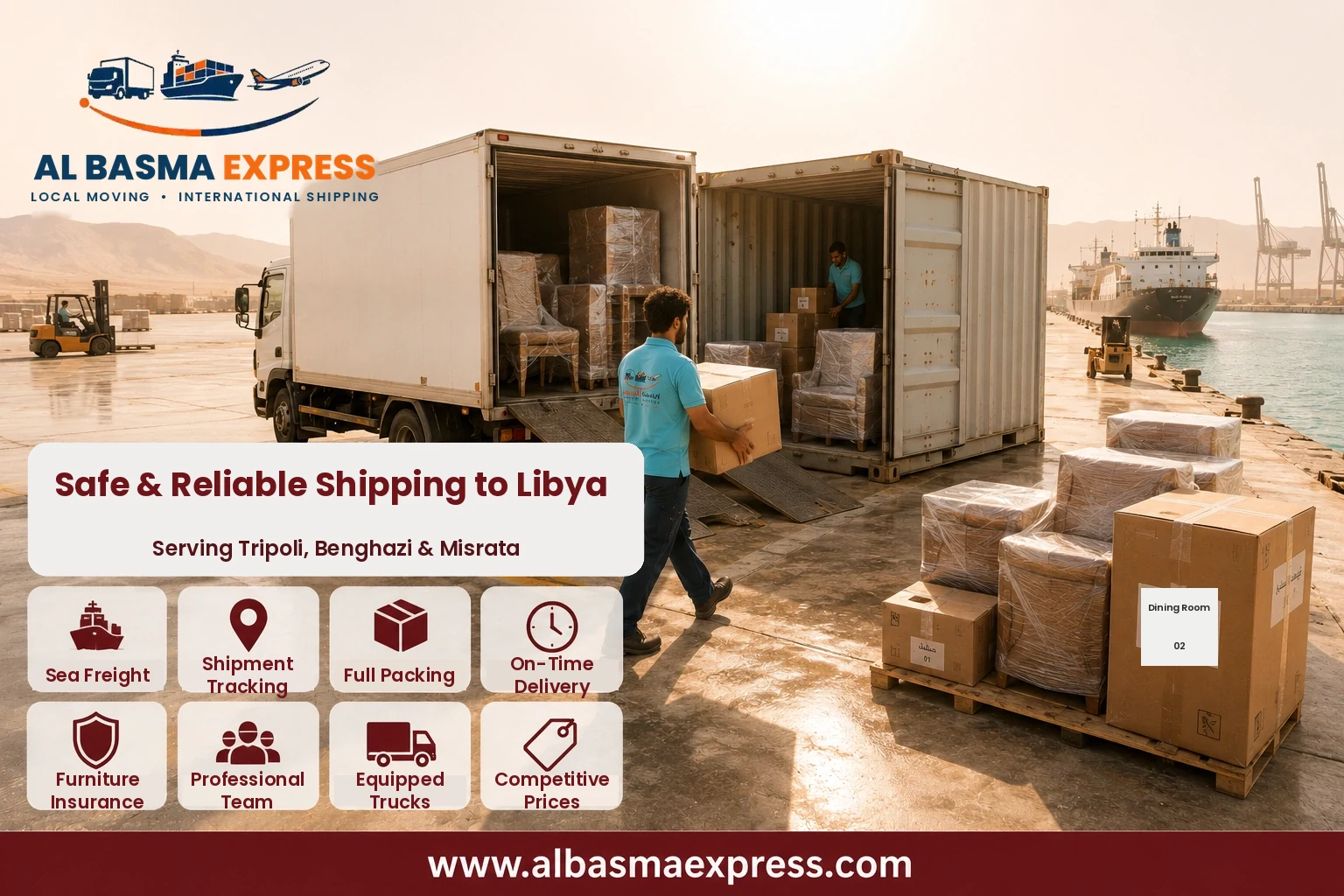
◆ “It’s arrived in Libya” doesn’t mean the shipment is at the customer’s door
There’s still a receipt, preparation and distribution stage that may vary by city and address, so the customer should know the end point of the service they’ve paid for.
The clearer the quote’s scope, the more accurately prices and schedules can be compared.
From Jeddah, Riyadh and Dammam to Libya: how does the Saudi stage change?
The first stage of the trip doesn’t start from “Saudi Arabia” as a general address, but from a home or company in a specific city. So the pickup point must be set before the service scope is calculated.
Shipping from Jeddah to Libya: starts with defining the furniture or goods, then disassembly, packing and inventory, after which the load is moved to the right shipping point according to the international service available. Being in Jeddah changes the inland stage compared with Riyadh or the Eastern Province, but it doesn’t remove the effect of the property type and volume.
Shipping from Riyadh to Libya: includes a land transport stage inside the Kingdom before the load enters the international part of the trip. So securing matters from the moment the furniture leaves the home, not just after reaching the shipping point.
Shipping from Dammam, Khobar and Dhahran: the consolidation route and suitable international service are chosen according to the type of load, volume and Libyan destination, with the road stage inside the Kingdom counted.
Shipping from Makkah: the furniture needs preparation inside the home, and dismantling large items may be useful before moving them to the shipping point.
Shipping from Madinah: the pickup and inland transport stage is part of the overall schedule, and the international stage’s time isn’t counted alone.
Shipping from Qassim and Hail: the pickup vehicle size and consolidation route are chosen according to the amount of furniture or goods, including whether the load needs an intermediate stage.
Shipping from Al Ahsa: furniture, cars, goods and equipment can be organized once the volume, weight and required Libyan city are set.
The floor, elevator and vehicle parking spot matter in every city. Two customers may have roughly the same international distance, but the pickup stage differs if one is in a villa and the other on a high floor.
West
Jeddah, Makkah and Madinah need pickup and preparation calculated and the load linked to the right shipping point.
Central
Riyadh and Qassim need an inland transport stage before the shipment enters the international trip.
Eastern Province
Dammam, Khobar and Al Ahsa are linked to the most suitable consolidation route according to the load and service.
Shipping cars to Libya: separate “the car’s status” from “the shipment’s status”
A car needs a different tracking system from furniture. The household shipment may be fully ready while the vehicle still needs procedures or different preparation, so the whole order shouldn’t be considered ready just because packing is finished.
The car’s process starts by recording its details and those of the owner and consignee, then photographing the exterior from several angles before pickup. The purpose of the photos is to document the existing visible condition.
Then running condition, tires, battery and any obvious leaks are checked. If the car doesn’t run, this must be stated before loading day, because handling it needs different equipment.
Personal belongings are taken out of the cabin and trunk, and the car isn’t used as extra space for storing household goods at random.
The regulatory and customs requirements in force for the vehicle’s status, the owner and the purpose of bringing it into Libya must also be reviewed before confirming shipping, because physically being able to move the car isn’t the only thing that determines whether the process can be completed.
Then the right transport method is chosen according to the operating route, and the car’s file stays separate from the list of cartons and furniture through to delivery.
On arrival, the exterior condition is compared with the available documents and photos before the delivery is completed.
▪ A car isn’t a big box inside the furniture shipment
The vehicle and household goods may be coordinated in one order, but each needs an inventory, documents, inspection and tracking that suit it.
Separating them administratively means any change to the car’s plan doesn’t disrupt the household data, and vice versa.
Goods to Libya: use the “void factor” before counting boxes
When shipping goods, there can be a big difference between the boxes’ theoretical space and the space they actually use inside the transport. The reason is the void created by packages that can’t be stacked or have irregular shapes.
So it isn’t enough to know the customer has fifty cartons. You need the dimensions of each group of packages, the weight, whether anything can be placed on top, and whether there are instructions about transport orientation.
If the boxes are strong, uniform and can be arranged neatly, space can be used very differently from packages that can’t take pressure or vary widely in size.
Palletized goods need each pallet’s length, width, height and weight recorded, along with whether they can be stacked and how they’re lifted.
The nature of the goods is also recorded in enough detail to set the handling method, rather than a general term like “assorted goods”.
The delivery location inside Libya must be known too. Goods heading to a warehouse in Misrata differ from an order being delivered to a shop in Tripoli, and an industrial site needing unloading equipment has different needs from an office.
Personal belongings and commercial goods must be kept separate if they’re combined in one order, so the contents lists don’t become unclear.
| Factor | The right question | Its effect on shipping |
|---|---|---|
| Dimensions | How much space does each package take? | Setting the space |
| Weight | What’s the individual and total weight? | Handling and distribution |
| Stacking | Can one package go on top of another? | Reducing voids |
| Destination | How will it be unloaded? | Choosing the distribution vehicle and equipment |
◆ The real volume of goods includes the space a package stops you using
A large box that can’t have anything placed on top may use more practical space than its outer size alone, which is why stackability is one of the most important data points in commercial shipping.
The more organized, uniform and able to bear suitable stacking the packages are, the more efficiently space can be used.
Shipping equipment: don’t count the equipment’s weight before setting the “handling weight”
You may have equipment that seems easy to move in theory because its weight is known, but weight alone doesn’t tell you how it will be lifted, where it will be secured or how it will leave the site.
So assessing equipment starts with individual weight, dimensions, lifting points and approximate center of gravity when it matters, and then how it will be loaded into the transport is set.
The space around the equipment at the pickup site is also reviewed: the site may be tight and not allow a certain forklift in, so the job needs a different arrangement.
If some parts of the equipment can be detached, it’s assessed whether detaching them helps reduce volume or makes lifting and securing safer.
Then attention turns to the Libyan site before loading: is there a forklift or crane? Is the entrance suitable? Can the floor bear the equipment’s movement? Can the vehicle get close to the unloading spot?
If handling equipment isn’t available, it’s arranged before the arrival date so a vehicle loaded with equipment that can’t be unloaded isn’t left waiting.
Accessories and detached parts are kept under a single code linked to the equipment, so the unit arrives complete at its final site.
▪ Every piece of equipment needs a “landing plan” before it gets a travel plan
Knowing how the equipment will be unloaded in Tripoli, Benghazi or Misrata before it leaves Saudi Arabia avoids choosing a vehicle or arrangement that doesn’t suit the final site.
With heavy equipment, the last ten minutes of the job can determine every decision of the trip.
Tripoli, Benghazi and Misrata: a distribution network, not a single destination
When requesting a price, the Libyan city must be specified, because the inland distance, type of property and nature of the area all factor into the distribution plan after arrival.
Tripoli: the area, neighborhood, floor, elevator and vehicle stopping point are specified. For offices or commercial sites, entry hours and the unloading location are confirmed.
Benghazi: the shipment needs a separate distribution plan according to the arrival point, service and address, and whether the destination is a home or business must be specified.
Misrata: furniture, goods and equipment can be moved to homes or warehouses, with attention to the site gate and unloading equipment for commercial shipments.
Zawiya: the property location, vehicle access and the assembly or lifting services required are set.
Al Khums: the city and property are part of the distribution stage, and the load reaching Libya isn’t treated as the final delivery date.
Zliten: furniture, parcels and goods can be delivered according to the address, the type of site and the service scope.
Al Bayda: a shipment heading east needs the inland distribution route built into the schedule and cost.
Tobruk: the city is specified from the start because of its location in eastern Libya and its different distribution stage from western cities.
Sirte: needs a delivery plan tied to the operating route, arrival point and type of property.
Sabha and southern cities: the inland distribution stage matters more because the destination is far from some entry points, so the city must be stated clearly in the assessment.
In every city, the assessment includes whether the shipment will be unloaded at the property entrance only or carried into the rooms with furniture reassembled as agreed.
West
Tripoli, Zawiya, Al Khums and Zliten need the address, property and distribution scope specified.
Central
Misrata and Sirte are affected by the entry point, operating route and type of consignee.
East and south
Benghazi, Al Bayda, Tobruk and Sabha need a separate inland stage counted in the schedule.
◆ Libya isn’t an address — the city and property are the service’s real address
Two shipments may be similar in volume, but their distribution stage can differ hugely if one is going to Tripoli and the other to Tobruk or Sabha.
Sending the city and location at the start of the order means the assessment includes the last part instead of it being added unexpectedly later.
GPS and tracking: turn the trip into a “stage board”
On a multi-method trip it isn’t practical for the customer to expect a single location marker staying with the shipment from their home in Saudi Arabia to Libya. So tracking is more useful when it’s divided into clear stages.
Stage one: survey and preparation. The customer knows the order’s volume and services are set and that packing materials and the crew have been arranged.
Stage two: pickup. Units are loaded and secured, and GPS can be used for the land vehicle’s movement depending on the service.
Stage three: reaching the shipping point. Here the focus of tracking shifts from the pickup vehicle’s location to the load’s status.
Stage four: international transport. The shipment’s status is updated according to the service used and the operating stages.
Stage five: arrival in Libya. Receipt, handling and preparation for distribution begin.
Stage six: land distribution. GPS tracking of the land vehicle comes back to the fore when the load heads out to the final city and property.
Stage seven: delivery. Matching, unloading and assembly take place as agreed.
This way “tracking” doesn’t just mean watching a moving dot, but knowing what has been done and what’s still to come.
▪ The customer needs to know the next stage more than the vehicle’s speed
Knowing the shipment is out for distribution means the home and consignee need to get ready, while knowing the vehicle’s speed alone doesn’t help make a practical decision.
That’s why order status works alongside GPS in the stages where land tracking is available.
The price of shipping to Libya: use the “six keys” model instead of looking for a ready-made number
No fixed number can be given for all shipments from Saudi Arabia to Libya, because every order is made up of a different mix of elements. Even so, the price can be understood through six clear keys.
Key one: volume. Sets how much space the furniture and cartons need after disassembly and packing.
Key two: weight. Its effect shows most with equipment, goods, parcels and air freight.
Key three: pickup city. Pickup from Jeddah isn’t the same as pickup from Riyadh or Dammam — the local transport stage is different.
Key four: the Libyan city. Tripoli, Benghazi, Misrata and Sabha have different distribution stages.
Key five: service level. Does the customer want full packing? Disassembly and assembly? Is there storage or lifting? Is delivery into the home or to another point?
Key six: type of contents. A home full of glass and antiques needs different work from a load of cartons, and a car or equipment adds a separate file.
These keys also explain how to save. Reducing unnecessary items cuts volume, finishing sorting cuts working time, and sending an exact address avoids uncounted services.
Lowering the packing quality of a sensitive item isn’t the best place to look for savings, because that item exists to protect something the customer wants to keep in the first place.
| Price key | Factors | What does the customer send? |
|---|---|---|
| Volume | Furniture, cartons and appliances | Photos or a survey |
| Weight | Goods, equipment and parcels | Weight data when available |
| Pickup | City, property and elevator | Address and building information |
| Destination | City, distance and distribution | The final Libyan location |
| Preparation | Disassembly, packing and assembly | The services required |
| Special files | Car, equipment or storage | Details for each category |
Temporary storage in “ready to leave” mode
The customer’s home in Libya may not be ready when the furniture leaves Saudi Arabia, and the home or office lease may end before the new delivery date. In that case temporary storage can be built into the plan when needed.
But good storage doesn’t mean putting everything in a closed space and thinking about order later. It’s better for the shipment to enter storage ready to come out again without new sorting.
Room codes stay on the cartons, dismantled furniture parts stay with their fittings, sensitive units remain identified, and priority boxes are placed where they can be reached.
Appliances must also be dry and prepared before storage, upholstery protected, and cartons well sealed and free of materials unsuitable for staying inside packages.
If the customer might need some contents before the whole load comes out, an “early arrival” zone can be created within the storage arrangement.
When the property is ready, the shipment comes out in distribution order, not in a random order resulting from where it sat in the warehouse.
◆ The best storage doesn’t add a new sorting stage to the trip
If the load goes in organized by room, number and priority, it must come out in the same order so it can go straight onto the distribution vehicle.
Keeping the inventory intact reduces handling and makes the warehouse a waiting stop rather than a new start to the process.
How do you prepare a “first-day box” for Libya?
One of the most frustrating mistakes after arrival is putting essential things in boxes whose numbers or locations the customer doesn’t know. So a clear set for use in the first hours and days can be created.
The set can include some clothes, bedding, basic kitchen tools, some work supplies and the things the customer needs right after entering the home.
These boxes are clearly marked and linked to rooms, such as “Priority 1 – Master bedroom” or “Priority 1 – Kitchen”.
That doesn’t mean putting all important things in one heavy box — they can be split into several small units that are easy to carry and reach.
Original documents, money, jewelry and medicines the customer needs continuously shouldn’t be treated as part of the first-day box inside the household goods — they’re handled according to their nature and kept with their owner when that’s most appropriate.
If there’s a real reason for some parcels to arrive before the main load, sending part of this set by air within 24–48 hours can be assessed depending on the contents and service.
The value of this system shows in storage too: priority boxes can be placed nearby instead of buried behind wardrobes and appliances.
Arrival night
- Bedding.
- Essential clothes.
- Personal items.
The first kitchen
- A few tools.
- Daily supplies.
- What you need before opening the rest of the boxes.
Work
- Work tools.
- Essential accessories.
- Devices suitable for shipping when needed.
The last 72 hours in Saudi Arabia: stop adding things and start closing files
Three days before the moving date, there shouldn’t be a new shopping trip adding things to the shipment or reopening decisions already made. This period is for closing the files that let moving day go smoothly.
The load file: the list of what will be shipped should be as final as possible, with items staying behind separated from the work area.
The personal items file: passports, documents, money, medicines and bags traveling with the customer go in a separate place outside the packing.
The appliances file: fridges are emptied, washing machines dried, appliances prepared and parts that need securing detached.
The electronics file: connections are photographed before dismantling computers and TVs, and cables and accessories are kept with the right device.
The building file: the truck position, elevator, entry time and any property management instructions are confirmed.
The car file: if it’s part of the order, personal belongings are removed and its details and photos completed.
The Libya file: the consignee’s name, phone number, city, area, location, floor and elevator or warehouse information are confirmed.
If these files are closed before the date, moving day is for disassembly, packing, inventory and loading, instead of waiting for the customer to decide the fate of each item.
Delivery day: follow “one path” for every item
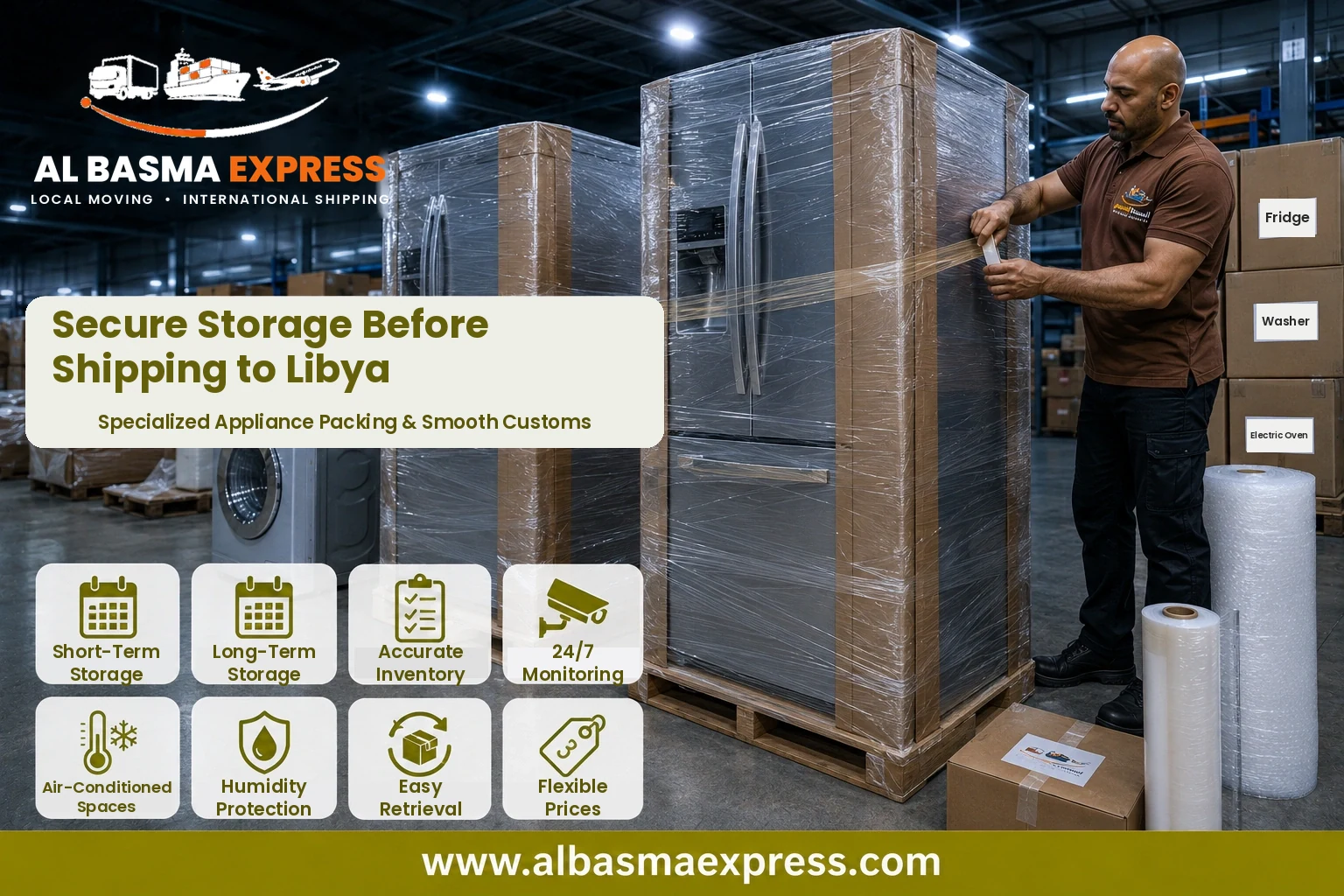
Every time an item is moved inside the home after unloading is extra handling that could have been avoided if its place was known. So the goal of delivery is for each unit to go from the distribution vehicle to its final place by the shortest path possible.
The process starts by checking the inventory as the load comes out. Large furniture, appliances, mirrors and sensitive items are inspected and then directed to their places.
Large furniture goes in before the rooms fill with cartons. Beds, wardrobes, tables and sofas need open corridors to move and be assembled.
If assembly is part of the agreement, all the item’s parts and fittings are gathered and its final position confirmed before the technician starts.
Then boxes move according to room names. A box meant for the kitchen isn’t left in the living room for the customer to move later.
Priority boxes are opened first, while books, décor and seasonal contents can wait until the main living areas are set up.
If there’s more than one delivery point, each address’s units must be separated before the distribution vehicle sets off, so the consignee’s door doesn’t turn into a sorting station.
◆ The goal isn’t the fastest truck unloading — it’s the least movement inside the home
Unloading dozens of cartons into the living room may seem fast, but it shifts the work onto the customer and creates a second stage inside the home.
When every box carries its room name, it can go straight from the door to its final place.
Why Al Basma Express for the Saudi Arabia–Libya route?
Shipping to Libya needs organization that links multiple stages instead of treating each one in isolation. Packing depends on the transport type, the transport type depends on the load volume, distribution depends on the city, and the city and property affect how some furniture is prepared from the start.
Al Basma Express starts with a free survey, listing the load and identifying the items that need disassembly and the level of protection, then prepares the inventory and distributes the contents according to their nature.
The service covers home and office furniture, appliances, cars, goods, equipment and parcels, with the option of creating more than one file within the order so each category gets the right method.
Suitable air services are available within 24–48 hours for parcels and suitable shipments that need speed, while suitable land services and stages can fall within 2–5 days depending on the city and service scope. The sea schedule is set according to the operating route, sailing dates and actual handling and clearance.
GPS tracking also helps in the land stages, and order status updates show the load moving from pickup and preparation to international transport, then arrival and distribution.
The price is set according to volume, weight, starting city, Libyan city, transport method, level of packing, disassembly and assembly, storage, lifting, the property, car, equipment and any extra service.
Delivery can be organized to Tripoli, Benghazi, Misrata, Zawiya, Al Khums, Zliten, Sirte, Al Bayda, Tobruk, Sabha and other cities according to the operating route and final address.
To arrange a survey, call +966553923364 or visit the official Al Basma Express website and send your load details.
Frequently asked questions about shipping from Saudi Arabia to Libya
What’s the best way to ship furniture from Saudi Arabia to Libya?
It depends on the furniture volume, starting city, destination and time required. Sea solutions can be assessed for large household loads, while air usually suits parcels and suitable shipments that need speed.
How long does air freight from Saudi Arabia to Libya take?
Air freight for suitable shipments takes 24 to 48 hours depending on the flight, content acceptance and handling stages, and a door-to-door service may need extra time for pickup, preparation and local distribution.
Does sea freight to Libya have a fixed transit time?
It’s best not to set one duration for all sea shipments: the schedule is affected by the available service, sailing dates, handling, clearance, arrival point and final Libyan city.
Can a whole household be shipped to Tripoli or Benghazi?
A full household move can be organized after a survey and listing of furniture, appliances and cartons, then what needs disassembly and packing is set and the right transport and distribution method to the final address chosen.
Does Al Basma Express offer a free survey before the price is set?
The free survey helps establish the shipment’s volume after preparation, the number of sensitive items, disassembly and packing requirements, the difficulty of the pickup site and the services required before the quote is prepared.
Can a car be shipped from Saudi Arabia to Libya?
Vehicle shipping can be assessed according to the available service, with the car photographed, its data managed separately, and the regulatory and customs requirements in force for the case reviewed before confirming the booking.
What’s the best packing for household goods going to Libya?
It depends on the item: protective blankets, bubble wrap, reinforced cartons, corner guards, padding and covers can be used, with more rigid reinforcement or suitable crates for some sensitive items when needed.
Can the shipment be tracked by GPS?
GPS tracking helps in the land transport stages, alongside order status updates during preparation, international transport, arrival in Libya and dispatch to the distribution stage.
How is the price of shipping from Saudi Arabia to Libya determined?
The price depends on volume, weight, type of load, pickup city, Libyan city, transport method, level of packing, disassembly and assembly, storage, lifting, the type of property and any additional car or equipment.
Can goods and equipment be shipped from Saudi Arabia to Libya?
Permitted goods and equipment can be assessed once the type, quantity, dimensions, weights, packing method, stackability, lifting points and delivery location are known — then the right shipping and handling method is chosen.
Does the service reach Misrata, Zawiya, Tobruk and Sabha?
Delivery can be organized to Tripoli, Benghazi, Misrata, Zawiya, Al Khums, Zliten, Sirte, Al Bayda, Tobruk, Sabha and other cities according to the operating route, address and accessibility.
How do I start booking shipping to Libya?
Call +966553923364 and send your pickup city, Libyan city, type of load and photos or a rough contents list — then the survey is arranged and the right transport method set.
From Saudi Arabia to Libya: don’t just ship things — ship their arrival plan with them
The difference between a load that arrived and a load that was delivered in an organized way shows in the details decided before the trip began. Does every box know its room? Are the screws linked to their furniture? Does the car have its own file? Has the Libyan city been specified? Does the customer know when to prepare the property?
Every clear answer removes a decision that would otherwise have to be made on the road or after arrival. That’s why good service starts before the vehicle moves and continues until the last item is in place.
The free survey helps define the load and filter out unnecessary things, then disassembly, packing and inventory set the shipment’s final form. After that the right method is chosen for the furniture, parcels, vehicles or goods and equipment.
Suitable air services take 24–48 hours for shipments that benefit from speed, suitable land stages and services can take 2–5 days depending on the city and service scope, and the sea stage is set according to the operating route and actual booking.
GPS tracking and order status updates also connect the pickup, international transport and distribution stages, so the customer knows where the order has reached and what the next step is.
Whether the destination is Tripoli, Benghazi, Misrata, Zawiya, Sirte, Tobruk or Sabha, sending the final address from the start lets the trip be built all the way to the consignee’s door instead of treating international arrival as its end.
Contact Al Basma Express on +966553923364 to send your shipment details, arrange a survey and choose the right packing, disassembly, transport and distribution services.