
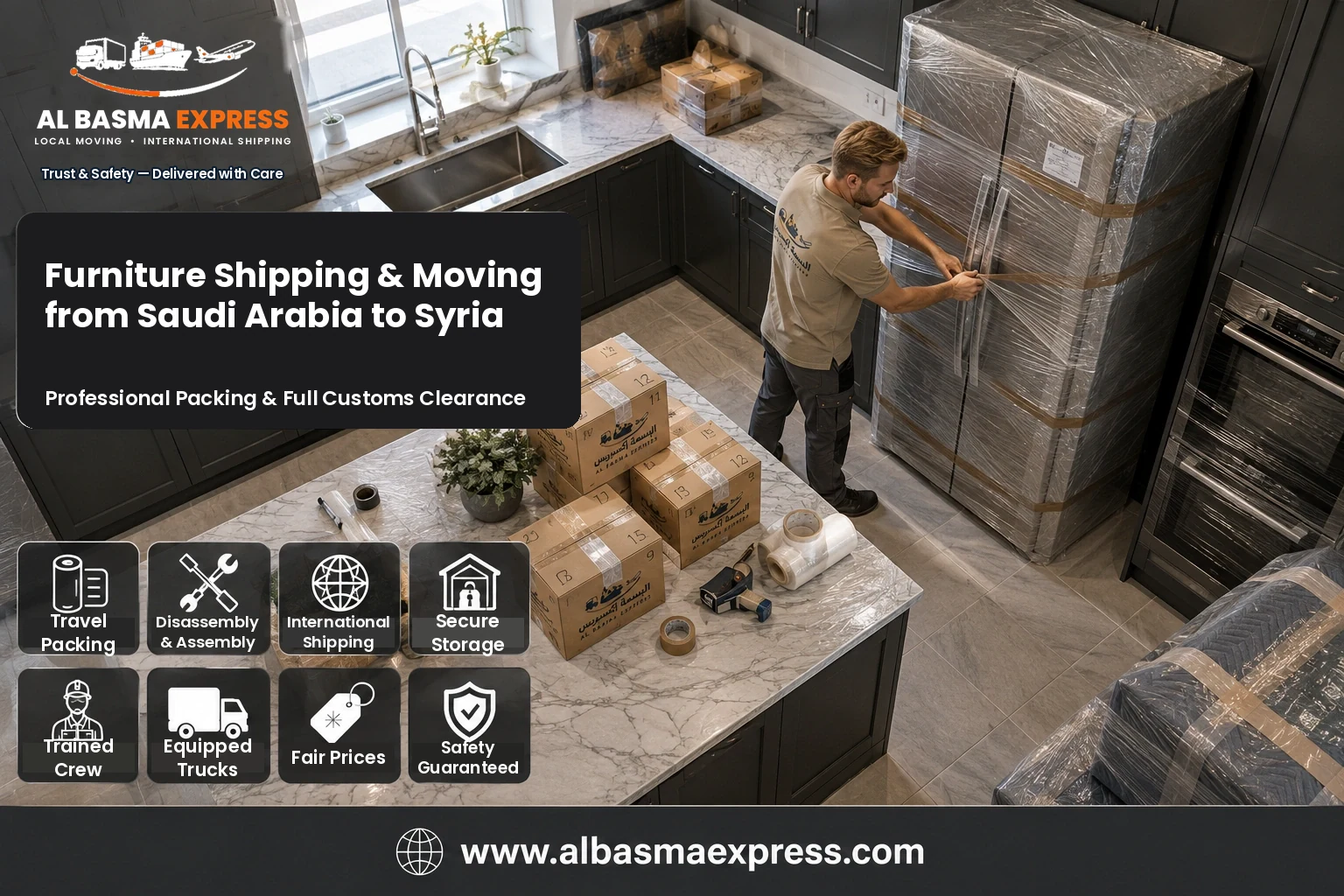
There are two ways to handle a shipment from Saudi Arabia to Syria. In the first, the customer treats everything in the home as one load, starts looking for a vehicle to move it, and then tries to solve packing, inventory, documents, crossing and delivery problems as they come up. The second starts the other way round: first deciding what’s worth shipping, then separating furniture from cars, goods, equipment and parcels, and then choosing packing, the transport plan and the crossing route according to each category. The difference between the two isn’t the truck, but how much organization happens before the shipment moves.
Guide sections42 topicsShowHide
Al Basma Express uses the second approach in its service as a shipping company from Saudi Arabia to Syria for individuals, families and business owners, with solutions for household goods, home and office furniture, appliances, cars, goods, equipment and parcels, pickup from Riyadh, Jeddah, Dammam, Khobar, Al Ahsa, Makkah, Madinah, Qassim, Hail and other cities, and delivery coordinated to Damascus, Aleppo, Homs, Hama, Latakia, Tartus, Daraa, As-Suwayda and other areas in Syria depending on the operating route and the final address.
This trip differs from short Gulf shipping routes: land transport may rely on an international route through Jordan and then into Syria, according to the road available at the time. One of the routes commonly used for shipments from the Kingdom passes through Al Haditha, then Jordanian territory toward Jaber–Nassib before entering Syria — and the actual route, procedures and crossings must be reviewed at booking rather than relying on outdated information.
Suitable land freight services take 2 to 5 days for the stages and services this range applies to, with the final time tied to the origin city, the transit route, crossing procedures and the Syrian city required. Air freight for suitable and urgent shipments takes 24 to 48 hours depending on the flight, content acceptance and handling stages, with possible extra time for pickup, clearance or distribution.
The cost doesn’t follow a fixed price: moving ten boxes from Riyadh to Damascus is nothing like moving a whole home from Jeddah to Aleppo, and a car, heavy equipment or a commercial shipment each have a different model. So the price is calculated according to volume, weight, type of load, transport method, packing, disassembly and assembly, pickup point, Syrian city, property location and extra services.
The service starts with a free survey that establishes the real volume after the furniture is prepared, identifies what needs disassembly and sets the level of protection for glass, wood and appliances, with GPS tracking for the land stages and shipment status updates during the trip. Call +966553923364 to send your order details and arrange a survey.
Comparison one: manage the shipment yourself, or manage it as an integrated operation?
An international move differs from moving furniture within a city, because any small problem at the start can stay with the shipment through several stages. Comparing the do-it-yourself approach with integrated management helps show the value of planning.
With self-management, the customer may look for someone to dismantle, then buy packing materials, then find a vehicle — and after that they need to know what to record, how to coordinate delivery in Syria, and who’s responsible if the date or route changes.
With integrated management, the process starts from a single shipment file. The contents list is defined and the services agreed, then disassembly, packing, loading, inventory, tracking and delivery follow as a connected chain.
The main advantage of the second approach isn’t that the customer does nothing, but that their role becomes clear. They decide what to ship, provide correct data and prepare the things that will stay with them, while the logistics work is managed according to the plan.
This matters especially when the shipment includes more than one category. A whole home with a car, for example, shouldn’t become one random file: the furniture has an inventory, the car has an inspection and documents, the goods have a description and weight, and the equipment has lifting points.
| Point | Separate management | Integrated management |
|---|---|---|
| Disassembly and packing | Coordinated separately | Linked to the shipping plan |
| Inventory | May start after packing | Starts before packages are sealed |
| Tracking | Across several parties | Within one order status |
| Delivery | Arranged later | Planned from the start |
◆ Every extra party in the trip needs an extra point of coordination
If disassembly is with one party, packing with a second, transport with a third and delivery with a fourth, the customer may need to explain the load details four times.
When the inventory, addresses and services work under one plan, each stage is built on the information recorded in the previous one.
The free survey isn’t just measuring cubic meters
A good survey doesn’t end at “how many items do you have?” Its purpose is to understand the movement itself. You may have little furniture that’s very delicate, or lots of easy cartons that need no complex work.
The survey starts with disassembly: identifying wardrobes, beds, tables and desks that can benefit from dismantling, and items that shouldn’t be dismantled because they’re more stable whole.
Then protection is checked. Mirrors, glass, TVs, glossy wood and marble are marked as more sensitive, while majlis seating and upholstery need protection from friction and dust more than from pressure.
Next comes ease of movement inside the property: doors, corridors, elevator and stairs are checked. An item may be of normal weight but have a shape that makes turning it in a narrow corridor difficult, which calls for removing part of it.
The vehicle position is also considered. If the truck can park beside the entrance, the work differs from a building that requires carrying items a distance or using an internal trolley.
At the end of the survey, all this is linked to the destination city. Moving furniture to a detached house in Homs differs from an apartment in Damascus or an address inside a building that may be harder to access.
Volume to be shipped
Not the size of the home, but the size of the furniture and packages after disassembly and packing.
Difficulty of getting it out
Doors, elevators, corners and vehicle position before loading.
Sensitivity of what travels
Glass, appliances, wood and surfaces that need special handling.
▪ A real survey reduces guesswork in the quote
The more the quote relies on information about volume, packing, property and destination, the less the assessment depends on a general phrase like “two-bedroom home” or “medium furniture”.
That’s why the free survey is useful even for a customer who hasn’t yet decided which shipping method to choose.
Packing furniture by “tolerance level” instead of room type
Not everything in a bedroom needs the same protection, and not everything in the kitchen is fragile. So packing can be divided more practically according to how well each item tolerates impacts, pressure and movement.
Level one: items that tolerate normal handling. These include some clothes, soft furnishings and unbreakable items. They need clean, sealed packages that prevent dirt and scattering more than heavy reinforcement.
Level two: items prone to scratches. Such as polished wood, some metals and painted furniture. They need separating layers, blankets and edge guards to prevent direct friction.
Level three: items prone to breakage. Mirrors, glass, antiques and some décor. They need padding, shock-absorbing layers and reinforcement that stops movement inside the package.
Level four: pressure-sensitive devices. TVs, computers and some electronics. They need front protection, nothing stacked on top and a suitable position inside the vehicle.
Level five: equipment or heavy items. These don’t just need packing, but a base, loading and securing suited to their weight and center of gravity.
Materials used across these levels include protective blankets, bubble wrap, reinforced cartons, corner guards, padding and outer wrapping, with rigid or wooden crates for items that need extra protection.
◆ Packing that works inside the home can fail if the item’s position in the vehicle changes
External protection can’t be separated from how items are arranged and strapped: a well-wrapped mirror shouldn’t bear the weight of a heavy wardrobe, and a TV shouldn’t be used to fill a gap in a stack of boxes.
That’s why the packing plan extends to choosing each item’s position in the load and using suitable barriers and straps.
Dismantling furniture: when does it save space, and when does it add risk?
Disassembly has two clear benefits: making it easier to get the item out of the property and reducing its size in transit. But it isn’t always the best option — some furniture becomes less stable once it’s turned into many parts.
Before dismantling, the door, corridor and elevator are measured and the way the furniture is built is examined. If removing the legs is enough, there’s no need to dismantle the rest. If a wardrobe is designed for assembly and disassembly, it can be turned into panels in a more organized way.
Each dismantled part gets a number linked to the original item. If there’s a large set of screws and hinges, they go in a bag carrying the same code rather than mixing the fittings of several items together.
A photo of the item can be taken before disassembly, especially for modular furniture, bookcases and desks with many parts. This photo helps the technician in Syria rearrange the parts faster.
Dismantled panels must be treated as surfaces sensitive to friction. Being smaller doesn’t mean they need less protection — polished wood can scratch if two panels are laid directly on top of each other.
On arrival in Damascus, Aleppo or another city, the room is decided before assembly starts, so moving a fully assembled item from one room to another doesn’t become extra work.
How is the land route from Saudi Arabia to Syria built?
The route plan to Syria must be built on the route available when the shipment is carried out. Some operating routes leave Saudi Arabia through Al Haditha, cross Jordan and reach Jaber–Nassib before entering Syria — a route that must be confirmed at the time of booking.
But the customer doesn’t need to memorize the name of every point to get a good service. What matters is knowing that the trip passes through several international stages, so the shipment data, documents and inventory must match from the start.
If the shipment starts in Jeddah, there’s a long stage inside Saudi Arabia before reaching the north of the Kingdom. From Riyadh the domestic distance differs, and from northern cities the start of the route is closer to the crossing points in some cases.
After entering Syria, the trip continues to the final destination. Reaching the Syrian border isn’t the same as reaching Damascus, Aleppo, Latakia or Homs, so the domestic distribution stage is built into the schedule.
A 2 to 5 day range is used for suitable land transport services and stages under the plan, with the actual duration confirmed once the route, load, transit procedures and destination are set.
| Stage | What happens? | What needs to be ready? |
|---|---|---|
| Pickup | Inventory, disassembly and packing | A final load list |
| Inside Saudi Arabia | Land road to the crossing route | Proper securing of the load |
| Transit | Passing through international points | Matching data and documents |
| Entering Syria | Completing entry procedures | Consignee and destination details |
| Distribution | Reaching the city and the property | Preparing the delivery and the site |
▪ Don’t rely on an old map of the shipping route
Transit routes, crossings and procedures can change, so the operating route available must be confirmed at the time of booking.
What must stay constant on the customer’s side is accurate data about the contents, the sender and the consignee.
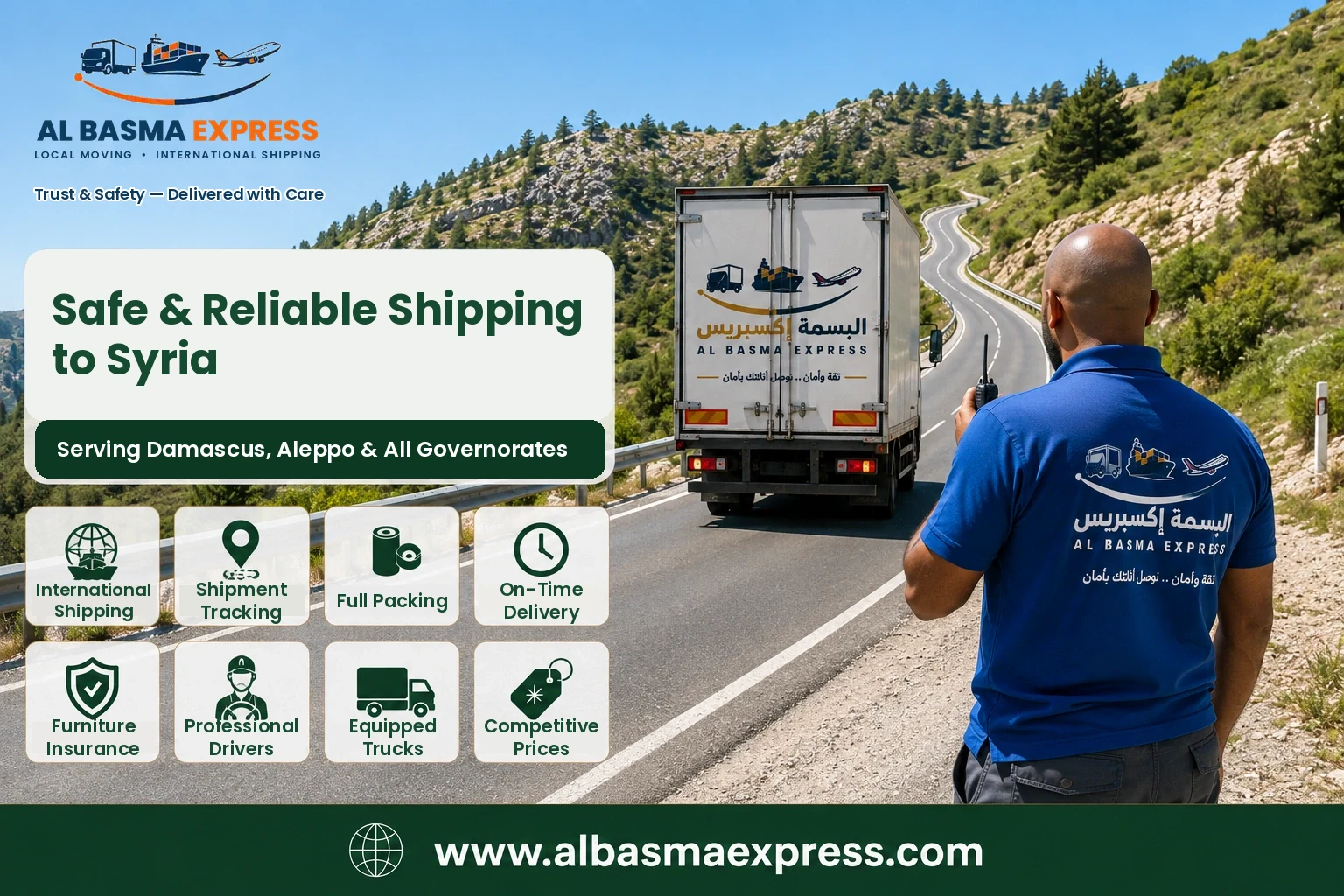
Air freight to Syria in 24–48 hours: separating urgent needs from the large load
If a customer is moving a whole home, it isn’t necessary for everything to arrive on the same day. Some things can wait, while others are needed on arrival. This is where dividing the load into “main” and “urgent” becomes more efficient.
Suitable air freight services take 24 to 48 hours depending on the flight, the nature of the contents, shipment acceptance and handling. This may suit some parcels or limited-size items that need more speed.
It’s important to measure weight and dimensions together: a bulky parcel may be light but take up significant air cargo space, which is why volumetric weight is assessed alongside actual weight.
Work tools, some clothes or permitted small devices can be separated from the main furniture, while large furniture travels by the method that suits its volume.
Passports, money, jewelry, essential medicines and original documents are best not included in the furniture shipment at all, but kept with the customer according to their nature.
★ You don’t have to choose land or air for everything
The ideal plan may be land for large furniture and air for a limited number of urgent parcels, rather than forcing everything in the home onto one method.
This balances time and volume better for each category.
The origin city inside Saudi Arabia changes half the trip
The word “Saudi Arabia” describes a whole country, but it isn’t enough to set a cost, a date or a transport route. The difference between Jeddah, Riyadh, Hail and Dammam is large in terms of domestic distance before reaching the international route.
Riyadh: home and office furniture, cars and goods can be moved from the capital, then set off along the available international shipping route. The survey is especially important for large homes or towers.
Jeddah: the shipment needs a stage inside the Kingdom before reaching the crossing route, so packing shouldn’t be treated as short-term protection but as part of a full international trip.
Dammam, Khobar and Dhahran: the shipment starts in the Eastern Province, but that doesn’t mean the schedule should resemble Gulf destinations — there are still other international stages before Syria.
Hail, Al Jouf and northern cities: the start of the route differs because of the location, and some road stages inside the Kingdom may be shorter than from the west, but transit and the final destination remain the key factors.
Makkah and Madinah: the local stage and preparation must be calculated before the load enters the international road.
Qassim: the route is set according to the pickup location, the nature of the load and the vehicle, and a shipping quote from another city isn’t used as a fixed model.
Al Ahsa: furniture, goods, cars and equipment can be arranged once the volume, weight, Syrian destination and required services are known.
West
Requires calculating a longer domestic land stage before international transit begins.
Central
The route is set by the city, the type of load and the plan available at the time.
North and east
Proximity to part of the route doesn’t remove crossing procedures and final distribution.
Shipping cars from Saudi Arabia to Syria: don’t let household goods hide inside the vehicle
When moving a car at the same time as the furniture, the cabin and trunk may look like tempting extra space for cartons or appliances, but this makes the file less clear and mixes the vehicle shipment with the household shipment.
It’s better for the car to start on its own: its data and the owner’s and consignee’s details are recorded, its exterior condition is photographed, and then running condition, tires, battery and any visible leaks are checked.
If the car doesn’t run, this must be stated before moving day, because loading it differs from a vehicle that can be driven onto the carrier.
Personal belongings, devices and documents are removed from the cabin, and it’s best not to use the car as unrecorded storage for belongings.
The regulatory requirements and documents in force at the time of shipping are also reviewed according to the vehicle, the owner and the purpose of the move, and an old experience or a different case shouldn’t be relied on.
On arrival in Syria, the visible condition is compared with the documentation, with the vehicle’s photos and file kept separate from the furniture inventory.
Shipping goods to Syria: start from how they’ll be stored in the vehicle
In commercial shipping, knowing the product name isn’t enough. The way packages will be stacked in the vehicle can affect the choice of space more than the type of product.
You need to know the number of packages, their dimensions, individual and total weight when needed, whether some can be placed on top of others, and whether there are instructions such as “this way up” or “keep upright”.
If the goods are on pallets, the dimensions and weight of each pallet and its lifting method are recorded. If they’re in separate boxes, their ability to be grouped and stacked is specified.
The delivery location in Syria must also be known. Goods heading to a shop in Damascus are unloaded differently from a load heading to a warehouse on the city’s outskirts or a facility in Aleppo.
Goods must be described correctly and not combined with personal furniture under a general description, so each category can be handled according to its nature and related documents.
◆ Three boxes may need more space than ten
If the three packages are large and nothing can be placed on top, they may take up more vehicle space than ten small stackable boxes.
That’s why commercial shipping isn’t assessed by the number of units alone, but by weight, dimensions and storage method.
Equipment: do you know how it will leave your site and how it will be unloaded in Syria?
Heavy or medium equipment needs both movements planned at the same time: leaving the pickup site and arriving at the delivery site. It isn’t enough to prepare a crane in Saudi Arabia and then find that the Syrian site has no way to unload.
The individual weight of each piece, its dimensions, lifting points, correct transport orientation and center of gravity, if it matters for handling, are recorded.
If the equipment has detachable parts, it’s decided whether separating them reduces volume or makes securing easier, with the parts and accessories given the same code in the inventory.
It’s also confirmed that straps and barriers secure the equipment from suitable points and don’t press on parts not designed to bear loads.
In Syria, a crane or handling equipment is arranged before the arrival date if the site doesn’t have what’s needed. This step avoids the vehicle waiting with a load that can’t be unloaded.
Damascus, Aleppo, Homs and Latakia: the delivery route changes with the city
Arriving in Syria marks the start of the final stage, not its end. The city, area and property must be known before the shipment moves, so the domestic part can be coordinated.
Damascus: household and office shipments need a clear address, the floor, the elevator and where the vehicle can get close to the building.
Aleppo: furniture, goods and parcels can be delivered according to the type of delivery site — whether a home, a warehouse or a business.
Homs: the area, property and required assembly or unloading service are set before the shipment goes out for distribution.
Hama: the domestic distribution stage is built into the schedule, making sure the consignee is present and the vehicle can reach the site.
Latakia: furniture, cars and goods can be coordinated according to the operating route and final address, taking into account the domestic distance from the entry point.
Tartus: the shipment needs the type of site and receiving time specified, especially if it’s commercial or equipment.
Daraa: delivery is coordinated according to the operating route, the address and the procedures available at the time.
As-Suwayda: the exact location is important for setting the final stage and the right type of distribution vehicle.
City apartment
- Floor.
- Elevator.
- Vehicle position.
Detached house
- Entrance.
- Distribution rooms.
- Assembly service.
Warehouse
- Gate.
- Receiving time.
- Unloading equipment.
▪ The city name sets the road, but the property type sets the last hour of work
Two buildings in Damascus can differ radically in how easy unloading is if one has a wide elevator and the other requires using the stairs.
That’s why property details are part of the delivery plan, not a detail left until the driver arrives.
GPS tracking: don’t just watch the road — watch “how complete the trip is”
When the trip passes through more than one country and stage, watching the vehicle’s dot alone becomes less useful. The location must be linked to how complete the operation is in operational terms.
The status starts with pickup, then preparation, then departure on the land trip, followed by the transit stage, then entry into Syria, and finally distribution and delivery.
GPS tracking helps follow the vehicle’s movement in the land stages, while status updates explain whether a stop is part of a procedure, a wait or a move to another stage.
When the shipment enters the distribution stage, it’s time for the consignee to prepare the property or warehouse — rather than preparing everything from the moment it leaves Saudi Arabia.
Tracking is also useful if the order contains a car and furniture moving under different arrangements: the status of each category must be known rather than assuming the whole order is in the same place.
◆ Tracking isn’t a race to see how fast the driver is going
The goal is for the customer to know the order’s stage and what they need to do next — not to monitor the vehicle’s speed moment by moment.
Every useful update should bring the customer closer to a decision: wait, prepare or receive.
The cost of shipping to Syria: five layers instead of one number
The price is easier to understand when it’s split into five layers. This helps the customer see where they can reduce costs without lowering the quality of protection.
Layer one: load volume. The more space the furniture and cartons take up, the more vehicle space the order needs.
Layer two: weight. Its effect shows clearly with equipment, goods, parcels and air freight.
Layer three: preparation. The number of items that need disassembly, special packing, extra crates and technicians.
Layer four: the route. The origin city inside Saudi Arabia, the transit route and the final Syrian city.
Layer five: the pickup and delivery sites. The floor, elevator, vehicle position, carrying distance and assembly or lifting service.
If the customer wants to reduce costs, the most logical step is to drop things not worth moving, then choose only the services they really need. Dropping the protection for an important mirror or TV might cut a small item from the bill, but it raises the risk to something they want to keep.
| Price layer | What does it include? | How do you control it? |
|---|---|---|
| Volume | Furniture and cartons | Leaving out what isn’t needed |
| Weight | Equipment, goods and parcels | Providing accurate data |
| Preparation | Disassembly, packing and crates | Protection as needed |
| Route | City, route and destination | Specifying addresses early |
| Property | Stairs, elevator and lifting | Sending site information |
Temporary storage: separating the property date from the shipment date
The home in Syria may not be ready when you have to vacate your home in Saudi Arabia, or a company may need to move its equipment before receiving its warehouse. In that case temporary storage means the shipment’s departure date doesn’t have to be tied to when the final site is ready.
If storage is expected from the start, cartons, appliances and upholstery are prepared to withstand staying sealed for an extra period.
Appliances are dried thoroughly, cartons sealed tightly, clear labels used that don’t disappear during stacking, and dismantled parts stay linked to their codes.
The order of things the customer may need first is also considered, so priority boxes aren’t placed behind heavy furniture that makes them hard to reach.
When the property in Syria is ready, the units are checked before leaving storage and then loaded according to the final distribution order.
▪ Storage shouldn’t start a new inventory
The number a box left the home in Saudi Arabia with must stay with it in storage and then in the Syrian home.
That keeps the shipment’s identity intact and avoids a full re-sort before distribution.
Three days before the move: use the rule “nothing without a decision”
Before the moving crew arrives, nothing should be left in the home that the customer hasn’t decided whether to ship or leave. Every undecided item can change the inventory, volume and vehicle layout at the last minute.
First, an area is created for the things staying with the customer: passports, documents, money, medicines, personal devices and the bags traveling with them.
Then wardrobes and drawers are emptied, fridge and freezer contents used up, and appliances prepared for drying and disconnecting.
The connections of computers, TVs and electronics are photographed, then wires, remotes and accessories are gathered with their own device.
The building is also reviewed: elevator times, truck position, the route the furniture will take out, and any property management instructions.
In Syria, the consignee’s details must be complete: name, phone number, city, area, location, floor, elevator and type of entrance.
That way moving day becomes a day of execution only, not of sorting and making decisions.
◆ The box that causes the most confusion is the one the customer hasn’t decided whether to ship at all
Settling decisions before moving day makes the load list final and prevents the space changing after loading has started.
It also lets the crew arrange the vehicle based on an actual number of units instead of an estimate that shifts during the job.
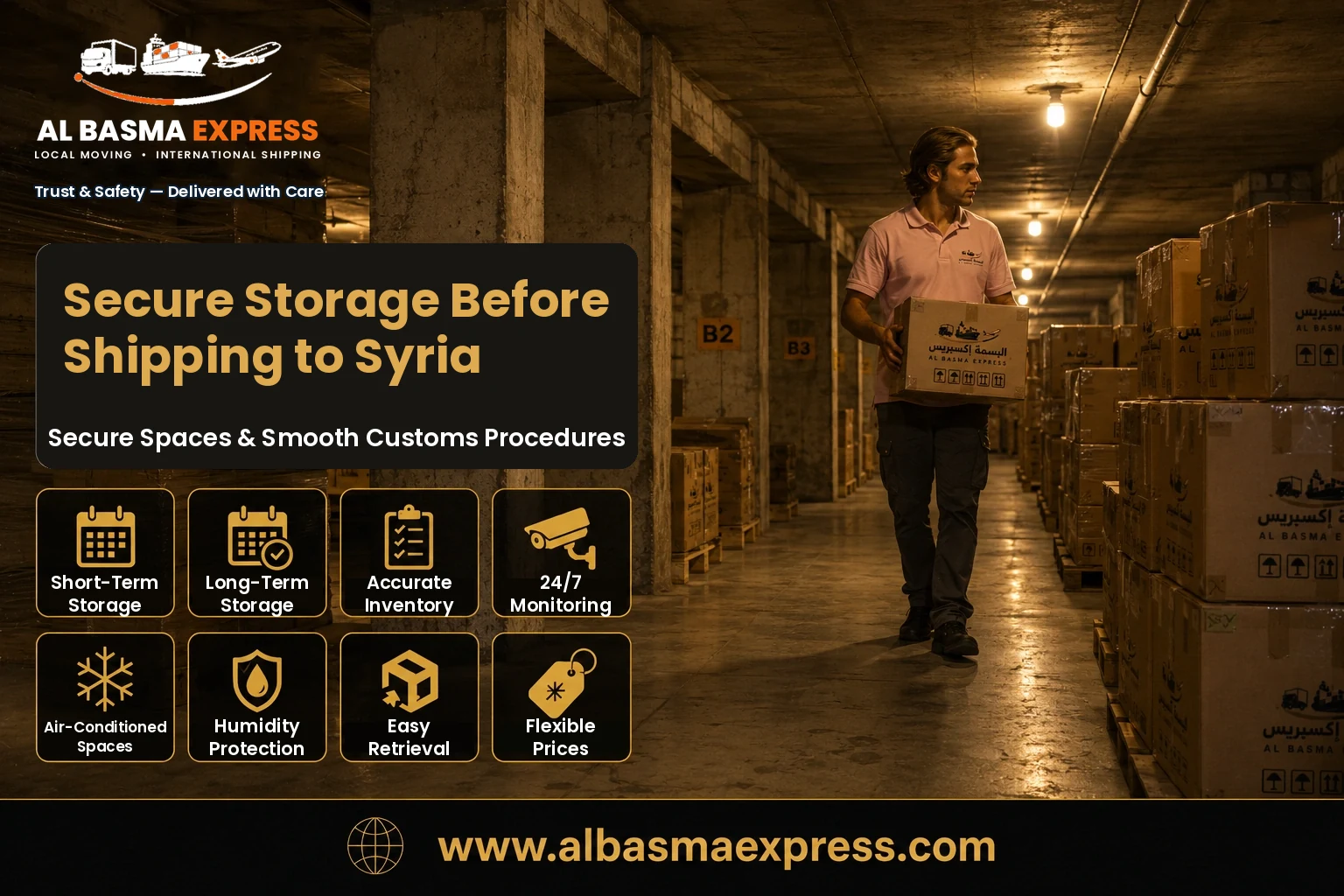
Receiving in Syria: the unloading order starts with the biggest item
It’s easy to unload boxes quickly because they’re relatively light, but that can fill the corridors and make bringing in large furniture harder afterwards. So the unloading order is part of the plan.
First, units are matched as they come off the vehicle, with mirrors, TVs, appliances and sensitive items inspected.
Then beds, wardrobes, majlis seating and tables go to their places before the home fills with cartons.
If assembly is included, the technician starts once each item’s final place is set, then uses the part codes and the fitting bags linked to them.
Then the cartons are distributed by room. A “kitchen” carton isn’t left in the living room just because it’s closest to the door, because that means moving it a second time later.
Finally, only the priority boxes are opened, while décor, books and non-essential things can wait until the essential spaces are ready.
★ Good delivery reduces the number of times an item is touched
The more directly an item goes from the truck to its final place, the less handling, time and friction.
That’s why writing the room on each package is part of practical protection, not just a way of staying organized.
Why Al Basma Express for shipping from Saudi Arabia to Syria?
The trip to Syria needs management that stays organized even with multiple road stages, so the service starts inside the home or office — not at the border.
Al Basma Express provides solutions for furniture, appliances, cars, goods, equipment and parcels, with the option of dividing the order into several categories and managing each in the way that suits it.
The free survey helps set the volume, packing, disassembly and site difficulty, then the inventory is created and the load prepared before departure.
Suitable land services are available within a 2–5 day range according to the actual route, stages and procedures, alongside suitable air services within 24–48 hours for suitable and urgent shipments.
GPS tracking of the land stages and order status updates also help follow the shipment from the pickup city to transit, then entry into Syria and domestic distribution.
The cost is set according to volume, weight, transport method, packing, disassembly and assembly, the Syrian city, the property and any storage, lifting, car or extra equipment.
Destinations include Damascus, Aleppo, Homs, Hama, Latakia, Tartus, Daraa, As-Suwayda and other cities and areas according to the operating route and accessibility.
To arrange a survey or send your shipment details, call +966553923364 or visit the official Al Basma Express website.
Frequently asked questions about shipping from Saudi Arabia to Syria
How long does land freight from Saudi Arabia to Syria take?
A 2 to 5 day range is used for suitable land services and stages, while the final duration depends on the origin city, transit route, crossing procedures, Syrian destination and domestic distribution — and the schedule is confirmed against the actual order.
How long does air freight from Saudi Arabia to Syria take?
Suitable air freight services take 24 to 48 hours depending on the flight, content acceptance and handling, with possible extra time for pickup, clearance and distribution to the final city.
Which land route is used for shipping to Syria?
Some trips may leave through Al Haditha, then pass through Jordan to Jaber–Nassib, but the route and details must be confirmed at booking according to operations and the procedures in force.
Can a whole household be moved from Saudi Arabia to Damascus or Aleppo?
A full household move can be organized after surveying the furniture and identifying what needs disassembly and packing, then creating the inventory and the transport and distribution plan according to the city and property.
Is a free survey available before shipping?
The free survey helps determine the load volume, sensitive items, disassembly and packing requirements, property difficulty and extra services — then a quote closer to the real job is prepared.
Can a car be shipped with the furniture to Syria?
The car and furniture can be coordinated in the same period, but the vehicle is handled in a separate file covering data, photos, inspection, documents and transport method.
What’s the best packing for household goods going to Syria?
Packing is chosen according to each item’s tolerance level: blankets, bubble wrap, reinforced cartons, corner guards, padding and covers can be used, with rigid or wooden crates for items that need them.
Can the shipment be tracked by GPS?
GPS tracking helps in the land stages, alongside order status updates showing pickup, the road, transit, entry into Syria and then distribution.
How is the price of shipping from Saudi Arabia to Syria determined?
The price depends on volume, weight, type of contents, origin city, transport method, packing, disassembly and assembly, the Syrian destination, the property, storage or lifting, and extra services.
Can goods and equipment be shipped to Syria?
Permitted goods and equipment can be assessed once the item, quantity, weight, dimensions, packing method, stackability, lifting points and delivery location are provided.
Does the service reach Latakia, Homs, Hama and Tartus?
Delivery can be organized to Damascus, Aleppo, Homs, Hama, Latakia, Tartus, Daraa, As-Suwayda and other areas according to the operating route, address and accessibility.
How do I start booking with a shipping company from Saudi Arabia to Syria?
Call +966553923364 and send your pickup city, Syrian destination, type of load and rough photos or a contents list — then the survey is arranged and the shipping plan set.
A successful shipment to Syria starts before you choose the road
The vehicle can change, a different land route can be chosen, or part of the load can be separated for air freight — but some things shouldn’t change: knowing the contents, having an inventory, packing quality, a clearly defined consignee, and every dismantled part linked to its original piece of furniture.
That’s why the Al Basma Express service starts with the survey and classification before getting into the details of the road. The furniture gets a disassembly and packing plan, the car a separate file, the goods weight and dimension data, the equipment a lifting plan, and urgent parcels a separate assessment.
Suitable land transport services are available within 2 to 5 days and suitable air services within 24 to 48 hours, with the final duration reviewed according to the route, crossings, clearance and the Syrian city.
GPS tracking supports the land stages, while status updates show when the order moves to transit, then enters Syria and goes to distribution.
Whether the destination is Damascus, Aleppo, Homs, Latakia or another city, sending the real address and property type before the trip starts lets delivery be planned as part of the service, not as a problem to solve after arrival.
Get started by calling +966553923364 and sending your pickup city, type of load and destination — then a free survey is arranged and the right plan chosen.