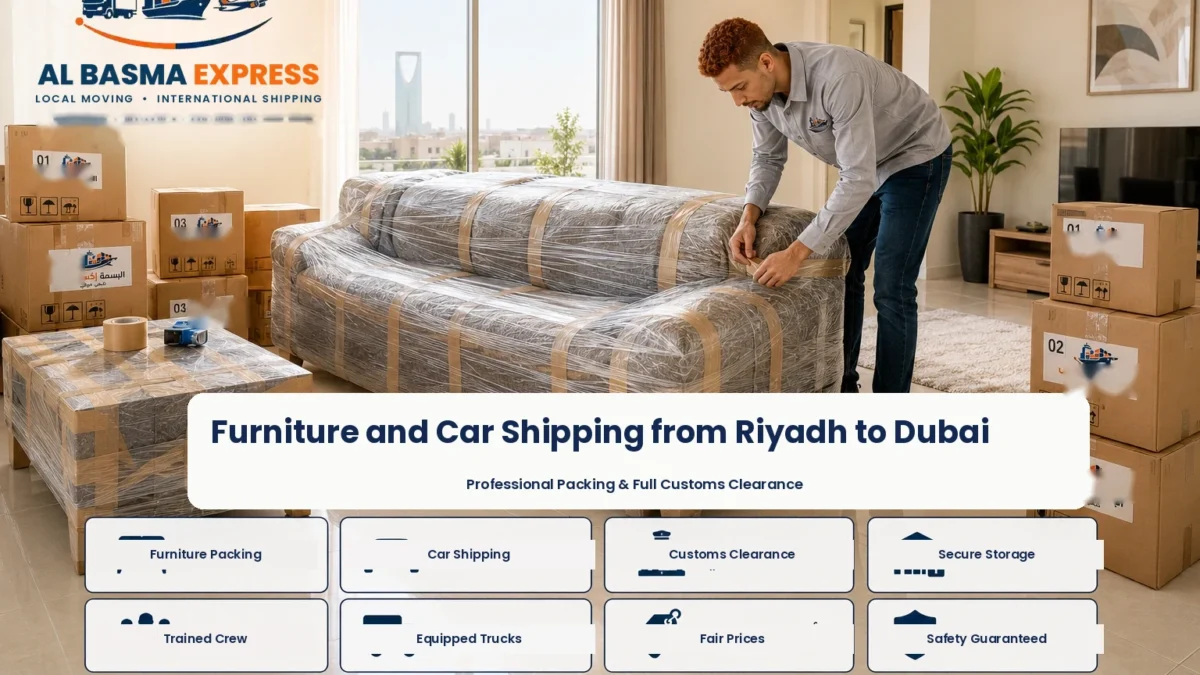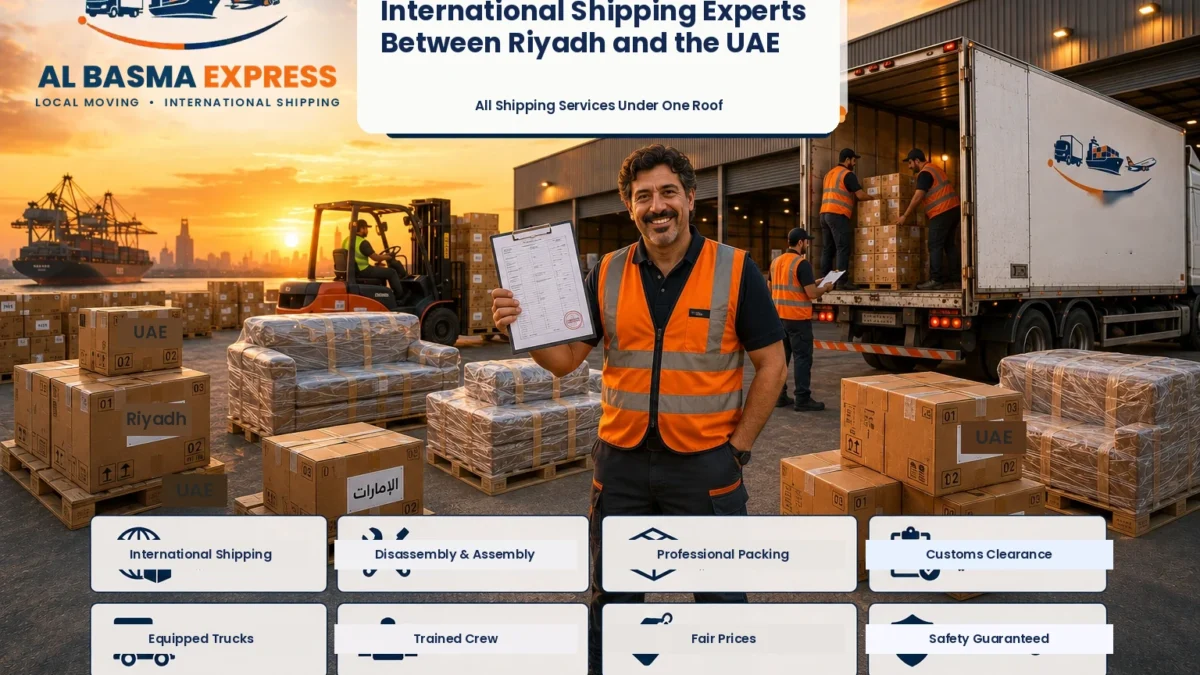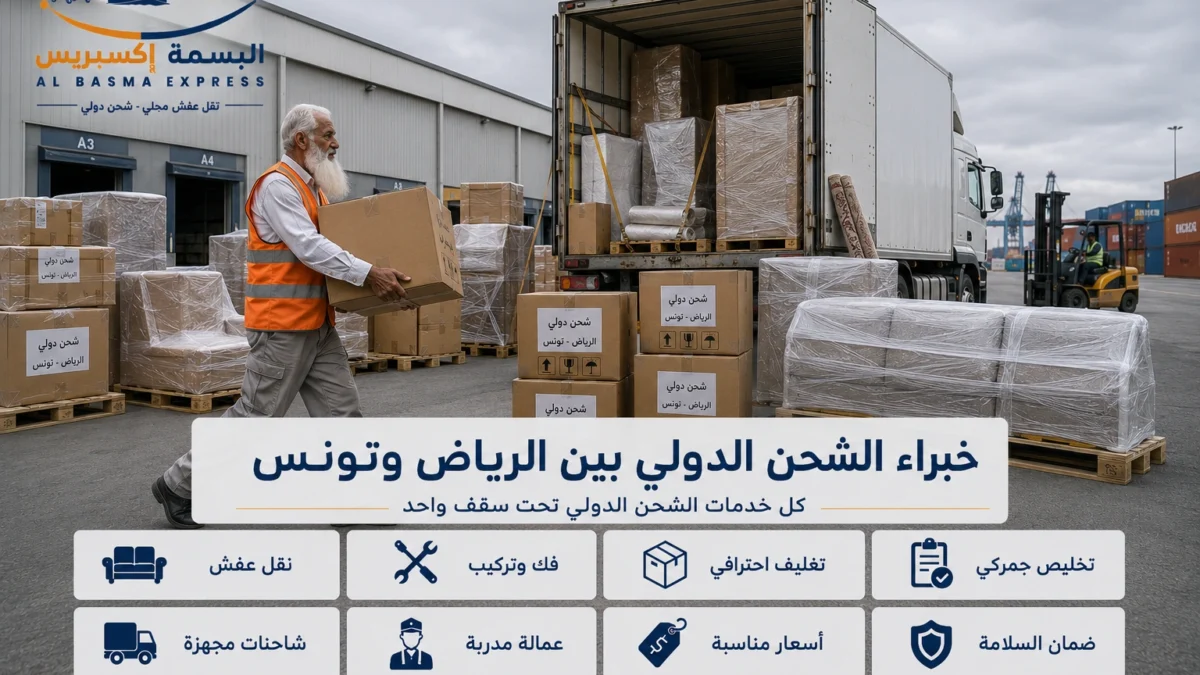

The relatively short distance between Saudi Arabia and the UAE doesn’t mean every shipment can be handled the same way. A shipment of a few cartons from Riyadh is different from moving a whole home from Jeddah; a car heading to Dubai needs different preparation from equipment being delivered to an industrial area in Abu Dhabi; and commercial goods bound for Jebel Ali aren’t managed like personal belongings. That’s why a successful journey starts with a different question: what route and service suit the nature of the load? — not: what’s the fastest truck we can send?
Al Basma Express operates as a shipping company from Saudi Arabia to the UAE for individuals, families and businesses who want to move home and office furniture, cars, goods, equipment, parcels and appliances — with pickups from many Saudi cities and delivery to Dubai, Abu Dhabi, Sharjah, Ajman, Ras Al Khaimah, Fujairah, Umm Al Quwain, Al Ain and other areas, depending on the operating plan and the final address.
Topic map41 topicsShowHide
Land freight is based on preparing the shipment inside the Kingdom, then arranging its departure on the right route and its crossing through official land border points. One of the most important crossings between the two countries is the Saudi Al Batha border crossing and the UAE’s Al Ghuwaifat, depending on the trip route and the procedures in force at the time. After entering the UAE, the domestic stage begins — it may end at an apartment in Dubai, a villa in Al Ain, a warehouse in Sharjah or a commercial site in Abu Dhabi — so reaching the border is never treated as the end of the job.
Land freight for suitable services takes 2 to 5 days depending on the trip plan, the origin city, the destination, the type of load, the border crossings, clearance procedures and the operating schedule. Air freight for suitable and urgent shipments takes 24 to 48 hours depending on the available flight, content acceptance and handling — and it’s important to distinguish the core transport time from the full door-to-door time from sender to consignee.
The service starts with a free survey that establishes the real volume, the weight when needed, the type of packing, the items that require disassembly and reassembly, and whether the shipment will move as a dedicated load or within another arrangement that suits its size. The land stages can also be followed through GPS tracking, alongside order status updates until delivery.
As for cost, there’s no fixed price: shipping a few cartons from Dammam to Dubai is different from moving a household from Riyadh to Abu Dhabi, and both differ from moving a car, equipment or commercial goods. The cost depends on volume, weight, the pickup point, the destination city, the nature of the load, and the level of packing, disassembly and assembly, storage, lifting and any extra services the order needs.
You can contact Al Basma Express on +966553923364 to request a free survey and share your pickup city, your destination in the UAE and the type of shipment — so the plan is built on real data rather than a generic estimate that ignores your order’s details.

Before the road: classify your shipment into one of four logistics tasks
A practical way to simplify shipping to the UAE is not to start with the number of boxes, but with the main task. Almost every shipment falls into one of four groups, and knowing the group helps choose the vehicle, packing, services and documents more accurately.
Task one: a household move. This covers bedrooms, living rooms, appliances, clothes and household items moving from a Saudi home to a home in the UAE. The priorities here are the inventory, disassembly, surface protection, saving space and a room system that makes it easy to set up the home again after arrival.
Task two: shipping a car. A car needs inspection, photos, data, documents and a loading and securing method that are completely different from furniture. It can be part of the same customer order, but it isn’t treated as a large item simply added to the furniture list.
Task three: commercial shipping. This covers goods, products, commercial cartons, pallets, spare parts and some fittings. Weight, dimensions, stackability and content description matter more than room names.
Task four: equipment or a special load. Here you need to know the weight of each piece, the lifting points, the center of gravity, the loading method, and whether cranes, pallets or dedicated securing gear can be used.
One order may combine more than one task — a family moving to Dubai with its furniture and car, or a company relocating its office to Abu Dhabi along with some equipment. In that case we don’t mix everything into one unclear inventory; each category is managed with its own information while the order stays under one coordinated plan.
Household move
- Room-by-room inventory.
- Disassembly and assembly.
- Multi-level packing.
- Placement in the new home.
Car shipping
- Inspection and photos.
- Separate data.
- Loading and securing.
- Documented delivery.
Commercial shipping
- Item and quantity.
- Weight and dimensions.
- Stackability.
- Warehouse or facility address.
Equipment
- Lifting points.
- Actual weight.
- Transport orientation.
- Handling equipment.
◆ The shipment type comes before choosing the vehicle size
A large vehicle doesn’t solve the problem of a load that has been packed or arranged the wrong way. Before choosing the means of transport, you need to know the nature of the items, their weights, dimensions and sensitivity — then the vehicle and space are chosen accordingly.
This step matters especially when furniture, boxes, appliances or equipment are combined in the same order, because weight distribution and the position of sensitive items must be calculated from the start.
The free survey: five decisions settled before the first item moves
The purpose of the survey isn’t just to see the furniture, but to answer five operational decisions that will shape the rest of the journey: what will be shipped? What will be dismantled? How will it be packed? How will it leave the site? And what’s the right means of transport for it?
Decision one: the final shipment volume. Assembled furniture doesn’t always reflect the space it will take up in transit. A wardrobe can become a neat stack of panels after disassembly, while a glass item can grow in size once placed in a protective case. So the expected shape after preparation is what gets assessed.
Decision two: how much to dismantle. Not everything is dismantled. We dismantle items that are hard to get out, whose volume benefits from disassembly, or that become safer to move once some parts are removed — while other items can stay whole.
Decision three: packing materials. A sofa is different from a mirror, a fridge from a table and an antique from clothes. So there’s no single type of “packing for travel to the UAE” that suits everything.
Decision four: site difficulty. The floor, the elevator, the stairs, the property entrance, where the vehicle can park and how far the crew must carry the furniture all affect the job.
Decision five: the shape of the trip. Does the load need a truck or dedicated space? Is there an urgent parcel that can go by air? Is there a car that needs a car carrier? And does the delivery site need a smaller vehicle for the last stage?
Knowing these answers means the price is based on the actual order and reduces plan changes during the job. It also gives the customer a chance to review their belongings and drop what they won’t need in the UAE before paying to pack, move and deliver it.
▪ The difference between a phone estimate and a real survey
A description like “two bedrooms and a living room” reveals nothing about furniture volume, the number of appliances or mirrors, or difficult entrances. Two packed rooms can hold more than a larger home with little furniture.
The survey turns a general description into data that can be used to set packing materials, technicians, space and loading method — and that’s what brings the quote close to the real job.
The land route between Saudi Arabia and the UAE: the road is part of the service, not just a distance
Land transport is one of the most important shipping options between the Kingdom and the UAE, thanks to the direct road link between the two countries and its suitability for furniture, cars, goods and equipment depending on the service. But it doesn’t start at the border — it starts the moment the load is collected from the customer’s home or warehouse.
The vehicle is prepared inside Saudi Arabia according to the size and type of shipment, then the data, inventory and required documents are reviewed before departure. The vehicle then follows the approved route toward the right crossing point, and the Al Batha – Al Ghuwaifat route is one of the key land corridors linking the two countries.
At the border, accurate data matters. Personal furniture isn’t commercial goods, a car has a different file, and equipment needs a description that fits its nature. That’s why categories are kept separate in the inventory and generic descriptions aren’t used when the load is mixed.
The journey doesn’t end after entering the UAE. The vehicle moves on, or the domestic stage is arranged, according to the destination — the consignee may be in Abu Dhabi, Al Ain, Dubai or Ras Al Khaimah, and goods may need to go to an industrial area or a warehouse rather than a home.
Land freight services take 2 to 5 days under a suitable plan, and the time varies with the origin city in Saudi Arabia, the type of load, border procedures, road conditions, the final UAE city and any distribution arrangements.
| Route stage | Main task | What needs to be ready? |
|---|---|---|
| Inside Saudi Arabia | Pickup, preparation and loading | Inventory, packing and address |
| Before the border | Reviewing shipment data | Information and documents |
| Crossing | Official procedures | An accurate description of the load |
| Inside the UAE | Distribution to the city | Consignee’s address and schedule |
| Delivery | Matching, inspection and unloading | The inventory list and a prepared site |
Air freight from Saudi Arabia to the UAE in 24–48 hours: when does it make sense?
The ease of the land route between Saudi Arabia and the UAE doesn’t remove the need for air freight. Some shipments can’t wait several days, or are small enough that speed becomes the deciding factor.
Suitable air freight services can take 24 to 48 hours depending on flight availability, content acceptance and handling times. This option is usually used for parcels, urgent supplies, samples, and some appliances and items of limited size.
Choosing air doesn’t necessarily mean every stage of the order ends within that time, because pickup from the customer’s address, shipment preparation, acceptance and clearance procedures, and delivery to the home or office may add time depending on the case.
Dimensions also affect air freight: a light but bulky parcel can be less suitable than a heavier but compact one. That’s why weight and dimensions are reviewed together before choosing the method.
In household moves, land and air can be combined. The main furniture travels by truck, while a few urgent items are sent by air — so the customer doesn’t have to raise the cost of the entire home for a handful of things needed quickly.
◆ Ask what time is worth before choosing air
If a parcel can arrive several days later without disrupting your work or move, you may not need an express service. But if it contains something your work or setup depends on, speed becomes a real part of the service’s value.
This way air freight isn’t a decision based on the idea that faster is always better — it’s used when time has a clear practical impact.
A different packing system: protection based on the moment of risk
Instead of classifying packing by room, it can be classified by the moment an item may be at risk. There’s risk while carrying, risk while arranging it in the vehicle, risk from road movement and risk during unloading. When these stages are considered, choosing materials becomes more precise.
While carrying: the parts most exposed to friction are edges, corners and legs. So tables, beds and some cabinets need guards and protection that let the crew grip the item without scratching the surface.
While loading: pressure and stacking become the main risk. Mirrors, screens and glass must be placed in suitable positions and never used as a base for securing other boxes on top.
On the road: movement and vibration become the biggest risk. This is where straps, barriers, internal padding and eliminating gaps that let items or carton contents shift come in.
While unloading: the markings on the package need to be clear. A box marked fragile must stay identifiable until the last stage — a label at the bottom of the carton or hidden under the wrapping is useless.
The materials used vary: protective blankets, bubble wrap, reinforced cartons, corner guards, outer wrapping, padding, and rigid or wooden crates for some items when needed. There’s no reason to use the highest protection level on everything if the items don’t need it.
While carrying
Protecting corners, surfaces and gripping points on furniture.
While loading
Preventing pressure on glass, screens and light packages.
On the road
Securing, padding and straps that stop movement and sliding.
While unloading
Clear codes showing the room, sensitivity and orientation of each item.
▪ A wooden crate isn’t an automatic upgrade for every item
It’s used when an item needs extra structural protection, such as some glass, antiques and sensitive appliances — but it adds volume and weight, so the decision must be tied to real need.
Professional protection means using the right material in the right place, not using the most expensive materials on every item in the shipment.

From Riyadh, Jeddah and Dammam to the UAE: the starting point changes the trip plan
Shipping from Saudi Arabia to the UAE may look like one route, but the Kingdom itself is vast, so the first stage differs with the pickup city. A shipment leaving the Eastern Province isn’t like one starting in Jeddah, Madinah or the south of the Kingdom.
Riyadh: its location makes it one of the key starting points for land freight to the UAE. Furniture, cars and goods can be moved from homes, offices and warehouses, with direct route planning and distribution to Dubai, Abu Dhabi or other cities.
Jeddah: the trip needs a longer land stage inside Saudi Arabia before heading east toward the UAE route, so time planning and securing the load matter, especially for household furniture.
Dammam, Khobar and Dhahran: a pickup point in the Eastern Province is closer to the routes leading to the UAE than some western cities, but the shipment type, its procedures and the final destination remain key to calculating the time.
Makkah and Madinah: the load is first prepared and moved to the suitable land route, taking into account the length of the domestic stage before reaching the border.
Qassim, Hail and central and northern cities: the route is set based on the city, the vehicle type and the destination — and it’s never assumed that all shipments take the same time just because they’re going to the UAE.
Al Ahsa and the east: furniture, goods and equipment can be moved while benefiting from the geographic proximity to the eastern route, with procedures and the nature of the load still determining the final plan.
That’s why, when requesting a shipping quote, it’s essential to state the pickup city inside the Kingdom rather than just writing “from Saudi Arabia” — the local stage is a real part of the time, work and cost.
Smart inventory for Gulf shipping: number + destination + priority
In a local move the customer may remember that a box is for the kitchen because the trip is short and they’ll be there during loading and unloading. In international shipping, memory shouldn’t be relied on — especially when there’s more than one home, consignee or type of load.
So the inventory can be built on three simple elements. First, the unit number: the serial number of the box or piece of furniture. Second, the internal destination, such as the bedroom, kitchen, office or storeroom. Third, the priority: whether it needs to be opened quickly or can wait.
For dismantled furniture, the item’s code is added to all its parts. If a wardrobe is dismantled, its panels carry the same code, and so does the bag of screws and hinges.
Sensitive boxes get a clear description such as “glass”, “screen” or “no weight on top”. These simple words affect the box’s position in the vehicle and how it’s lifted.
On arrival in the UAE, the boxes aren’t all piled at the entrance; they’re distributed straight to the rooms or departments. If the shipment is for an office, a department’s equipment can go directly to its room instead of being moved twice after unloading.
| Information | Example | Used for |
|---|---|---|
| Number | Box 12 | Matching the number of units |
| Final location | Master bedroom | Direct placement |
| Contents | Glassware | Handling method |
| Priority | Open first | Making day one easier |
| Sensitivity level | No weight on top | Setting the loading position |
◆ A good inventory saves work twice
The first time at loading, because the crew knows what they’re handling; the second time in the UAE, because every unit goes straight to its place.
The less a box is moved from place to place after unloading, the less time, effort and handling — which helps sensitive items as much as it helps organization.
Shipping cars from Saudi Arabia to the UAE: a separate track within one order
Cars are one of the most common categories shipped between the two countries, but a car’s journey doesn’t begin when the carrier arrives — it begins with reviewing its condition, its data and the documents required for the specific case.
First, the vehicle, owner and consignee details are recorded, then the car is photographed from all sides to document its exterior condition. Photos should ideally include the body, glass, rims and any existing marks.
Next, personal belongings are removed from the cabin and trunk, unless the service and procedures allow a clearly defined arrangement for certain contents. Using the car as random space for household cartons can mix up the vehicle’s file with the furniture file.
The battery, tires and absence of leaks are checked, and if the car doesn’t run, the transport team must be told early, because a non-running vehicle needs different loading equipment.
The official procedures currently in force for exporting or importing the car must also be reviewed according to the order, the vehicle’s status and the owner. No fixed list of papers is used for every case, because the details can differ.
On delivery in Dubai, Abu Dhabi, Sharjah or another city, the visible condition is inspected and compared with the documentation, and the vehicle’s file is kept separate from the furniture list.
Shipping goods to Dubai, Abu Dhabi and Sharjah: what a business owner needs before calling
If the load is commercial, the most useful information isn’t just the product name, but how it appears as a shipment: how many units? What do they weigh? What are their dimensions? Can they be stacked? Do they need refrigeration or special protection? And is delivery to a shop, a warehouse or an industrial area?
A business owner can prepare a small table before requesting a quote, listing the item, quantity, weight, dimensions and packing method. This table lets us picture the space, choose the vehicle and decide whether pallets, a forklift or special securing gear are needed.
Goods in sturdy cartons may be stackable, while other products can’t take any weight on top. If this information isn’t mentioned, the package may be handled in a way that doesn’t suit its contents.
Equipment needs additional data such as the center of gravity, lifting points and the correct orientation for transport. A single piece may need a crane because of its weight, even if its dimensions are modest.
Goods must also be described correctly and not combined with household items under a generic label. Clear separation makes it easier to prepare the documents, choose the transport method and handle each category.
▪ Five lines are enough to start assessing a commercial shipment properly
Item name, number of units, weight, dimensions and delivery address. Then add notes such as stackability, the need for a forklift or any sensitive contents.
This data avoids relying on photos that show the shape but not the weight, and helps determine the vehicle type and space before loading day.
The UAE isn’t just Dubai: how the delivery stage changes across the seven emirates
Choosing the destination city is part of the price, the timing and the execution. The route to Abu Dhabi differs from continuing north to Ras Al Khaimah, and delivery inside Dubai may need different coordination from a home in Al Ain or a facility in Fujairah.
Dubai: residential, office and commercial destinations. The area must be specified precisely because of the city’s size and its mix of towers, compounds, villas and industrial zones. Building rules, elevators and vehicle parking should also be confirmed before the unloading appointment.
Abu Dhabi: delivery of furniture, cars and goods can be coordinated to the city and surrounding areas according to the address, taking into account whether the site is residential or commercial.
Al Ain: the final stage needs to account for the domestic distance from the entry route to the consignee’s address, specifying the villa or building and the area.
Sharjah: receives a wide range of residential and commercial shipments, and the delivery site may be a home, a warehouse or an industrial area — so the type of address must be specified, not just the name of the emirate.
Ajman: furniture, parcels and goods can be delivered to residential and commercial areas, with the consignee prepared before arrival.
Ras Al Khaimah: continuing north means an extra domestic stage compared with destinations closer to the entry route, so the location factors into the expected date.
Fujairah: this eastern destination needs the right domestic route to be set, especially for heavy shipments or large vehicles.
Umm Al Quwain: delivery of furniture, parcels and goods can be organized according to the final location and the nature of the shipment.
Areas such as Jebel Ali, Mussafah and others can also be served depending on the service type, the shipment and the address — and it’s always best to send the exact location rather than relying on the emirate’s name alone.
Home or villa
Specify the area, entrance, vehicle parking, floors and the assembly service required.
Residential tower
Check entry procedures, the service elevator and the permitted moving hours.
Warehouse or company
Specify the receiving gate, forklifts, operating hours and the person receiving the goods.
★ The name of the emirate isn’t enough to plan the last twenty minutes of the trip
The site may be inside a compound that requires an entry permit, on a street where a large vehicle can’t stop, or at a warehouse with a specific gate. All of this only becomes clear once the actual address is known.
Sending the location — and a photo of the entrance when needed — lets these details be settled before the shipment arrives, instead of trying to solve them while the vehicle waits outside.
GPS tracking between Saudi Arabia and the UAE: location alone isn’t enough
The land route makes tracking especially useful, but the customer doesn’t just need a dot on a map. They need to know what that dot means for the stage their order is at.
The status can be split into stages: shipment collected, packing and inventory completed, vehicle left the origin city, reached the crossing stage, entered the UAE, moved to the final city, then out for delivery.
GPS tracking supports following the vehicle’s movement during the land stages, while status updates explain what’s happening. If the truck is stationary in a certain area, it may be due to a normal procedure or an operational stop — and a location dot alone doesn’t tell you that.
Once the shipment enters the UAE, tracking becomes useful for the consignee. They can see that the shipment has moved on to Dubai or Abu Dhabi, for example, and prepare themselves and their building instead of waiting for a surprise call from the driver.
Tracking also matters for commercial shipments, because the warehouse may need to prepare space, a forklift or a responsible staff member before the vehicle arrives.
You can contact Al Basma Express with your order details to get service updates and the contact channels linked to your shipment.
How is the price of shipping from Saudi Arabia to the UAE set — without generic numbers?
Shipments differ so much that publishing a single number for every order isn’t practical. That’s why understanding the price factors is more useful to the customer than a number they can’t tell applies to them.
Pickup city in Saudi Arabia: the local distance before reaching the UAE route affects operations. Pickup from Riyadh is different from Jeddah, Madinah or the Eastern Province.
Final city in the UAE: Dubai, Abu Dhabi, Al Ain, Ras Al Khaimah and Fujairah aren’t a single point — each destination has its own domestic distance and distribution plan.
Volume: one of the most important factors for furniture and cartons. The space after disassembly and packing is what counts, not just the number of rooms.
Weight: important especially for goods, equipment and some parcels, and it may affect the lifting method and vehicle type.
Nature of the load: furniture needs technicians and packing, a car needs separate preparation, goods need commercial data and equipment may need cranes.
Shipping method: land differs from air, and a small parcel differs from a truck or a large dedicated space for the load.
Packing: the number of fragile items and the level of protection required affect the amount of materials and time.
Disassembly and assembly: moving furniture that’s already dismantled and ready is different from sending technicians to dismantle whole rooms and reassemble them.
Site: floors, elevators, difficult truck parking and the carrying distance all factor into the work estimate.
Extra services: storage, crane lifting, special crates, car shipping, equipment or multiple delivery points are added only when the order needs them.
| Pricing factor | Information needed | What it changes |
|---|---|---|
| Origin city | City and address | The transport stage inside the Kingdom |
| Volume | Dimensions and number of items | Space required |
| Weight | Actual weight when needed | Vehicle and handling |
| Packing | Types of sensitive items | Materials and labor |
| Destination | Emirate, area and property | Distribution stage |
| Services | Disassembly, assembly, storage and lifting | Scope of work |
◆ Don’t compare two prices before comparing what each includes
One quote may include packing, disassembly and door delivery, while the other covers transport only. Comparing the two numbers alone doesn’t show which suits you.
Compare the vehicle type, packing, pickup point, delivery city, unloading, assembly, tracking and any extra service — then compare prices once the scope is the same.
Household furniture to the UAE: less disassembly, better protection, faster assembly
One of the most important decisions in a household move is how much furniture to dismantle. Too much disassembly wastes time and increases the number of small parts, while leaving a bulky item whole can make it harder to get out or secure.
So each item is assessed on three factors: whether it can pass through the doors, the benefit of reducing its size, and how safely it can be reassembled. Wardrobes, beds, tables and desks may benefit from disassembly to varying degrees.
Every dismantled item gets a code, and each part carries the same code. The bag of screws, hinges and handles also goes into the inventory system rather than putting the whole home’s fittings together.
Complex furniture can also be photographed before disassembly, especially items with a particular arrangement or similar-looking parts. That photo becomes a quick guide for the technician in the UAE.
On delivery, assembly doesn’t start straight away. The item’s final position must be decided first — assembling a wardrobe in one spot and then moving it minutes later means extra maneuvering that can be avoided.
▪ An item isn’t dismantled just because it’s large
A large item may be designed to be moved whole, while a smaller one may have protruding parts that make disassembly safer. So there’s no single rule based on size alone.
A good decision balances saving space, protecting the item and ease of reassembly — the three things that determine whether disassembly is actually worthwhile.
What to prepare before shipping day — in just three stages
Instead of a long to-do list, preparation can be split into three stages: what stays with you, what will be shipped, and what’s awaiting a decision. Closing these stages before the crew arrives makes the job faster.
Stage one: what stays with you. Passports, original documents, money, valuables, essential medicines and everyday devices should be in an area the packing crew doesn’t enter.
Stage two: what will be shipped. Wardrobes and drawers are emptied, appliances prepared, the fridge and freezer contents used up, appliances that hold water dried, and electronic connections photographed before unplugging.
Stage three: what needs a decision. Old furniture that may not suit the new home, appliances that may be replaced, and bulky items rarely used. These should be settled before the final survey so they don’t take up space by mistake.
Then the building is prepared: informing management or the guard, making sure the elevator can be used, setting the vehicle parking spot and clearing the corridors.
In the UAE, the consignee’s details and exact address should be ready, along with any building or compound rules, since some delivery sites need advance coordination for moving vehicles to enter or to use service elevators.
Temporary storage between two dates: when the furniture leaves before the UAE home is ready
Your lease in Saudi Arabia may end before your new home in the UAE is handed over, or a company may relocate before its office or warehouse is ready. In these cases, temporary storage can be built into the plan.
When storage is known before packing, the load can be prepared better. Appliances must be dry, upholstery covered, boxes sturdy and labels clear for a longer period.
The inventory system must also continue inside storage. A furniture item’s parts aren’t separated from their code, and room or department groups aren’t mixed without being recorded.
It’s best to minimize handling inside the storage site. Every new movement adds a chance of friction, so an arrangement that lets a group be taken out easily is more suitable.
When the delivery site is ready, the number of units is checked and loaded for the final stage, and the room or department code remains usable until the item is in its final place.

Delivery day: how a truck becomes an organized home rather than a room full of boxes
The best delivery starts before the vehicle doors open. The consignee should be present, the parking spot available, the elevator or entrance ready, and the customer should know where the large furniture will go.
The first step once unloading begins is matching the inventory — not opening cartons. The number of boxes, furniture items, appliances and accessories is checked, then visible sensitive items are inspected.
Next, the large items go into their rooms first. Placing the wardrobe, bed, living room set and table before the space fills with cartons reduces the need to move boxes later.
If the service includes assembly, it starts once each item’s final position is fixed. Then the cartons go to their rooms or departments according to their codes.
Once matching and placement are done, priority boxes are opened first — the cartons with everyday clothes, essential kitchen tools, bedding, or the materials an office needs to resume work straight away.
The rest can be opened in stages. There’s no reason for arrival day to become chaos when the inventory list shows what’s inside every carton.
◆ Five words for an organized delivery day
Match, inspect, place, assemble, then open. In this order the inventory stays clear until the last stage, and opened packages don’t get mixed with sealed ones before the count is checked.
Furniture also reaches its place before the space gets crowded, and the family or company starts using the priority items first.
Why Al Basma Express for shipping between Saudi Arabia and the UAE?
Shipping between two neighboring countries may sound simple, but its real value shows when the shipment is large or varied. There’s a difference between moving a box and managing furniture, a car, appliances, documents and a delivery appointment at a building with special entry rules.
Al Basma Express starts with a free survey to define the load and services, then carries out disassembly, packing, inventory and loading according to the order’s needs — rather than using a fixed package for every customer.
Solutions are available for furniture, cars, goods, equipment and parcels, with land freight taking 2 to 5 days for suitable services depending on the trip, and air freight in 24 to 48 hours for suitable urgent shipments.
GPS tracking also helps follow the land movement stages, with order status updates until the shipment enters the UAE and goes out for delivery — so the customer knows where the process has reached and what comes next.
The service covers many Saudi cities, with delivery to Dubai, Abu Dhabi, Sharjah, Ajman, Ras Al Khaimah, Fujairah, Umm Al Quwain, Al Ain and more, depending on the operating plan and the final address.
The cost is set based on volume, weight, type of load, pickup location, shipping method, final city, packing, disassembly and assembly, and any storage, lifting or special services — so the quote reflects what the customer actually needs.
You can contact Al Basma Express on +966553923364 to discuss your shipment and arrange a survey, or visit www.albasmaexpress.com to learn more about the company and its contact channels.
Frequently asked questions about shipping from Saudi Arabia to the UAE
How long does land freight from Saudi Arabia to the UAE take?
Suitable land freight services take 2 to 5 days depending on the origin city in the Kingdom, the type of shipment, the trip route, border procedures and the final UAE city, and the expected date is reviewed against the actual order.
How long does air freight from Saudi Arabia to the UAE take?
Suitable express air freight services can take 24 to 48 hours depending on the flight, content acceptance and handling, with possible extra time for pickup, preparation, clearance and final delivery.
Which border crossing is used for land freight between Saudi Arabia and the UAE?
The route through the Al Batha crossing on the Saudi side and Al Ghuwaifat on the UAE side is one of the most important land corridors between the two countries, with the actual route set according to the origin city, the service and the procedures in force at the time.
Does Al Basma Express offer a free survey before pricing?
Yes. The free survey helps establish the load volume, the furniture needing disassembly, the sensitive items, site difficulty, the type of packing and the services required — and then a quote that’s close to the actual job is prepared.
Can a whole household be moved from Saudi Arabia to Dubai?
Yes, a full household move can be organized from various Saudi cities to Dubai, with disassembly, packing, inventory, loading, transport, unloading and assembly according to the order’s scope and the delivery site.
Can a car be shipped together with household furniture to the UAE?
The car and the furniture can be coordinated within the customer’s order, but the car has its own file in terms of data, inspection, documents, loading and delivery, and isn’t treated as part of the furniture list.
Can the shipment be tracked by GPS?
GPS tracking is available for the land stages alongside order status updates, helping the customer follow the shipment’s movement, the crossing stage, entry into the UAE and dispatch for delivery.
What’s the best packing for land freight to the UAE?
Packing is chosen per item: protective blankets, bubble wrap, reinforced cartons, corner guards, padding and outer wrapping can be used, with more rigid crates for some glass, antiques and sensitive appliances when needed.
How is the price of shipping from Saudi Arabia to the UAE determined?
The price depends on the pickup city, volume, weight, nature of the shipment, transport method, delivery city, packing, disassembly and assembly, site difficulty, storage, lifting and any car or equipment shipping — so there’s no single fixed price for every order.
Can goods and equipment be shipped to the UAE?
Permitted goods and equipment can be shipped once clear details are provided on the type, quantity, weight, dimensions, stackability, lifting method and destination — then the right vehicle, packing and procedures are chosen.
Does the service reach Abu Dhabi, Sharjah, Ras Al Khaimah and Fujairah?
Delivery can be coordinated to Dubai, Abu Dhabi, Sharjah, Ajman, Ras Al Khaimah, Fujairah, Umm Al Quwain, Al Ain and other areas depending on the address, the operating plan and the nature of the load.
How do I book a shipping company from Saudi Arabia to the UAE?
Contact Al Basma Express on +966553923364 and send your pickup city in Saudi Arabia, your destination city in the UAE, the type of load and your expected date — then a free survey is arranged and the right shipping plan is set.
One route between two countries — but every shipment needs a different decision
The advantage of shipping between Saudi Arabia and the UAE is a direct land connection that allows services suited to furniture, cars, goods and equipment — but an easy road doesn’t mean skipping the planning. What protects the shipment is making the right decisions before it reaches the road.
If the load is a home, start with sorting, the survey and the inventory. If it’s a car, prepare its file and document its condition. If it’s goods, record the item, quantity, weight and dimensions. And if there are urgent parcels, consider whether 24–48-hour air freight suits them better than adding them to the main load.
Suitable land transport takes 2 to 5 days depending on the route, the city and the procedures, with GPS tracking for the land stages — while delivery inside the UAE remains a core part of the service until the furniture reaches its room, the goods reach the warehouse or the car reaches its consignee.
Al Basma Express ships from Saudi cities to Dubai, Abu Dhabi, Sharjah, Ajman, Ras Al Khaimah, Fujairah, Umm Al Quwain, Al Ain and more, with a free survey, packing, disassembly and assembly, and services for cars, goods, equipment and parcels tailored to each order.
To get started, you don’t need to know the truck size or work out the cost yourself. Have your pickup city, the type of load and your UAE destination ready, and call +966553923364 — the clearer your shipment details from the start, the easier it is to choose the right route and service.