

What you'll find in this guide184 topicsShowHide
Moving from Riyadh to Al Ahsa needs planning that allows for more than the distance alone. Al Ahsa holds several cities and residential areas, and the destination may be in Hofuf, Mubarraz, a newer district, a farm or a rest house, and each location has a different way of being reached, loaded and unloaded.
When looking for a furniture moving company from Riyadh to Al Ahsa settling for the price question isn’t enough; you must understand what the offer covers: is there a survey? Is an inventory prepared? Who dismantles the wardrobes? What kind of packing materials? How is the load secured? And who receives the shipment and follows its assembly?
This guide is dedicated to Al Ahsa, and its structure differs from the earlier articles. It focuses on setting the arrival city inside the governorate, handling the humidity and the heat, preparing apartments, villas, farms and rest houses, and organizing office and household moves separately.
Al Basma Express provides Al Basma Express intercity moving services by each shipment’s size and both sites’ nature, and you can get in touch on the number 0553923364 or visit www.albasmaexpress.com to discuss the move’s details and the services required.
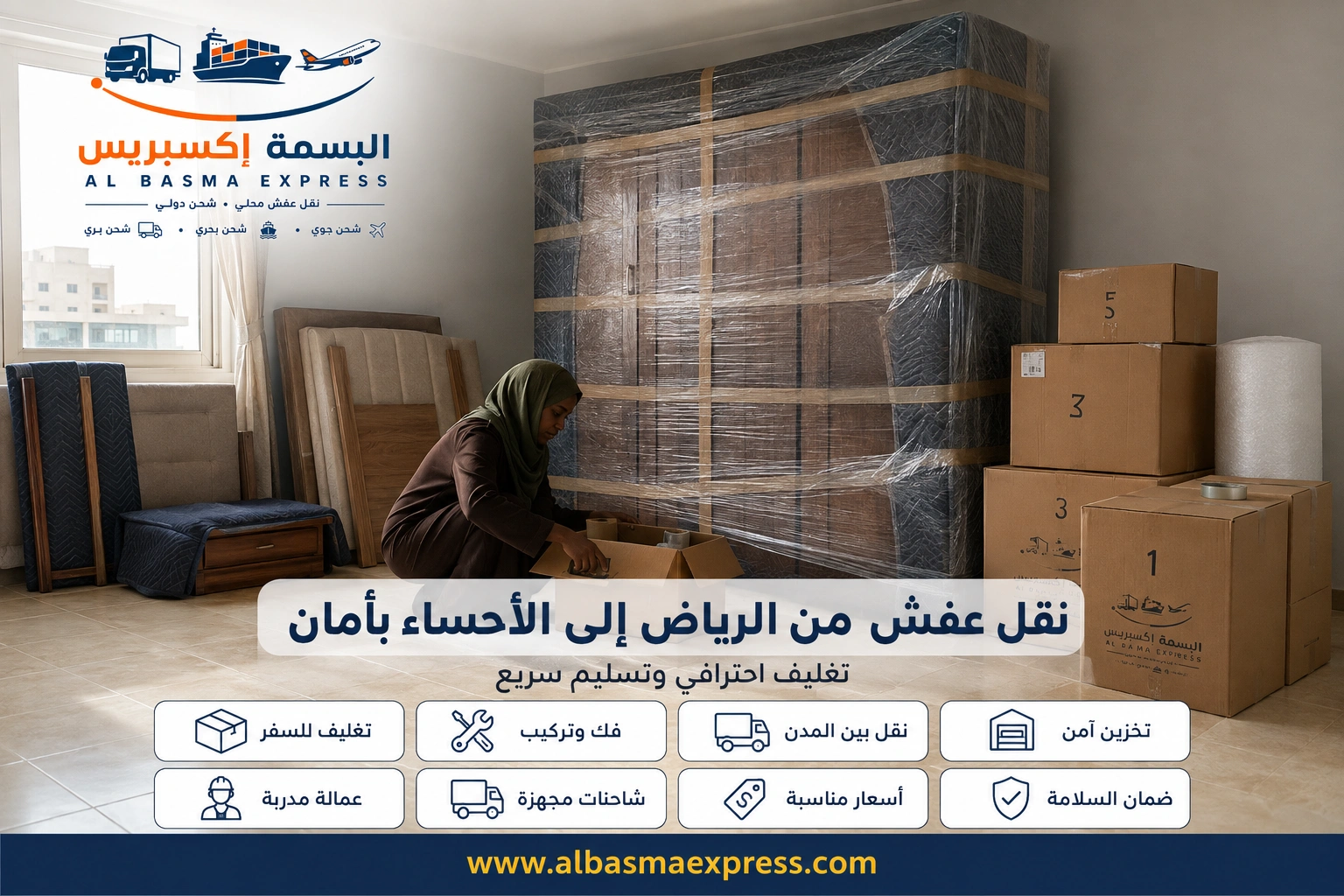
Why does Al Ahsa need its own moving plan?
Al Ahsa isn’t one arrival point; Hofuf, Mubarraz, the villages, the newer districts and the farms all differ in the nature of their roads, their entrances and the carrying distance. So the planning starts from a precise address and clear photos of the location, not from the governorate’s name alone.
The climate may also be hot and humid in some periods, which makes it important not to leave the wood, the soft furnishings and the appliances inside their wrappings or the vehicle for a long period after the arrival, and to prepare a dry, well-ventilated space.
The aim is turning the location, load and climate information into practical steps that prevent delay and reduce moving things again inside the new home.
Setting the destination
Hofuf, Mubarraz, a district or a farm with a precise link.
Surveying the load
Knowing the sensitive and heavy pieces and the dismantling needed.
Suitable protection
Packing materials suiting wood, glass and appliances.
An organized handover
Directing the boxes, assembling the pieces and checking them.
Setting the arrival city inside Al Ahsa
Whether the destination is Hofuf, Mubarraz or another district must be set, along with sending the location link and photos of the street and the entrance. This information affects the kind of vehicle, the carrying distance and the parking spot.
If the destination is outside the built-up area or inside a farm or a rest house, send photos of the road, the gate and the truck’s turning space.
Surveying the Riyadh home and the route out
The survey starts from the pieces then the corridors, the doors, the stairs, the elevator and the vehicle’s parking spot. A piece may be easy to pack but need dismantling because of a tight angle.
If the supervisor can’t attend, send a continuous video starting from the room and ending at the building’s door.
Preparing an inventory by room
Write the room’s name, the main pieces and the number of boxes, such as master bedroom: a bed, a wardrobe, a dressing table and six boxes.
Use numbering such as kitchen 1 of 8, and update the list as soon as any box or piece is added.
Sorting before the packing
Every unused piece consumes space, materials and time, so review the furniture, the clothes, the books and the appliances before the move.
Compare the measurements with the Al Ahsa home’s space, and set what will move and what will be sold or donated.
Setting the first-day boxes
Set aside boxes or bags for the sleeping supplies, the clothes, the medicines, the chargers and some kitchen and bathroom tools.
These boxes are loaded so they stay easy to reach, and aren’t put behind pieces needing a long assembly.
Separating the personal belongings
The documents, the keys, the money, the jewelry, the medicines and the personal devices travel with the family, not inside the truck.
Set aside a closed place for them away from the workers and use a checklist before setting off.
Dismantling the bedrooms and the wardrobes
The technician dismantles only the necessary parts, because some materials don’t take complete or repeated dismantling.
The screws, the mounts and the keys go in bags carrying the piece’s name, and the similar panels are numbered.
Protecting the polished wood
Polished wood needs a soft layer preventing scratches, then a blanket or an outer wrap. Tape isn’t stuck directly onto the paint.
The legs, the corners and the decoration are protected, and the panels separated so they don’t rub during the trip.
Protecting majlis seating and soft furnishings
The cushions are removed and packed separately, the legs and the corners protected, and a clean cover used that doesn’t press on the fillings.
No weights go on the sofa, and it isn’t left uncovered in the sun or the humidity.

Mirrors and glass
The edges are protected first, then padding and cardboard or a frame are added. A “fragile” mark doesn’t make up for securing.
The mirrors are moved in a suitable position away from pressure, and checked as soon as they arrive.
Screens and computers
The original pack is best, and if it isn’t available a suitable box is used with padding preventing movement.
The bases and the wires are separated, and a backup taken of the important files.
Fridges and washing machines
The fridge is emptied, disconnected, cleaned and dried, the washing machine’s water drained and the hoses disconnected.
The fittings are kept in named bags, and the appliance isn’t switched on before the connections are checked.
Safes, marble and heavy pieces
These pieces need their weight, dimensions and movement route known, and may require equipment or extra workers.
The safe is emptied of its important contents, and the marble carried in a way that prevents bending.
Choosing the suitable truck
The vehicle’s size is set by the load’s shape, not by the number of rooms alone. Majlis seating and long panels need space different from boxes.
The truck must be closed, clean and dry and fitted with straps, separators and blankets.
Full or partial moving
Full moving suits a whole home or office, while partial moving suits a room or a limited number of pieces.
With partial moving you must know how the shipment is separated, the delivery date, and how many times the vehicle is opened.
Distributing the weights inside the vehicle
The heavy pieces are put in balanced positions and secured against sliding, then the lighter pieces and the boxes arranged.
Heavy boxes aren’t put on top of glass or soft furnishings.
The securing before the departure
The packing protects the surface, while the securing prevents the movement. Straps and separators are used and a strap isn’t tightened directly onto a sensitive surface.
The doors, the locks and the inventory are reviewed before the vehicle moves.
Coordinating the arrival date
An update is agreed at the departure, at any change, and at a suitable time before the arrival.
The location link, the recipient’s number and the entrance instructions must be clear to the supervisor and the driver.
| The stage | The review required | The result |
|---|---|---|
| The survey | The load, the entrances and the destination | Setting the vehicle and the workers |
| The packing | The material, the corners and the labels | Protection from scratching and pressure |
| The loading | The balance, the straps and the separators | Preventing movement inside the truck |
| The arrival | The location, the gate and the rooms | Organized, fast unloading |
| The handover | The inventory, the glass and the appliances | Documenting any issue |
Arriving in Hofuf
If the destination is Hofuf, send the district, the location link and photos of the entrance and the street. Blocks and villas differ in their elevators and their parking.
Set the floor, the number of rooms and the places for the large pieces before the truck arrives.
Arriving in Mubarraz
In Mubarraz the district, the type of property, the parking spot and the carrying distance must also be known. Some streets need the vehicle coordinated in advance.
If the home is inside a residential compound, review the gate’s rules and the parking.
Moving to a farm or a rest house
Send precise coordinates and photos of the road, the gate and the truck’s turning space, and set out the ground’s condition and the carrying distance.
The site must be open, dry and ready to receive the furniture, especially if it’s far from services.
Handling the heat and the humidity
Don’t leave the furniture or the appliances inside the vehicle for a long period after the arrival. The pieces go straight into dry rooms then the wrappings are opened gradually.
Confirm the floors and the walls are dry before fixing the wardrobes or putting the mattresses down.
Coordinating the elevator and the parking
If the home is an apartment, review the elevator’s dimensions, its load limit and its usage times, and book it if the management requires that.
Coordinate the truck’s parking spot and remove the cars or obstacles before the arrival.
Receiving the truck with one supervisor
One person directs the crew and follows the inventory, while another looks after the children or the older people.
Any change to where a large piece goes is settled before it’s carried from the vehicle.
Bringing the large furniture in first
The beds, the wardrobes and the large tables come in before the rooms fill with boxes.
Once the frame is assembled, the boxes are put near the piece without blocking the doors or the drawers.
Organizing the unloading room by room
Review every room separately: the main pieces, the number of boxes and the bags of fittings.
The unidentified boxes go in a review area rather than being distributed at random.
The reassembly
The technician reviews the parts and the screws, then assembles the frame and confirms the alignment before the final tightening.
The doors, the drawers and the hinges are tested, and the spare pieces aren’t thrown away before confirming everything is complete.

Checking the appliances after the arrival
Check the frame, the wires and the hoses, and put the appliance in its final place before connecting it.
Review the operating instructions, especially if the appliance’s position changed during the move.
Reviewing the inventory before signing
Match the number of boxes and pieces, and check the glass, the surfaces and the appliances.
Open a sample of the sensitive boxes and document any issue before signing.
The factors that set the cost
The cost is affected by the volume, the workers, the vehicle, the packing, the floors, the elevator and the dismantling and assembly.
The destination inside Al Ahsa, the heavy pieces, the storage and the partial moving affect it too.
Comparing companies’ offers
Send the same information to every company, then compare the vehicle, the materials, the workers, the dismantling and assembly and the follow-up.
Ask about the waiting, the postponement and the extra pieces, and ask for the details in writing.
Saving without reducing the protection
The customer can pack the clothes, the books and the simple items, while leaving the glass and the appliances to the specialists.
Sorting, preparing the entrances and booking the elevator reduce the time without cancelling the protection.
Temporary storage
If the Al Ahsa home isn’t ready or there’s a gap between the handover and the receiving dates, temporary storage can be used.
Ask about the warehouse’s cleanliness, the ventilation, the inventory and the retrieval method.
Moving apartment furniture
Apartments need the elevator, the parking and the corridors coordinated, and may need the elevator booked or its walls protected.
If there’s no elevator, the number of floors and the turns are set.
Moving villa furniture
The villa is split by floors and rooms, and a crew can be set for the dismantling and another for the carrying.
Colours or names are used for each floor, and every room is reviewed before it’s closed.
Moving offices to Al Ahsa
The move starts with an inventory of the furniture, the devices and the files and ordering the priorities to reduce the work’s downtime.
The devices are numbered by department, and the technical officer supervises the computers and the networks.
Moving kitchens
The kitchen needs the new site surveyed because the measurements and the connections may differ.
The doors and the drawers are numbered, and the marble and the appliances separated by a technician.
Luxury furniture and inherited pieces
These pieces need documenting, individual packing and someone responsible following them from the dismantling to the handover.
Some pieces don’t take dismantling and may need a dedicated box or base.
Setting the family’s responsibilities
Split the responsibilities before execution day; someone for the inventory, another for the keys and the documents, and a third for the communication with the supervisor.
The final decision stays with one person so the instructions don’t conflict.
Preparing the first days’ box
Put the chargers, the medicines, the everyday clothes, the toiletries and some kitchen tools into easy-access boxes.
Having them makes settling in easier without opening all the cartons.
Choosing the box size
Small boxes suit books and heavy tools, and large ones suit clothes and soft furnishings.
Don’t leave large gaps and don’t fill the box until it becomes hard to carry.
Naming the boxes on more than one side
Write the room’s name, the number and the general contents on two sides so the details stay visible when they’re stacked.
Colours can be used as an aid, but they don’t replace the writing.
Separating the liquids and the cleaning products
Liquids are sealed tight and put in a separate box lined with an inner bag.
Avoid moving open containers or materials that could be affected by heat.
Protecting the photos and the artworks
The corners and the glass are protected, and large artworks put in suitable cardboard or a frame.
The mounts and the nails are kept in a named bag.
Moving games consoles
The console, the wires and the controllers are separated.
Discs aren’t left inside the device and the console isn’t stacked under weights.
Protecting the printer and the ink
The printer is closed under its instructions and the paper removed.
It’s moved upright as far as possible and protected from pressure.
The outdoor furniture
Garden or roof furniture is cleaned and dried and the cushions and the parasols dismantled.
The metal pieces are protected from scratching.
Managing the storage room
Start with it early because it usually holds unsorted items.
Split the contents into what moves, what’s disposed of and what needs a decision.
Setting the workers’ route
Remove the obstacles, set the entry and exit door, and protect the corridors’ corners.
A clear route reduces the risk of tripping and collisions.
Reviewing the stairs and the entrances
Confirm the stairs are dry and clear of obstacles, and the corners may need guards.
If the staircase is narrow, the pieces needing extra dismantling are set.
Temporarily removing a door where needed
Removing a door may be easier than dismantling a whole piece, but the decision needs a technician.
The hinges and the screws are kept and the door refitted.
The emergency plan for a delay
Prepare somewhere to sleep and the first days’ bag if the shipment is late.
Having a simple plan reduces the effect of any delay.
Handling a vehicle breakdown
Ask about the process for communication and who’s responsible for updating the customer.
There must be a clear party rather than relying on the driver alone.
Setting a time for the check
Set aside time to review the inventory, the glass and the appliances before the crew leaves.
A rushed check may miss important issues.
Keeping the important packing materials
Keep the screen’s box or the sensitive piece’s wrap until the check is over.
Once you’ve confirmed everything is sound it can be disposed of.
Reviewing the spaces behind the appliances
Confirm there’s space for ventilation, wires and hoses.
Don’t push the appliance flat against the wall without need.
Organizing the first week of school or work
Prepare the necessary clothes, devices and files in separate boxes.
Don’t make the everyday things part of the postponed boxes.
Updating the address and the services
Update the national address, the delivery apps, the banks and the services once you’ve settled.
Transfer the internet and the correspondence to the new Al Ahsa address.
Organizing the new home’s store room
Put the seasonal items in clearly marked boxes on shelves or bases.
Leave a corridor allowing you to reach them without emptying the whole store room.
Reviewing the inventory after a week
Once most of the boxes are open, review the small fittings, the wires and the keys.
Record any issue and follow the agreed communication process.
Redistributing the furniture once you’ve settled
The beds and the main wardrobes are assembled before the clothes boxes are opened, and a clear corridor left for the technician.
Once the piece is confirmed stable, the right boxes are put near it.
Documenting the final result
The fridge and the appliances are put in their places once the electricity and the water are checked, then the everyday tools boxes opened.
Don’t fill the cupboards before cleaning them and confirming no adjustment or maintenance is needed.
Reviewing the home after two weeks
Review the furniture’s layout, the movement spaces and the boxes that stayed sealed.
Move the unnecessary into storage and carry out any simple maintenance.
Closing the moving file
The doors and the drawers are opened and the alignment and the stability reviewed, and the wardrobe isn’t filled immediately if an issue appears.
Tall wardrobes may need fixing to the wall depending on its type.
Handling the furniture in the humid season
In the more humid periods, make sure the rooms are ventilated and the wood or the mattresses aren’t put flat against a damp wall.
The wrappings are opened gradually and the soft furnishings checked after two days.
Organizing farm equipment or tools
If the destination is a farm, separate the sharp or oily tools from the home’s furniture and put them in their own boxes.
They’re clearly marked and not put near the soft furnishings or the electrical appliances.
Moving furniture to a ground floor
A ground floor may make the carrying easier, but the gate, the thresholds and the trolleys’ route inside the home must be checked.
The floors are protected and the nearest entrance to each room set.
Moving furniture to a high floor
A high floor needs the elevator, the stairs and the number of workers reviewed, with the pieces needing extra dismantling set.
The load isn’t pressed into the elevator beyond its capacity.
Managing truck parking in the districts
Coordinate the parking spot and remove the cars and the obstacles, especially on internal or busy streets.
Parking close reduces the carrying distance and protects the furniture from waiting outside.
Preparing the air conditioning and the ventilation
Run moderate air conditioning or suitable ventilation before the shipment arrives if the weather is hot or humid.
Don’t direct the air straight at the wood or the leather for a long period.
Checking the wood once things have settled
After a few days, review the doors, the drawers and the wooden surfaces, and confirm no rubbing or damp has appeared.
If an issue appears, improve the ventilation or adjust the piece’s place.
Organizing the appliances’ first run
The appliances are switched on one after another once the sockets, the wires and the hoses are checked.
Keep the packing materials until the first test is over.
Assessing the company’s service
Assess the furniture’s condition, the clarity of the offer, the organization, the communication and the assembly’s quality.
A detailed review naming Al Ahsa as the destination and the type of home is more useful than a general phrase.
Common mistakes to avoid
- Writing Al Ahsa without setting Hofuf, Mubarraz or the precise location.
- Starting the packing before sorting the furniture.
- Leaving the boxes with no names or numbers.
- Gathering all the screws in one bag.
- Choosing a vehicle smaller than the load.
- Leaving the furniture inside its wrappings for a long time after the arrival.
- Switching the appliances on immediately without a check.
- Several people giving the crew instructions.
- Closing the truck before reviewing the inventory.
- Signing for the handover before checking the sensitive pieces.
Preparing the farm before the furniture arrives
If the home is inside a farm, confirm the road, the gate and the parking space allow the vehicle in, and that the rooms are free of dust and maintenance work.
Boards can be used to protect the furniture while passing over uneven ground, and the soft furnishings aren’t left outside.
Organizing more than one address inside Al Ahsa
If part of the shipment goes to Hofuf and another part to Mubarraz or a warehouse, a separate inventory is prepared for each address.
The load is arranged by the order of the stops and different marks used for each site.
Checking the furniture after two days
Review the wood, the soft furnishings and the mattresses two days after the wrappings are opened, and confirm there’s no damp or odour.
Improve the ventilation and leave a gap behind the wardrobes if the room needs more air.
Organizing the boxes in the store room
Put the boxes on shelves or bases and don’t stack them directly on the floor, especially in places that may be exposed to moisture.
Write a list of the contents and leave a corridor allowing access.
Reviewing the wires and the connections
The connections are photographed before the disconnection, and the devices’ names written on the wire bags.
After the arrival the sockets and the water are reviewed before the appliances are run.
Arranging the guest room
The guest room is prepared after the family’s rooms and the basic kitchen, unless guests are expected soon.
The room isn’t used as a random store for the postponed boxes if it will be needed soon.
Organizing the cleaning after the unloading
A light clean is done to remove the dust and the traces of the movement, avoiding wetting the floors near the wood and the soft furnishings.
Gather the packing materials first then clean the corridors and the main rooms.
Checking the tall furniture
Tall wardrobes and bookcases may need fixing to the wall, especially in children’s rooms.
The wall’s type and the electricity route are checked before drilling.
Preparing a home office
The electricity, the internet and the desk are prepared before the computers and the printers are opened.
The wires are kept by device and the backups reviewed.
Assessing how things have settled after two weeks
Review the furniture’s layout, the movement spaces and the unopened boxes after two weeks.
Move the unnecessary into storage and carry out any simple maintenance.
Reviewing the entrance’s readiness
Switch each device on separately and watch its first run rather than testing everything at once.
A fault noticed on its own is easy to trace; a fault noticed among five isn’t.
Reviewing the kitchen boxes
Check that the shelves carry what was planned for them and that nothing sensitive sits under a weight.
A store room arranged once properly saves opening it repeatedly.
Reviewing the living room devices
Open the sensitive pieces’ wrappings last, somewhere quiet and away from the crew’s movement.
These are the pieces worth a few unhurried minutes.
Reviewing the store room’s arrangement
Confirm the children’s beds, books and daily things reached their room rather than the general pile.
A child’s room finished early is the fastest way a family feels settled.
Reviewing the sensitive furniture pieces
Match every key against the piece it belongs to before the fittings box is closed.
A small key can make a whole wardrobe unusable.
Reviewing the children’s things
Review the screwdrivers, the spare screws and the mounts and gather what’s left into one place.
Tools scattered between rooms are tools bought again.
Reviewing the wardrobe keys
Reconsider which rooms still need work and which are finished, and set the order for what remains.
Priorities set on arrival day rarely survive the first week unchanged.
Reviewing the assembly tools
Gather the contract, the inventory, the invoice and the photos and confirm nothing is missing before the file is closed.
Documents are easiest to collect while the move is still fresh.
Reviewing the rooms’ priorities
Walk through the rooms and confirm the air moves freely behind the wardrobes and around the appliances.
Ventilation is the one check in Al Ahsa that repays being done twice.
Reviewing the moving documents
Set out the small repairs on one list rather than dealing with them one at a time.
One visit that fixes six things beats six visits.
Reviewing the ventilation
Confirm the pieces that arrived after the main load reached their right rooms too.
Anything delivered separately is the thing most often forgotten.
Reviewing the maintenance work
Review what’s left undone and set a date for it rather than leaving it open.
A task with no date attached is a task that waits indefinitely.
Managing moving day from dawn to handover
Moving day needs a clear sequence starting with the supervisor arriving and the inventory reviewed, then the workers distributed across the rooms, then the last boxes sealed, the appliances disconnected and the dismantling and packing begun. When everyone knows their task, the overlap drops and the time becomes more predictable.
Before the truck moves the empty rooms are reviewed, the bags of fittings and the priority boxes confirmed loaded, then the vehicle closed once the count matches the inventory. On arriving in Al Ahsa a new stage begins that matters just as much: directing the pieces, assembling them and checking them.
Choosing a date that suits the family and the building
The date isn’t tied to the family’s preference alone, but to the Riyadh home’s and the Al Ahsa home’s readiness, the elevator’s availability, the maintenance work finishing, and the crew’s ability to finish without pressure. A good date is one that allows review and checking, not one that compresses every stage into a few hours.
If the building sets moving hours or service elevator times, these must be fixed before the truck is booked, because the crew waiting or the arrival time changing may affect the whole plan.
Handling large shipments
A large load needs a clear split by rooms and groups, and may need more than one stage of dismantling and packing. Preparing the unused items can start before execution day, then the last day set aside for the main pieces and the appliances.
There should also be one supervisor linking the crews, because working in several rooms without coordination may lead to the parts getting mixed or a piece being loaded before its packing is complete.
Handling small shipments
A small shipment doesn’t mean skipping the inventory or the packing. It may hold a screen, a glass table or a luxury piece needing more care than a whole home full of ordinary things.
With partial moving the marks must be clear, the pieces separated from any other load, and the customer must understand the consolidation and delivery dates and the checking method.
Preparing the children’s room before the move
The children’s toys, clothes and books are sorted, and a box set aside for what they need on the first day. This box stays with the family or somewhere easy to reach.
The beds and the wardrobes are dismantled carefully and the screws kept in named bags. After the arrival the children’s room is assembled early so they feel settled away from the workers’ movement.
Preparing the master bedroom
The wardrobe and the drawers are emptied, the everyday clothes separated from the seasonal, and the parts’ arrangement photographed if the wardrobe is complex. The bed and the wardrobe are assembly priorities at the new home.
A clear corridor is left for the technician, and the clothes boxes aren’t put in front of the doors or the drawers before the assembly and the check are complete.
Organizing the majlis and the hall
The sofas’ and the tables’ places are set before the arrival, and a simple layout or floor marks can be used. This prevents the heavy pieces being carried more than once inside the home.
It’s better to leave the décor and the artworks until the furniture’s layout settles and the packing materials are cleared, so the small pieces aren’t dropped or damaged.
Preparing the kitchen for the move
The perishable food is used up or moved separately, and the tools cleaned and dried before the packing. The liquids and the cleaning products go in a separate box away from the pots and the clothes.
The heavy pots are packed in small boxes, and the glass and the china in padded, marked boxes. And a basic kitchen box is set aside for the first day.
Preparing the bathrooms
The everyday cleaning tools are separated from the stock, the liquid containers sealed, and the medicines and the personal supplies moved with the family.
At the Al Ahsa home the water, the heaters and the drainage must be confirmed working before the family arrives, so the first day doesn’t become harder.
Preparing the old store room
The store room usually holds things that haven’t been used for a while, so it must be started early. The contents are split into what moves, what’s disposed of and what needs a decision.
The sharp tools, the chemicals and the oils are separated from the home’s furniture and packed in suitable, clearly marked boxes.
Protecting the floors at both sites
Covers or protective boards are used for the sensitive floors, and the wardrobes and the appliances aren’t dragged directly across tiles, wood or polished marble.
The trolleys’ wheels are cleaned before entering the home, and any moisture or dust that could cause slipping or scratching reviewed.
Protecting the walls and the corners
The corridor and door corners are the places most exposed to friction, and can be covered with temporary guards before the work starts. The artworks and the décor near the workers’ route are also removed.
If the staircase is narrow or holds sharp turns, the pieces needing extra dismantling are set rather than trying to force them through.
Managing the bags of fittings
The bags of screws, keys, mounts and wires are gathered into a central box, with the piece’s and the room’s name written on each bag.
On arrival, the technician reviews this box before starting the assembly, and doesn’t open the bags at random or mix their contents.
Keeping the keys and the backups
The wardrobe, drawer and small safe keys are kept with the customer or in the fittings file, and aren’t left inside the locks during the move.
If there’s only one copy, it’s photographed and the name of the piece it belongs to written down, so a whole piece doesn’t become unusable because of a small key.
Moving the files and the documents
The important files are arranged in sealed boxes split by subject, and sensitive details aren’t written on the outside. The important originals travel with the customer.
The boxes can be numbered and a list of their contents kept, especially when moving an office or a home holding a lot of paperwork.
Preparing the medical devices
Medical devices need particular care, and moving them with the family or through a specialist party may be better depending on their kind and their instructions.
The medicines, the batteries and the fittings are kept in a separate bag, and the place the device will run in Al Ahsa prepared before it arrives.
Handling furniture made to measure
Wardrobes, bookcases and kitchens designed for a particular space may not suit the new home. Both sites must be measured and the value of moving and adjusting assessed before the dismantling.
If moving them is decided on, how they’re assembled is photographed, the parts numbered and the measurements kept, and a technician who knows how to readjust them coordinated with.
Moving antiques and keepsakes
Antiques, photos and keepsakes with emotional value are packed individually and documented with photos, and carrying the small pieces with the family may be better.
The piece’s value isn’t written on the outside; a sensitive mark the customer and the supervisor understand is used instead.
Handling furniture already damaged
Any existing scratch, break or weakness is photographed before the move, and the crew told about it so they choose the right carrying method.
Some furniture may need repairing before the move to raise what it can take, or restoring after the arrival if the dismantling would affect it.
Handling removable doors
In some cases removing a door temporarily is safer than dismantling a whole piece or scratching it. This decision needs a technician who knows how to remove and refit it.
The hinges and the screws are kept in a named bag, and the door refitted once the movement is over.
When do you need a lifting hoist?
A hoist is used when a large piece won’t fit through the stairs or the elevator, and lifting it from a window or a balcony is possible and safe.
The site must be assessed and the operation carried out by a specialist; a hoist isn’t used as a quick fix without study and safety procedures.
Preparing the air conditioners
Air conditioners need a specialist technician for the disconnection and the installation, and the remotes, the mounts, the screws and the pipes are kept in named bags.
The technician’s time is coordinated so the disconnection finishes before the moving crew arrives, and the installation in Al Ahsa doesn’t start before the electricity and the drainage are ready.
Managing the cables and the wires
The connections are photographed before the disconnection, and the wires wrapped and put in bags carrying the device’s and the room’s name.
At the new home the sockets and the television’s or the desk’s place are prepared before the devices are opened, so the wires don’t spread through the corridors.
Reviewing the sockets and the power sources
Before running the large appliances, the sockets, the loads and the connections are reviewed, especially if the home is new or has been through maintenance.
Temporary extensions aren’t used for high-consumption appliances, and a technician is called if there’s any doubt about an electrical point.
Organizing the ventilation after the arrival
The wood’s and the soft furnishings’ wrappings are opened gradually in well-ventilated rooms, and the full wardrobes aren’t closed immediately if the pieces stayed wrapped for a long period.
The ventilation matters in Al Ahsa, especially in the hot or humid periods, and helps in preventing odours and trapped moisture.
Checking the walls before fixing the wardrobes
The wall must be confirmed dry with no damp or leak before a wardrobe is placed flat against it. The electricity and water points are also reviewed before drilling.
Tall wardrobes may need fixing to the wall, especially in children’s rooms, using fixings suited to the wall’s type.
Organizing the service elevator
If the building has a service elevator, its dimensions, its load limit, its usage times and the management’s rules are reviewed. It may need booking or the floor and the walls protecting.
The unloading is organized in batches rather than stacking the pieces near the elevator, and someone stands on the floor to direct them.
Handling the absence of an elevator
If there’s no elevator, the number of floors, the staircase’s width and the turns are set, and the right number of workers and tools chosen.
A large piece isn’t carried up the stairs without a clear plan or protection for the walls and the floor.
Preparing the truck’s parking spot
The parking spot is coordinated before the arrival, the cars and the obstacles removed, and it’s confirmed the vehicle can get close to the entrance.
The shorter the carrying distance, the less the time and the exposure to dust, heat and friction.
Handling farm entrances
Farms and rest houses may have narrow gates or dirt roads, so photos of the road, the entrance and the truck’s turning space must be sent.
The crew may need a smaller vehicle or protective boards and trolleys suited to uneven ground.
Handling the outside dust
The soft furnishings and the appliances aren’t left uncovered outside, even if the waiting period is short. They stay inside the vehicle or in a covered, clean area.
The rooms’ doors and windows are closed while the pieces come in if the outside area is full of dust.
Organizing the first night
The beds are assembled and the bathrooms and the basic kitchen prepared, and only the everyday clothes, the medicines and the chargers boxes opened.
The books, the décor and the seasonal boxes can be left to the following days so the corridors stay clear.
Organizing the first week
The boxes are opened by priority and by room, and the address, the services, the internet and the delivery apps updated.
The appliances, the wardrobes and the fittings are reviewed a few days later, because some issues don’t appear straight away.
Managing the packing materials
The cardboard, the plastic and the padding materials are separated, and only what’s fit for reuse is kept.
The materials aren’t left in the corridors or the store room if they’re damp or dirty, and the company’s blankets and tools are returned as agreed.
Reviewing the final invoice
The invoice is compared with the services carried out and the written offer, and an explanation asked for any extra item before paying.
A digital copy of the invoice, the contract, the inventory and the photos is kept within the moving file.
Assessing how things have settled after two weeks
After two weeks, the movement spaces, the unopened boxes and the wardrobes’ and the appliances’ stability are reviewed.
A piece’s place can be adjusted or unnecessary things moved into the store room once how the home is used becomes clear.
Managing long-term storage
The boxes are arranged on shelves or bases, a list of their contents written, and a corridor left for access.
The sensitive items aren’t stacked under heavy weights or near a source of moisture.
Keeping a moving reference
The measurements, the dismantling and assembly photos, the technicians’ names and the final inventory are kept in an organized file.
This reference saves a lot of time for maintenance, storage or a future move.
Reviewing Hofuf’s readiness
The district, entrance, elevator and room details are reviewed, and it’s confirmed the recipient has the keys and knows the order of priorities.
Any new issue is sent to the supervisor before the vehicle arrives, and the photos and the instructions kept within the moving file.
Reviewing Mubarraz’s readiness
The stopping point, the carrying distance, the gate and the elevator are reviewed, especially on internal streets or in residential compounds.
The safest route is set for each piece, and the obstacles removed before the unloading starts.
Reviewing the kitchen boxes
The labels, the weight and the padding are checked, and the glass boxes separated from the heavy pots and the cleaning products.
The boxes to be opened first are set, and put near the kitchen without blocking the corridors.
Reviewing the clothes boxes
The clothes are split by person, room and season, and the everyday clothes kept in easy-access bags.
The postponed boxes go into the store room rather than being spread through the bedrooms.
Reviewing the electronic devices
The wires, the bases, the fittings and the backups are reviewed, and it’s confirmed there are suitable boxes and enough padding.
After the arrival the devices are checked somewhere quiet before being switched on and the packs disposed of.
Reviewing the heavy furniture
The dimensions, the weight, the movement route, the number of workers and the equipment required are reviewed, and a heavy piece isn’t added at the last moment without updating the plan.
These pieces are secured inside the vehicle and given priority in the unloading and the assembly.
Reviewing the fittings boxes
The bags of screws, keys, mounts and wires are gathered into a central box carrying a list of its contents.
The box is opened in front of the technician at the assembly, and isn’t left among the general cartons.
Reviewing the ventilation
The ventilation, the air conditioning and the dryness of the floors and the walls are reviewed before the wood and the soft furnishings arrive.
Once the wrappings are opened the rooms are left moderate and well ventilated without exposing the pieces to a direct draught.
Reviewing the documents
The contracts, the keys, the addresses, the contact numbers, the invoice and the inventory are reviewed before execution day.
The originals stay with the customer and the digital copies in a file reachable from the phone.
Reviewing the postponed maintenance
The small issues such as a hinge, a shelf, a wire or an appliance connection are written on one list.
Once the main unloading is over, the issues are dealt with in one organized visit rather than holding up each stage.
Handling furniture in rented homes
If the Riyadh home or the Al Ahsa home is rented, the walls’, the floors’ and the entrances’ condition must be documented before the movement starts. This documentation separates any old scratch from any new issue, and helps in handing the property over properly.
The furniture belonging to the landlord should also be clearly separated from the family’s property, with a list of what will stay and what will move so a piece isn’t loaded by mistake.
Reviewing the housing contracts and the dates
Confirm the date for handing over the Riyadh home and the date for receiving the Al Ahsa home, because any gap between them may need temporary storage or a change to the truck’s schedule.
Keep copies of the contracts, the owners’ or the property management’s numbers and the keys with you, and don’t put them inside the general boxes.
Organizing the food on moving day
It’s better to prepare light meals and water for the family, reducing the reliance on the kitchen in the last hours. The first day’s box holds simple tools enough until the kitchen is arranged.
Perishable food isn’t moved inside the furniture truck, especially in hot weather. It’s used up, donated or moved in a separate cool box.
Handling the smart home devices
The cameras, the router and the smart home devices need organized disconnection and a record of the accounts, the passwords and the connection method. The wires are photographed and the pieces numbered by room.
At the Al Ahsa home the internet and the sockets are prepared before switching back on, so the devices and the boxes don’t stay in the corridors.
Moving cameras and security systems
If the cameras belong to the customer and can be removed, a technician who knows the system and how to disconnect it is used. Some systems are tied to a contract or cloud storage needing review.
Each camera is numbered by its position, and the mounts, the screws and the wires kept in separate bags.
Protecting marble tables
It’s better to separate the marble top from the base if the design allows, then carry it in a position preventing bending. A heavy top may crack from twisting even without a direct impact.
The edges are protected and a suitable base used, and no weights go on top of it inside the vehicle.
Irregularly shaped furniture
Some tables and sculptures don’t stack easily because of their shape, so the space they need inside the truck must be calculated rather than relying on their general dimensions.
The protruding points are protected and the piece secured so it doesn’t turn or roll during the movement.
Preparing the guest rooms
The guest room isn’t always a first-day priority, but if guests are expected soon its bed and wardrobe can be prepared after the family’s rooms.
Its boxes are clearly marked so they don’t get mixed with the majlis or the children’s room contents.
Moving sewing and craft tools
Needles, scissors and sharp tools are closed and put in safe containers, and the threads and the fabrics packed away from liquids and dust.
Small machines are protected with suitable padding and their fittings kept in named bags.
Protecting the dust-sensitive devices
Printers, games consoles and computers need a light clean, the ports closed and packing that keeps the dust out.
Don’t use dirty covers or blankets carrying remains from earlier shipments, because the device may be affected even without taking an impact.
Organizing the school books
The school books and the files the children will need quickly are separated from the rest of the books, and put in a fast-access box.
The child’s name and the year or the room is written on the box, so the school things don’t get lost among the general bookcase cartons.
Protecting bicycles and large children’s toys
The baskets and the removable fittings are emptied, and the moving parts of the bicycle or the large toy secured.
If the toy can be dismantled, photograph how it’s assembled and keep the screws in a clear bag.
Organizing the workers inside the home
Everyone doesn’t work in the same room without need. The crew can be split between the dismantling, the packing and the carrying, with a supervisor reviewing the sequence.
This split reduces the crowding and prevents a dismantled piece being put somewhere that blocks the rest of the workers’ movement.
Managing the time between the loading and the departure
After the last piece is loaded the vehicle doesn’t set off immediately before the doors, the straps, the inventory and the box’s space are reviewed. These minutes prevent big problems.
It must also be confirmed the Al Ahsa address and the recipient’s number are saved with the driver and the supervisor.
Setting the time for the handover check
A realistic time is set aside for the check before the crew leaves, and another appointment isn’t tied directly to the unloading ending.
The glass, the appliances and the wardrobes need a calm review, and the count must be matched with the inventory.
Organizing the first maintenance visit
If small issues appear such as a hinge, a shelf or an appliance connection, they’re gathered onto one list and dealt with in an organized visit.
This approach saves time and prevents details staying unresolved inside the home.
Updating the delivery and service details
Once you’ve settled in Al Ahsa, the address is updated in the delivery apps, the banks and the services, and the internet and the correspondence transferred to the new location.
Doing this early prevents lost orders or bills continuing to go to the Riyadh address.
Reviewing how well things have settled
Once the furniture is arranged, the movement routes, the doors and drawers opening, the seating spaces and the ventilation are reviewed.
It may become clear a large piece needs a slight adjustment to its place, but it isn’t moved while full or without protection for the floor.
Organizing the postponed work list
The non-urgent work such as hanging the artworks, fitting the shelves or adjusting a piece’s place is written on a separate list.
Carrying this work out once the daily use has settled makes the decision more precise and prevents pressure on the family on the first day.
Closing the experience properly
The moving file is closed after reviewing the inventory, the invoice, the photos and any notes, and confirming the furniture has settled and the essential appliances work.
The lessons the family learned are kept as a reference for any future move or storage.
Why Al Basma Express?
Al Basma Express treats Al Basma Express moving furniture from Riyadh to Al Ahsa as an operation starting with understanding both sites and the load, then organizing the inventory, the dismantling, the packing, the loading, the securing and the handover.
A clear scope of service and following up with one supervisor help in reducing the chaos and protecting the pieces, whether the destination is Hofuf, Mubarraz, a farm or a rest house.
To get in touch and discuss the shipment’s details, call 0553923364 or visit www.albasmaexpress.com.
Planning to move your furniture from Riyadh to Al Ahsa?
Share the home’s details and the destination inside Al Ahsa with Al Basma Express to get a suitable plan.
Frequently asked questions about moving furniture from Riyadh to Al Ahsa
Should Hofuf or Mubarraz be named when requesting the service?
Yes, because the arrival city, the district and the type of property affect the route in and the entrances.
Can only one room be moved?
Yes, through partial moving or a vehicle suiting the quantity.
Should a survey be carried out?
The survey is best, and photos, a video and a clear inventory can be used if a visit isn’t possible.
Does the move include dismantling the bedrooms?
It can cover that if it’s written in the agreement.
How do I organize the boxes?
Write the room’s name, the box’s number and the general contents.
How are the mirrors protected?
By protecting the edges, using bubbles and cardboard, and securing them.
Can the fridge and the washing machine be moved?
Yes, once they’re emptied, disconnected and dried.
What factors affect the cost?
The volume, the workers, the vehicle, the packing, the floors, the elevator, the dismantling and assembly and the arrival city.
Is temporary storage possible?
It can be agreed when needed with the terms made clear.
How do I follow the shipment?
Through one supervisor and an update at the departure and before the arrival.
Can office furniture be moved?
Yes, with an inventory, numbering and a staging plan.
How do I check the shipment?
Review the inventory room by room and check the sensitive pieces.
When should I book the date?
It’s better to book early to allow the survey and the preparation.
Does the humidity affect the furniture after the arrival?
It may, if the wood or the soft furnishings stay sealed somewhere damp, so the wrappings are opened gradually with good ventilation.
How do I get in touch with Al Basma Express?
on the number
0553923364 or the website www.albasmaexpress.com.
The summary
Moving furniture from Riyadh to Al Ahsa succeeds when the plan starts by setting the arrival city and the district, then surveying both sites, sorting the furniture, preparing the inventory, and choosing the vehicle and the suitable packing.
The real organization shows in the load’s arrangement, preparing the entrances, receiving the shipment room by room, and airing the pieces after the arrival.
You can get in touch with Al Basma Express on 0553923364 to discuss the shipment’s size, the destination inside Al Ahsa and the suitable services.
Keywords related to this article: furniture moving company from Riyadh to Al Ahsa, moving furniture from Riyadh to Al Ahsa, furniture moving in Hofuf, furniture moving in Mubarraz, intercity furniture moving, furniture packing, dismantling and assembling bedrooms, closed furniture moving trucks, moving apartments and villas, moving offices, temporary furniture storage, Al Basma Express.