

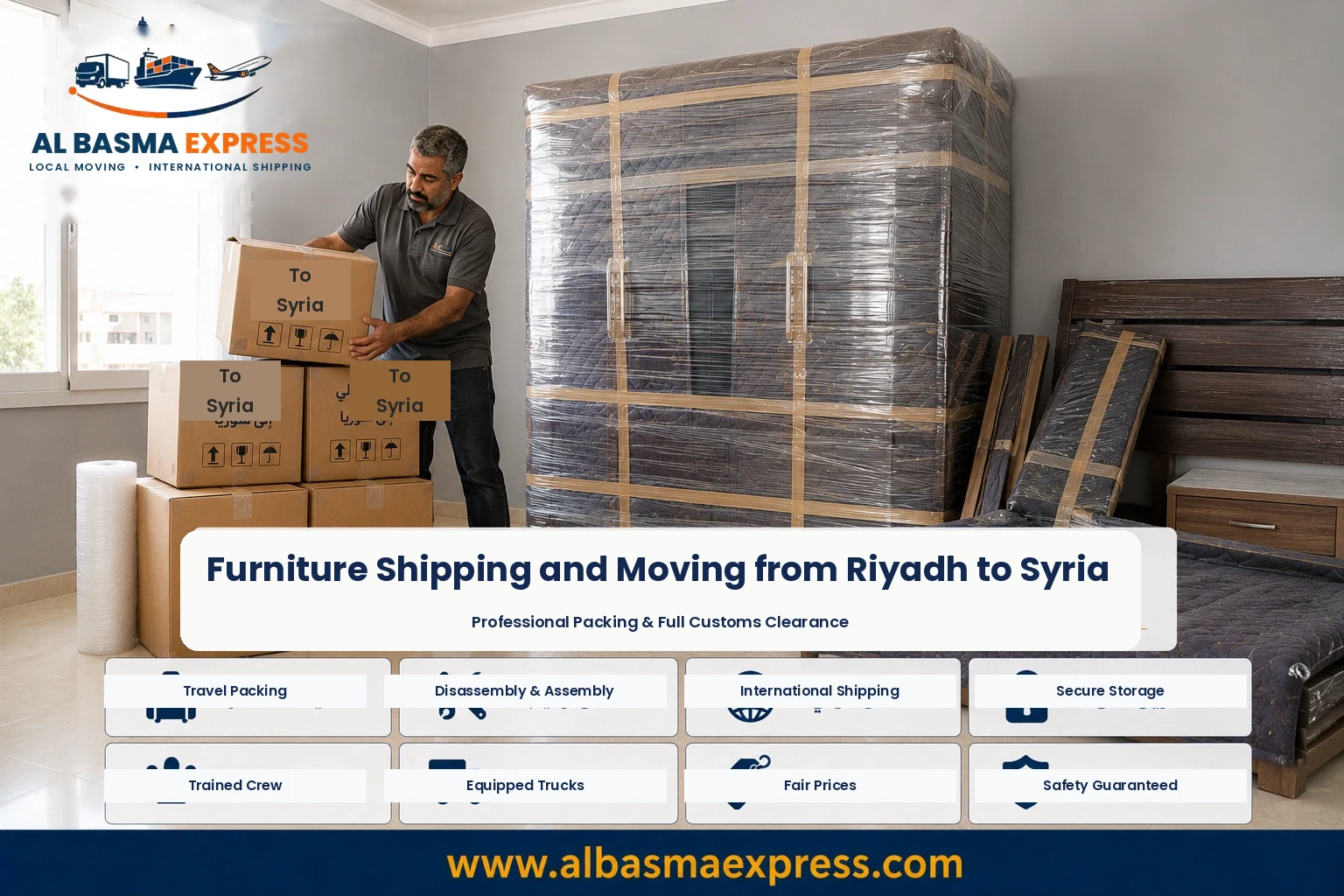
Al Basma Express provides a furniture shipping and moving company from Riyadh to Syria service that starts with listing the furniture, appliances and cartons, then choosing the packing level and the transport method, preparing the packing list, and organizing the loading, the tracking and the delivery inside Syria. This guide aims to give practical content and a professional visual design, away from repeated headings and paragraphs or undocumented marketing claims.
What you'll find in this guide145 topicsShowHide
The summary in 30 seconds
Start with a clear survey, separate the personal furniture from commercial goods, choose between full, consolidated and air shipping by the volume and the speed, and ask for a quote that explains the packing, the expected route, the storage, the clearance and the final delivery point.
🧰 The services the customer actually needs
Moving complete furniture
Disassembly, numbering, packing, loading, delivery and basic assembly according to the service scope.
Shipping cartons and bags
A suitable solution for students, expatriates and small quantities through consolidated shipping.
Moving offices and companies
An inventory by department, moving devices and files while reducing the downtime.
Shipping sensitive pieces
Wooden crates, documentation and insurance for glass, paintings and antiques.
🧭 Start from the purpose of the move, not from the lowest price
First set what you want to happen on delivery day. Does the furniture need to go inside the rooms? Does the agreement include reassembling the wardrobes and beds? Is the Syria address ready or will you need storage? Is the shipment a whole home or only cartons? Answering these questions creates the real service scope.
A quote that looks low may end at a warehouse, exclude the assembly, or rely on long consolidated shipping. So write down the result you want before requesting a price, then compare the companies on an equal service.
🧭 Sorting the furniture before the survey
Review every piece for its value, condition and suitability for the new home. An old piece may hold sentimental value and deserve special protection, while a huge, low-value wardrobe may not be worth the cost of dismantling and shipping.
Split the contents into essential, high-value, replaceable and unused. Make the exclusion decisions before the final survey so the volume and the price are realistic.
🧭 An on-site survey or a video survey
A video survey suits small apartments if the filming is thorough, while villas, offices and custom-made pieces benefit from an on-site visit. The supervisor records the dimensions, the entrances, the floor, the elevator, the sensitive pieces and the expected number of boxes.
Anything that didn’t show during the survey may affect the type of vehicle, the materials, the workers and the time. So the storeroom, the balcony, the appliances, the bags and the items not yet packed must be filmed.
🧭 Why is the volumetric size more important than the number of rooms?
A small apartment may hold a huge wardrobe, a marble table and several appliances, while a larger apartment is furnished with light, dismantlable pieces. What sets the shipment’s space is the volume after disassembly and packing, and the pieces that can’t have anything stacked on them.
Calculating by volume helps in choosing a full truck, consolidated space or air freight for particular parcels. And the volume can be reduced by professional dismantling and sorting the belongings, not by compressing sensitive pieces.
🧭 Three service levels
The basic service focuses on the transport, the complete service adds the disassembly, packing, inventory and basic assembly, while the managed move covers the coordination, the storage, specialized protection and broader follow-up.
Choosing the level is tied to the customer’s time, experience and the sensitivity of their belongings. Someone moving a few cartons doesn’t need a villa package, while a family moving a whole home needs fuller management.
| Service level | What it usually covers | Who it suits |
|---|---|---|
| Basic transport | Loading, transport and unloading | Cartons and simple pieces prepared in advance. |
| Complete service | Disassembly, packing, inventory, transport and basic assembly | Apartments and villas moving in full. |
| Managed move | Storage, coordination, special protection and extended follow-up | Offices, towers, luxury pieces and sensitive dates. |
⚖️ Full or consolidated shipping?
Full shipping
Suitable for villas, large apartments and offices. It gives the customer dedicated space and a more direct schedule and reduces waiting for other shipments to be consolidated, but it usually costs more.
Consolidated shipping
Suitable for cartons and limited pieces. It lowers the cost because the customer pays for the space, but it needs clarity in the separation, the numbering and the distribution date.
📦 Packing built on the risk
Wood fears scratches and friction, glass fears pressure on the edges, fabrics are affected by dust and moisture, and appliances are damaged by their position and movement. So there’s no single layer that suits every piece.
Materials such as felt, cardboard, bubble wrap, corners, stretch film and wooden crates are used according to the type of piece and its value. Packing quality shows in the way it’s secured, not in the quantity of materials alone.
📦 Bedrooms and wardrobes
The piece is photographed before the disassembly, the panels numbered, and the screws and hinges kept in bags carrying the same code. The edges and glossy surfaces are protected, and mirrors separated where needed.
The wardrobe’s dimensions must also be compared with the entrances of the new Syrian home, because moving a piece that won’t fit through the door or the elevator doubles the effort and the cost.
📦 Sofas, majlis seating and soft furnishings
The cushions and removable legs are separated, and a clean layer placed over the fabric before the outer insulation. The wrap mustn’t press the foam or leave marks.
No weights are placed on long majlis pieces, and the soft furnishings are protected from the vehicle’s floor. And if there’s a storage stage, dust and moisture must be kept out.
📦 Glass, mirrors and marble
The protection starts at the edges, then the piece is wrapped and secured upright. Marble surfaces need support that prevents bending, and large paintings and mirrors may need a wooden crate.
A “fragile” mark is useful, but it doesn’t make up for correct securing and preventing pressure and careless handling.
📦 Electrical appliances
Fridges are emptied, cleaned and dried, washing machines prepared per the manufacturer’s instructions, and screens moved upright. Cables and remotes are separated and numbered.
It’s better to photograph the appliance working and record its serial number. After arrival the manufacturer’s instructions must be followed before switching on.
📦 Antiques, chandeliers and paintings
The separable parts are dismantled and wrapped individually, with dividers used inside the crates. High-value pieces need documentation, an estimated value and a dedicated crate.
Separate or dedicated shipping may be better for some pieces than putting them inside a consolidated shipment with a lot of handling.

🛣️ The shipment’s journey from start to handover
The survey and approving the service scope
Setting the contents, the volume, the service level and the suitable transport method.
Disassembly, packing and inventory
Numbering the pieces, preparing the packing list and documenting the sensitive pieces.
Loading and securing
Distributing the weights inside the vehicle and preventing movement and friction.
Running the route
Moving the shipment by the available land, air or consolidated route.
Clearance and distribution
Completing the procedures then sending the shipment on to the Syrian city.
Handover and assembly
Matching the inventory, opening the sensitive pieces and recording the remarks.
🚚 Land freight
It suits furniture, cartons and large shipments when the transit routes and crossings are available. The land route usually passes through Jordan, but the actual route depends on the operating and border situation at the time of booking.
The advantage is the possibility of a door-to-door service in some cases; the challenge is the number of crossings and the changing duration. So a time promise or a final route shouldn’t be fixed before it’s verified.
🚚 Air freight
It suits documents, urgent parcels, samples and small high-value items. It isn’t usually economical for large furniture because of the volumetric weight.
The permitted materials, the packing method, the pickup and delivery points inside Syria, and whether the service covers the final clearance must all be confirmed.
🚚 Consolidated shipping
It allows small shipments to be gathered into one trip to reduce the cost. It suits students, expatriates, cartons and a limited number of furniture pieces.
The consolidation and departure dates, the separation system, the number of handling stages and the final delivery point must be known.
🚚 Sea freight where the route suits
It may be an option for some containers or large goods depending on the available ports and routes, but it isn’t the direct or best choice for every furniture shipment.
The port, the handling, the storage and the distribution route into Syria must be reviewed, and it mustn’t be assumed sea is always cheaper once the fees are added.
| Transport method | Most suitable for | The main advantage | The point to review |
|---|---|---|---|
| Land | Furniture and cartons when the route is available | A possible direct service | The crossings and the transit route. |
| Air | Urgent parcels and documents | Higher speed | The volumetric weight and the permitted materials. |
| Consolidated | Small quantities | Lower cost | The consolidation date, the separation and the handling. |
| Sea | Containers and large volumes where the route suits | High capacity | The ports, the storage and the distribution. |
A note about routes and durations
Border and operating conditions can change, so the route, the duration and the requirements must be confirmed at booking. Don’t rely on fixed figures or absolute promises.
🧾 The packing list and the documents
The file usually needs the sender’s and consignee’s details, a packing list, identity documents, and papers that differ with the transport method and the type of contents. Personal furniture differs from commercial goods.
The descriptions must be clear, avoiding writing “assorted items” on every box. The customer is responsible for the accuracy of the data even if the company helps with the preparation.
🧾 Used furniture and exemptions
Talk of exemptions or fast clearance comes up a lot, but these points need official verification at the time of shipping, because the conditions, the valuation and the fees may change.
Don’t rely on a verbal promise. Ask for a list of the documents, and separate the new or commercial pieces from the used personal furniture.
🧾 Prohibited and restricted materials
Don’t include medicines, foods, chemicals, liquids, batteries or special devices without checking the conditions. Some materials need approvals and some are banned.
Declaring early protects the whole shipment. Hiding a small item may lead to the boxes being opened, delayed or refused.
🧾 Insurance and documentation
Ask for a policy explaining the cover, the exclusions, how the pieces are valued and the claim period. The phrase “full guarantee” or “100% safe” isn’t enough.
Photograph the high-value pieces before the packing, link the photos to the inventory codes, and inspect them at the handover with the supervisor present.
📍 Coverage inside Syria
Damascus and its countryside
Coordinating the address, the floor, the entrances and the unloading hours inside urban areas.
Aleppo
Counting the distribution stage and the distance and choosing a vehicle suited to the district and the building.
Homs and Hama
Setting the final address, the distribution route and the storage if there is any.
Latakia and Tartus
Taking the distance, the coastal climate and the furniture’s protection level into account.
📍 Delivery to Damascus
Damascus and its countryside have districts and buildings that differ in their entrances, elevators and parking. The full address, the geographic location and the consignee’s details must be sent, along with knowing whether a large vehicle can get there.
In older buildings the pieces may need more dismantling, extra workers or an external hoist. These details are settled before the pricing.
📍 Delivery to Aleppo
The distribution stage after the shipment enters Syria must be counted, along with knowing whether the delivery is direct or through a consolidation point. A precise address reduces the waiting and the distance.
In consolidated shipping the distribution date and the separation system are set, and the consignee must be available during the agreed window.
📍 Delivery to Homs and Hama
The distance, the district, the building and the type of road are reviewed. The shipment may need a different vehicle at the last-mile stage, especially if the entrances are narrow.
The city’s and the area’s name must appear in the quote rather than settling for the phrase “delivery to Syria”.
📍 Delivery to Latakia and Tartus
The coastal areas need the distribution stage calculated and the fabrics and wood protected from moisture in case of storage or waiting.
It must also be known whether the shipment will arrive directly or pass through a warehouse, and how many times it will be handled before arrival.
📍 Delivery to the other governorates
Delivery to other cities can be arranged according to the address, the route and the available conditions. It shouldn’t be assumed all the cities have the same cost and duration.
Every serious quote states the final delivery point and whether the service reaches inside the unit, a warehouse or a collection point.
🔹 Moving offices and companies
It starts with an inventory by department, numbering the desks, devices and files, and setting what must work first at the new site. The servers and networks are coordinated with the IT team, and the move can be carried out in phases to reduce the downtime.
The commercial building’s permits and the temporary storage place are reviewed, and the sensitive documents separated from the general furniture.
🔹 Shipping the archive and documents
The files are packed in small numbered boxes, and a code is used for the department and the period without exposing sensitive information. The boxes are sealed and the people authorized to receive them named.
Important original documents may need a separate route or air freight depending on the priority.
🔹 Moving shops and showrooms
The shelving, display fronts and point-of-sale devices are arranged by the installation sequence, and the basic structure loaded so it can come out first.
The trip may be split into fitting-out and goods, and the commercial documents must be separated from the personal belongings.
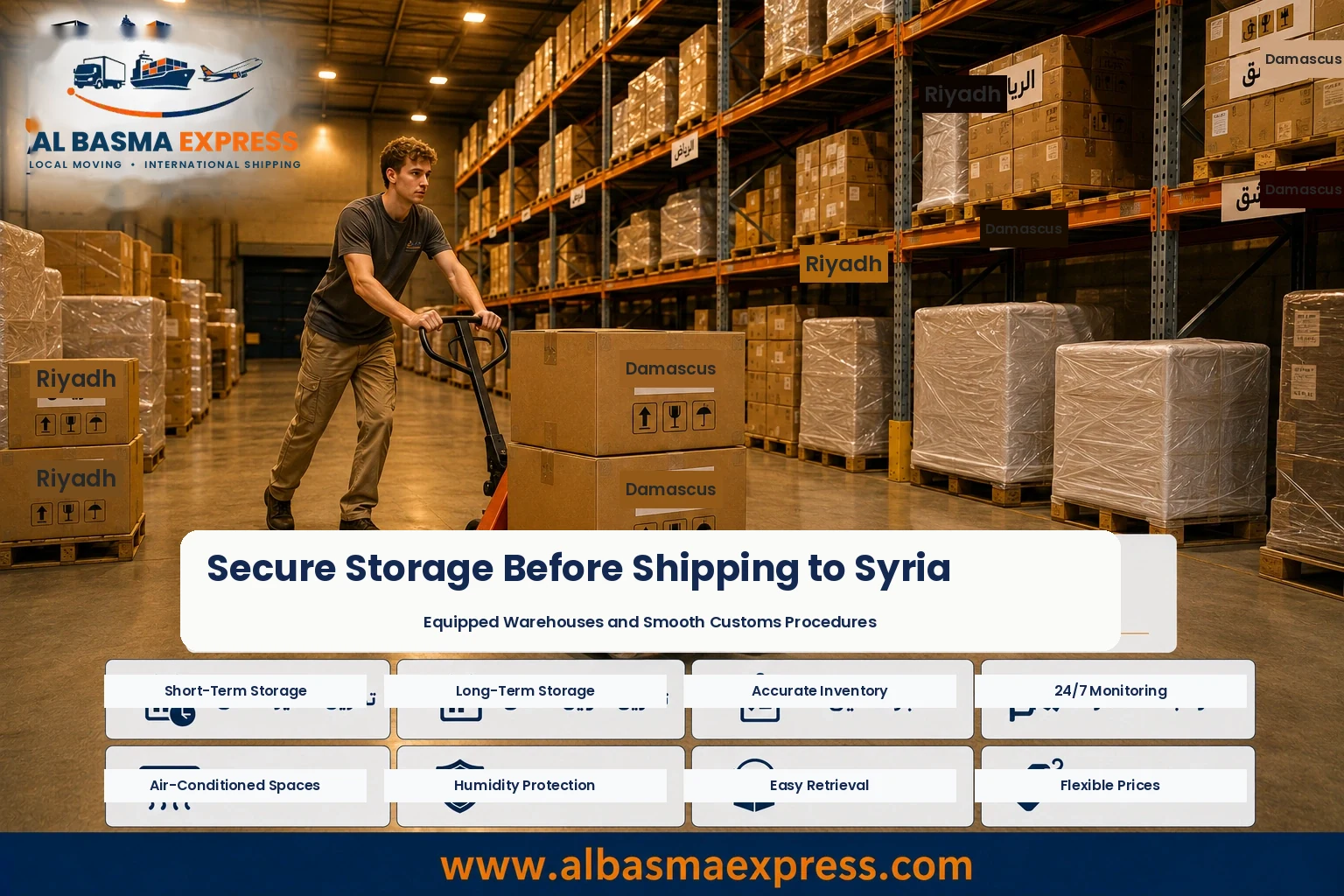
🔹 Temporary storage
The customer may need to store the furniture before the housing is ready. The warehouse’s nature, the period, the fees and how the belongings can be reached must be known.
Documents, medicines and daily needs aren’t stored. Wood and fabrics need a dry, clean place.
🔹 Planning the execution day
The supervisor confirms the list of what will move and what will stay, and the customer sets aside an area for the documents, medicines and personal items. The crew starts with the least-used rooms, then dismantles, numbers and packs.
Having one person authorized to give instructions prevents conflicts. Children and pets should also be kept away from the work area.
🔹 The first days’ box
It holds clothes, chargers, bedding, cleaning supplies, essential medicines and some eating utensils, and stays easy to reach.
The passports, documents, jewelry and important keys stay with the customer and don’t enter the furniture shipment.
🔹 Measuring the furniture and the entrances
Record the dimensions of the wardrobes, sofas and tables, and compare them with the unit’s door, the elevator and the stairs in Syria. A piece may be movable but not fit through the new entrance.
Discovering that early allows extra dismantling, an alteration or excluding the piece, and prevents the need for a hoist or unplanned waiting.
🔹 Organizing clothes and shoes
Clothes travel in dry boxes, and wardrobe boxes are used for formal wear. Shoes are separated, and perfumes or liquids aren’t placed with the clothes.
Split the boxes by family member and room, and keep several days’ clothes with you.
🔹 Kitchen tools and glassware
Cups and plates are wrapped individually, with dividers used inside the box. Heavy pots go at the bottom, and sharp tools are protected.
Open liquids or materials that could leak aren’t shipped, and any foodstuffs must be checked before being added.
🔹 Moving books and bookcases
Books are heavy, so they’re packed in small or medium boxes. The bookcase’s parts and shelves are numbered, and the fixings kept in a labeled bag.
Rare books need protection from moisture, and the boxes are placed near the bookcase’s spot on arrival.
🔹 Pianos and very heavy pieces
These pieces need trolleys, lifting means and enough workers. The plan starts with measuring the corridors and the parking point and setting whether a hoist or partial dismantling is needed.
The corners and surfaces are protected and the piece secured at strong points. Some instruments need tuning after the move.
🔹 Furniture that has been repaired before
The supervisor must be told about any weak point or previous repair in a table, a wardrobe or glass. The part can be reinforced or dismantled separately.
The condition is photographed before the move to tell the old mark from any new remark.
🔹 Protecting the floors and walls
Floor protection runs and covers for the corners and elevators are used. Pieces mustn’t be dragged along the ground; suitable trolleys are used instead.
Protecting the building prevents disputes and helps in keeping to the owner’s or the management’s instructions.
🔹 Handling a change of address
If the delivery address changes, the company must be told immediately, because the distance, the vehicle and the entrances may change. The cost and the schedule are reviewed in writing.
If the address isn’t ready, organized storage is better than the vehicle waiting for an open-ended period.
🔹 The customer’s absence at arrival
An authorized person is appointed who knows the inventory list, the room plan and the limits of the signing authority. The customer can follow the handover by video, but someone must be present.
Having no one to receive may lead to waiting, storage or rescheduling.
🔹 Shipping in peak seasons
Requests rise in the summer, at the end of leases and in the travel seasons. Booking early leaves time for the survey and the documents and gives more options.
A margin should also be left in the schedule and the delivery not tied to a date that can’t slip.
🔹 Reverse shipping from Syria to Riyadh
The same principles apply in the reverse direction: survey, sorting, packing, inventory, documents and a final address. But the price, the route and the duration shouldn’t be assumed identical.
Return trips can be used when they’re available, while keeping the separation, the numbering and the insurance.
🔹 The after-delivery service
The service doesn’t end when the last box is put down. There must be a channel for recording remarks and reviewing the inventory and the pieces needing adjustment or follow-up.
Having a written procedure makes handling a missing fitting or a piece needing readjustment faster and clearer.
🔹 Signs of a professional moving crew
Professionalism shows in the crew arriving with the right materials and tools, having a supervisor, using codes, protecting the place, and carrying the furniture rather than dragging it.
It also shows in reviewing the inventory before closing, and in calm, organized communication.
🔹 Documenting any change to the agreement
Adding boxes, changing the date, or adding storage, assembly or a hoist must be written down and reach the execution crew.
The latest written version of the quote and the list of services is the real reference, not scattered phone calls.
🔹 Building a realistic timeline
Start from the date you take over the housing in Syria then work backwards: the survey, the sorting, the packing, the documents and the loading. Leave a margin for the crossing and the distribution.
A realistic schedule reduces the pressure and prevents costly last-minute decisions.
🔹 Handling unusually low quotes
A low quote may be consolidated shipping, or may not cover the packing, the delivery inside the unit or the possible fees. So the items are compared rather than the figure alone.
If the company refuses to explain the route, the delivery point, the insurance and the exclusions, that’s a sign worth caution.
🔹 Delivery at the door or inside the unit?
Delivery at the door may mean the building’s entrance only, while delivery inside the unit covers the elevator or the stairs and distributing the boxes. And that differs from the assembly and removing the packing.
The quote must state clearly where the company’s responsibility ends.
🔹 Removing the packing waste
After the pieces are unwrapped, quantities of cardboard, plastic and felt pile up. It must be agreed who collects them and where they go.
Collecting the materials as you go keeps the corridors clear and makes the assembly easier.
🔹 Inspecting the appliances on arrival
The packing, the visible condition, the fittings and the serial numbers are reviewed. The appliances aren’t switched on before their position is confirmed and the manufacturer’s instructions followed.
Any noise, warning or remark is documented immediately before the operation continues.
🔹 Assessing the assembly’s quality
The wardrobes, beds and desks are tested after assembly, confirming the doors are aligned, the pieces stable and there are no leftover screws without an explanation.
If a piece needs fixing to the wall, a tool suited to the wall type must be used.
🔹 The review before the vehicle is closed
The count, the codes, the bags of screws and the keys are reviewed, and it’s confirmed the appliances and sensitive pieces are secured. A general photo of the load is taken.
The address, the consignee’s name and the arrival instructions are also confirmed before departure.
🔹 Keeping moving day calm
Prepare a task list, name one person for the communication, keep children and pets away, and put the documents and medicines somewhere separate.
Calm doesn’t mean no follow-up; it means follow-up built on a clear, written plan.
✅ A checklist before shipping
❓ Frequently asked questions
What’s the best shipping method to Syria?
It depends on the shipment’s size, the speed and the state of the routes. Furniture may suit land, urgent parcels suit air, and small quantities suit consolidated shipping.
Is there a fixed land route?
No; the route is affected by the state of the crossings, the regulations and the operating conditions, and it must be confirmed at the time of booking.
Can a single carton be shipped?
Yes, through consolidated shipping when it’s available, with the consolidation and delivery dates set.
Is the price by the kilo?
Weight may be used for parcels and air freight, but furniture also depends on the volumetric size, the packing and the handling.
Does the price include the clearance?
It depends on the quote, and what’s included and what remains the customer’s responsibility must be specified.
Is used furniture exempt?
There may be conditions or exemptions, but they must be verified officially at the time of shipping.
Can the furniture be stored?
Yes, once the type of warehouse, the period, the fees and the final delivery are agreed.
Is the assembly done in Syria?
It can be included depending on the package, with the pieces and the technical work clearly specified.
Does the service reach Aleppo and Latakia?
Delivery can be arranged to several Syrian cities according to the address and the available route.
Is removing the packing included?
That must be stated in the quote because it isn’t automatic in every package.
When should I book?
The larger the shipment or the more it’s tied to crossings or a consolidation schedule, the better it is to book early.
How do I choose the company?
Compare the clarity of the quote, the packing, the route, the insurance and the communication, not the price alone.
🧩 An apartment move to Damascus
The scenario and the solution
A family moving a bedroom, a sofa, a screen and several boxes to a building in Damascus. A careful video survey is done, the elevator doors measured, and the boxes numbered by room. Full shipping is chosen because the family needs an organized arrival on a set date. At the handover the bed and wardrobe go in first, then the essential boxes are opened. The main challenge isn’t the shipment’s size but the narrow entrance and the need to coordinate the unloading time. The solution came from dismantling the wardrobe further and preparing assembly photos for the arrival crew.
🧩 A student’s cartons to Aleppo
The scenario and the solution
The customer has books, clothes, a computer and some personal items. Consolidated shipping suits him because the volume is small and the date flexible. Small boxes are used for the books, solid protection for the computer, and the documents and medicines stay with him. The consolidation and distribution dates are explained to him rather than just the departure date. This case differs from moving a whole home; here the priority is the weight, the organization and ease of receiving.
🧩 An office to Homs
The scenario and the solution
A small company moving desks, devices and an internal network. The work starts with an inventory of each department, numbering the screens and cables, and identifying one core workstation that must run first. The sensitive files move in sealed boxes, while the IT team coordinates disconnecting the network. Executing in two stages reduces the downtime and prevents the commercial furniture getting mixed with personal belongings.
🧩 Luxury pieces to Latakia
The scenario and the solution
The shipment includes a large painting, a marble table and a light-colored sofa. Solid protection is made for the painting, the marble is supported from below, and the fabrics are covered with a clean layer and outer insulation. Because of the coastal climate and the possibility of short storage, moisture insulation is given more attention. The pieces are documented with a value and separate photos before loading.
🧩 A whole home to Hama
The scenario and the solution
The home has several rooms, appliances, a majlis and a kitchen. The survey is carried out on site and the disassembly and packing split over two days. A detailed list is prepared, and the pieces that go into the inner rooms first are identified. Choosing the truck rests on the volume after disassembly rather than the number of rooms. On arrival the room plan is used to avoid piling everything in the living room.
🧩 A change of address before the arrival
The scenario and the solution
The delivery was set for an address in the Damascus countryside then changed to a building inside the city. The change meant different entrances, parking and elevator, so the distribution plan was updated and a smaller vehicle chosen for the last mile. Documenting the change before the arrival prevented the large vehicle waiting and unexpected extra fees.
🔸 Choosing what genuinely deserves shipping
Not every piece in the home is a good candidate for international transport. Each item can be assessed against three questions: will it be used in the new home? Are its dimensions suitable? And is the cost of moving it reasonable compared with its value or the difficulty of replacing it? This way the customer can exclude worn or huge unsuitable items and keep what has practical or sentimental value. The sorting also helps reduce the packing materials, the number of boxes and the disassembly and loading time. It’s better for this decision to be made before the quote is approved, because changing the list on execution day may mean a different type of vehicle, a different reserved space or a different number of workers.
🔸 Checking the new home’s dimensions
Measuring the doors, corridors, elevator and stairs in Syria is an essential step before shipping wardrobes, sofas and large tables. A piece may be sound and movable but not fit through the new entrance, or need more dismantling than planned. Sharing the measurements and photos with the survey team makes it possible to decide whether the piece needs an extra carpenter, a hoist or an alteration. The data also helps in putting the furniture in the right room rather than discovering on delivery day that the door, the balcony or a turn in the stairs blocks the movement.
🔸 Preparing the clothes and bags
Everyday clothes travel inside clean, dry boxes, while formal wear, abayas and suits benefit from wardrobe boxes that reduce creasing. Shoes are separated into bags or smaller boxes, and perfumes or liquids aren’t placed with the clothes to avoid leaks. The boxes can be split by family member, room and season, with a clear mark on the everyday clothes box. It’s better to keep a bag holding several days’ clothes with the customer, because the shipment’s arrival time may differ from the family’s.
🔸 Packing the kitchen tools
Cups and plates are wrapped individually or in small groups with dividers, with the heavy pots at the bottom of the box and the light ones on top. Knives and sharp tools are protected inside a solid wrap that prevents piercing the cardboard or injuring the workers. Open liquids or containers that could leak aren’t recommended, and any foodstuffs must be checked before being included in the shipment. Kitchen boxes should be medium-sized so they stay liftable and don’t collapse under the weight.
🔸 Books and bookcases
Books are dense despite their small size, so they’re packed inside small or medium boxes rather than a large carton that’s hard to carry. The bookcase’s parts and shelves are numbered, and the screws and supports kept in a bag carrying the same code. Rare or delicate books benefit from a suitable insulating layer, making sure the paper is dry before sealing. On arrival the boxes go straight to the bookcase’s spot to reduce how often they’re moved inside the home.
🔸 Custom-made furniture
Wall wardrobes, kitchens and desks designed for a specific space need their own review. Dismantling them may be possible, but installing them at the new site may need altering, cutting or replacing some parts. Before shipping, the measurements and the position of the sockets, windows and ceiling height must be compared. Sometimes altering the piece in Riyadh before the move is easier and cheaper than trying to solve the problem after arrival. The disassembly method must also be documented and every part numbered clearly.
🔸 Pieces that have been repaired before
Any piece that has been broken or repaired before must be treated as more sensitive. The supervisor should be told about a fixed table leg, a weak wardrobe back or replaced glass, because the repair point may not take the usual carrying method. The part can be temporarily reinforced or dismantled separately, with its condition photographed before the move. Declaring an old defect doesn’t harm the customer; it helps in choosing realistic protection and makes the documentation clearer.
🔸 Pianos and heavy pieces
A piano, metal cabinets and large marble need more workers, lifting equipment and suitable trolleys. The planning starts with measuring the entrances, the elevator and the parking point, then setting whether the piece needs a hoist or partial dismantling. The corners and surfaces are protected, and it’s secured inside the vehicle at strong points that don’t press on the frame. Some musical instruments need tuning after the move, so that step should be counted within the settling-in plan in Syria.
🔸 Preparing air conditioners and fitted appliances
Air conditioners, ovens, extractor hoods and fitted appliances need a qualified technician for the dismantling, not just a moving worker. It must be set whether the quote covers handling the gas, the connections and the pipes, and whether installing them in Syria is part of the service or done by an independent technician. The openings are sealed, the cables and pipes protected, and each unit numbered with its fittings. The appliance’s compatibility with the new site is also checked before shipping it.
🔸 Rugs and carpets
The rug is cleaned and dried completely then wrapped in a layer protecting it from dust and moisture. It isn’t placed under sharp or heavy pieces that could cause a dent or deformation. The room’s name can be written on each roll to make the distribution easier on arrival. If the trip includes storage, the rug mustn’t be sealed while damp, because that can cause odors or stains that are hard to treat.
🔸 Mattresses and soft furnishings
Mattresses are covered with clean, dust-resistant bags, and aren’t folded or compressed for long periods because that can change their shape. They’re loaded in a stable position away from metal edges or a dirty floor. The cushions and soft furnishings are also separated by room, and it’s set what needs opening quickly on arrival. This organization helps the family prepare the bedrooms before the rest of the home.
🔸 Planning a shipment in two batches
Splitting the shipment may make sense when the customer wants to send the non-essential furniture early then the daily needs later. This option eases the pressure of a single day, but it may increase the vehicle and handling costs. The two shipments must be compared with a single shipment plus temporary storage. If it is split, two separate lists are prepared, the boxes clearly distinguished, and what must arrive first is set.
🔸 Coordinating arrival at older buildings
Some older buildings in Damascus, Aleppo or other cities may have narrow stairs and small elevators or no elevator at all. The entrances must be measured, the turning points identified, and the possibility of using an external hoist assessed. The staircase and walls must also be protected and the residents or the concierge coordinated with. The more information available before the truck arrives, the better the workers and equipment can be chosen and long waiting avoided.
🔸 Booking the elevator and the parking spot
In towers and managed compounds, booking the service elevator may be a basic requirement. The permitted hours, the booking period and whether the management asks for wall protection or a deposit must be known. The vehicle’s parking spot and the distance to the elevator must also be set. If the slot isn’t booked, the truck may have to wait or redistribute, which raises the cost and consumes the crew’s time.
🔸 Protecting the floors and walls
Floor protection runs and corner covers are used, and the elevator doors and corridor walls protected. Heavy pieces mustn’t be dragged directly along the ground; suitable trolleys and padding are used instead. Protecting the place reduces disputes with the owner or the management, and protects the furniture itself from knocks while passing through narrow corridors.
🔸 Preparing the delivery address in detail
The address mustn’t be limited to the city’s or the district’s name. It’s better to record the street, the building, the floor, the unit number, the geographic location, the contact numbers and the arrival instructions. In areas that don’t use clear addresses, a photo of the entrance or a description of a nearby landmark helps. These details reduce the time lost searching and help in choosing a vehicle that can reach the site.
🔸 Handling narrow or mountain roads
A large truck may only reach a nearby point, then a smaller vehicle is used for the final stage. This scenario must appear in the quote because it adds handling, distance and cost. In mountain areas or narrow roads, the road’s condition, the turning point and the parking spot are reviewed. The weather may also affect the timing, so a margin should be left in the schedule.
🔸 A change in the delivery address
If the address changes after the shipment has departed, the company must be told immediately. The new address may change the city, the distance, the type of vehicle, the number of workers or the need for storage. The change is reviewed in writing, and any new cost or duration set before the redirection is carried out. A delay in reporting may mean the vehicle arriving at a site that isn’t ready or isn’t suitable.
🔸 The home not being ready in time
If the painting, flooring or electricity isn’t finished, temporary storage may be better than bringing the furniture into a place exposed to dust or damage. The shipment is split into what the customer needs immediately and what can be stored. The warehouse’s nature, the storage period and the redelivery fees must be known. This option needs an early decision, not an emergency solution when the truck arrives.
🔸 The customer’s absence at the handover
An authorized person is appointed who knows the inventory list, the room plan and the limits of the signing authority. The customer can follow the handover by video, but someone must be present to take decisions and record remarks. Having no one to receive may lead to waiting, storage or rescheduling. So the substitute person’s details are sent before the date.
🔸 Delivery at the door or inside the unit
Delivery at the door may mean the building’s entrance only, while delivery inside the unit covers the elevator or the stairs and distributing the boxes to the rooms. And that differs from unwrapping, assembling and removing the waste. The quote must state clearly where the company’s responsibility ends, because each level needs different workers, time and equipment.
🔸 Managing the packing waste
After the pieces are unwrapped, quantities of cardboard, plastic and felt pile up. It must be agreed who collects them and where they go. Some buildings prohibit leaving them in the corridors or near the entrance. Collecting the materials as you go preserves the working space and reduces the risk of tripping, and it allows the furniture to be inspected in a more organized environment.
🔸 Planning the order for opening the boxes
All the boxes shouldn’t be opened at once. Start with the beds, bedding and the essential bathroom and kitchen tools, then the clothes and appliances, and leave the books and décor until the end. This plan makes the home usable quickly and prevents the contents and packing materials spreading through every room. Put a clear mark on the priority boxes.
🔸 Reviewing the appliances after arrival
The inspection starts by reviewing the packing, the visible condition, the fittings and the serial numbers. The appliances aren’t switched on immediately before their position is confirmed and the manufacturer’s instructions followed. If an unusual noise or a warning appears, it’s documented and the operation isn’t continued. The protective materials can be kept until the inspection is complete.
🔸 Assessing the assembly’s quality
After the wardrobes, beds and desks are assembled, the doors, drawers, stability and alignment are tested. It’s reviewed that the screws are in their right places and that the piece doesn’t block a door or a socket. If a piece is fixed to the wall, a tool suited to the wall type must be used. Any remark is recorded before the crew leaves.
🔸 Commercial shipping kept separate
Goods for sale shouldn’t be mixed with personal household furniture under one description. Each category has different documents and treatment, and mixing them may cause a delay or a change in the fees. A separate list is prepared for the commercial goods with the necessary invoices and documents, and they’re kept apart from the personal belongings in the packing and the inventory.
🔸 Moving cars along with the furniture
If the service includes a car, it’s handled on an independent track. It’s photographed from all sides, the odometer, the fuel and the scratches recorded, and it’s emptied of personal items. The transport method, the documents and the delivery point are set separately from the furniture. Unifying the follow-up is useful, but it doesn’t mean putting the car and the furniture in one vehicle.
🔸 Moving bicycles and sports equipment
The protruding parts of bicycles and gym equipment are removed, the tires and frames protected, and the bolts and fittings kept in labeled bags. Heavy equipment needs measuring and lifting means, and it must be confirmed there’s suitable space for it in the new home. Some machines may need a technician for the installation and calibration.
🔸 Handling plants
Live plants may be subject to restrictions and may not suit international shipping. The conditions must be checked and they mustn’t be put inside the furniture shipment without a permit. Empty pots can be kept after cleaning if that’s allowed. It’s better to arrange an alternative for the plants than to expose the whole shipment to delay.
🔸 Peak seasons
Requests rise in the summer, at the end of leases and in the travel seasons. Booking early leaves time for the survey and the documents and gives better options for the dates. A margin should also be left in the schedule and the arrival not tied to a work or travel commitment that can’t slip. Rushing in a busy season may mean fewer options or a higher cost.
🔸 Handling a delay on the road
A delay may come from the crossings, the weather, an inspection or congestion. The customer should get an update when a significant change happens, with the new stage and the expected time explained realistically. Repeating the phrase “on its way” with no details doesn’t help. Having one follow-up contact makes the communication clearer.
🔸 The bill of lading and the transport document
The transport document sets out the sender’s and consignee’s details, the shipment’s nature and its destination. The names, the counts and the city must be reviewed before it’s issued, and a digital copy kept. Any error in a name or an address may cause a delay at the delivery or the clearance. The document is reviewed against the packing list and isn’t left to the office without the customer checking it.
🔸 Handling the insurance
An insurance policy needs reading, not just existing. It must be known whether it covers the loading, unloading and storage, how used pieces are valued, and what the exclusions are. High-value pieces must be declared and documented. The claim period and the documents required are also established.
🔸 The after-delivery service
The service doesn’t end when the last box is put down. There must be a channel for recording remarks and reviewing the inventory and the pieces needing adjustment or follow-up. The customer may discover a missing fitting or a drawer that doesn’t work hours later. Having a clear procedure makes the handling faster and more organized.
🔸 Signs of a professional crew
Professionalism shows in the crew arriving with the right materials and tools, having a supervisor, using codes, protecting the place, and carrying the furniture rather than dragging it. It also shows in reviewing the inventory before closing and in calm communication. The quality of the workers matters no less than the quality of the vehicle.
🔸 Documenting any change
Adding boxes, changing the date, or adding storage, assembly or a hoist must be written down and reach the execution crew. A verbal agreement may not pass between the office, the driver and the workers. The latest written version of the quote and the list of services is the real reference.
🔸 Building a realistic timeline
Start from the date you take over the housing in Syria then work backwards: the survey, the sorting, the packing, the documents and the loading. Leave a margin for the crossing and the distribution. Don’t tie the arrival day to an important meeting or other travel. A realistic schedule reduces the pressure and protects the quality of the decisions.
🔸 Very low quotes
A low quote may be consolidated shipping or may exclude the packing, the delivery inside the unit or the possible fees. So the items are compared rather than the figure alone. Ask about the route, the delivery point, the number of handling stages and the insurance. If the company refuses to explain the scope, that’s a sign worth caution.
🔸 The review before the vehicle is closed
The count, the codes, the bags of screws and the keys are reviewed, and it’s confirmed the appliances and sensitive pieces are secured. A general photo of the load is taken, and the address, the consignee’s name and the arrival instructions confirmed. These last minutes prevent a box being forgotten or the instructions differing between the loading crew and the arrival crew.
🔸 Keeping moving day calm
Prepare a task list, name one person for the communication, keep children and pets away, and put the documents and medicines somewhere separate. Don’t arrange travel or an important meeting at the same time. Calm doesn’t mean no follow-up; it means follow-up built on a clear plan that prevents rushed decisions.
🟠 Choosing the type of vehicle by the last kilometer
The type of vehicle isn’t set by the shipment’s size alone, but also by whether it can reach the final address. A large truck may suit the main trip, but the street, the district or the building’s entrance may not allow it in. In that case a smaller vehicle is used for the final stage, and this scenario must be known before departure. Every extra handling means time, cost and a greater chance of friction, so the transfer between the two vehicles is planned carefully, keeping the inventory codes and protecting the sensitive pieces. Sending photos of the road, the entrance and the parking spot helps the company make the right decision rather than discovering the problem after the shipment arrives.
🟠 Organizing the furniture keys and remotes
Small keys, appliance remotes and fittings are among the things most likely to be lost if they’re put inside general boxes. It’s better to create a central fittings box holding separate bags, each carrying the code of the piece it belongs to. The bag’s contents can be photographed before it’s sealed, and the box handed directly to the assembly supervisor on arrival. Keys aren’t left inside drawers because a drawer may be removed or opened during the handling. This simple system prevents the assembly stopping over a missing screw or key, and makes reviewing the fittings faster and more accurate.
🟠 Handling furniture highly sensitive to moisture
Some woods, fabrics and musical instruments are affected by moisture even if they aren’t exposed to water directly. If the shipment will pass through a warehouse or wait in a coastal area, a suitable insulating layer must be used along with ventilation that prevents moisture being trapped inside the wrap. A damp piece shouldn’t be wrapped, nor cleaned with water immediately before sealing. Moisture-absorbing materials can also be placed inside the sensitive boxes where suitable. This need is identified during the survey, because the wrong kind of extra protection can be as harmful as too little.
🟠 Checking the condition of the boxes used
A used cardboard box isn’t always refused, but it must be clean, dry and strong with no tears or signs of crushing. Weak boxes may collapse when stacked or open during lifting. Double-wall cardboard is used for books and heavy tools, and smaller boxes for dense contents. The base is sealed with strong tape crosswise rather than a single strip in the middle. Writing the contents, the direction and the room on more than one side makes the label visible however the box sits inside the truck.
🟠 Separating personal items from the work shipment
When a company or office owner moves, personal papers and devices may get mixed with the work furniture and goods. It’s better to prepare three separate lists: the office furniture, the commercial equipment and files, and the personal belongings. This separation eases the inventory, the documents and the handover, and prevents a personal box being opened while commercial goods are inspected. It also helps in setting who may receive and sign. The employee responsible for the archive may not be the same person receiving the furniture or the devices, so the responsibilities must be distributed from the start.
🟠 Assessing the need for a wooden crate
Not every piece of glass or every screen needs a wooden crate, and not every high-value piece can be protected with bubble wrap alone. The decision depends on the size, the weight, the fragility, the number of handling stages and the difficulty of replacement. A good wooden crate has a lining, a protective gap and securing points, and isn’t just panels surrounding the piece. It may suit a large painting, an expensive screen or a laboratory device, while reinforced cardboard protection is enough for a smaller piece. A specialized survey balances the cost against the protection rather than applying one solution to everything.
🟠 Arranging the loading of the priority boxes
The boxes the customer needs immediately on arrival mustn’t be buried deep in the load, but placing them near the door mustn’t come at the expense of the vehicle’s balance or the pieces’ protection. The supervisor sets a suitable position for the first days’ box and the essential fittings, with a prominent mark in the inventory. At the unloading these boxes are handed first to a specific person and aren’t left among the rest of the cartons. The organization prevents the customer searching for a medicine, a charger or keys among dozens of boxes after a long trip.
🟠 Handling pieces that can’t be dismantled
Some tables, sofas or wardrobes are designed as a single unit and can’t be dismantled without damage. These pieces need precise measurement of the entrances, strong corner protection, and a clear carrying route from the room to the vehicle. Doors or a banister may be removed temporarily if that’s allowed and safe, or an external hoist used. If access isn’t possible, a decision must be taken before execution day: alter the piece, exclude it, or change the entry point. Leaving the decision to the last moment creates pressure and risk for the workers and the building.
🟠 Preparing the consignee’s details
The consignee’s details in Syria must be clear and match what the service or the procedures require. The name, the contact number, the address and the authorized person’s identity where needed are recorded. If the consignee isn’t the shipment’s owner, the limits of their authorization and their ability to sign the handover record and note remarks must be set. An alternative number is also preferable, because one phone failing may cause waiting. These details are sent to the operations contact and reviewed before the shipment nears its destination.
🟠 Setting the policy for opening the boxes at the handover
Some customers want every box opened and inspected, while others prefer to check the sensitive pieces only then open the rest later. What the crew’s time and the service scope allow must be agreed. Opening every box may need time, workers and waste removal, and may not be included automatically. It’s better to set a list of the pieces to be opened with the supervisor present: the screens, the glass, the antiques, the expensive devices, then inspect the rest of the boxes visually and record any sign of pressure or moisture.
🟠 Reviewing the fees for extra services
Extra services such as storage, a hoist, waiting, a small vehicle and redelivery must have a clear calculation method. The customer doesn’t ask for a fixed figure for every possibility, but they need to know the basis: the cost of a storage day, an hour of waiting, or a distribution trip. This transparency prevents a dispute when something unexpected happens. It must also be clear who approves an extra service, so a new cost isn’t incurred on a site worker’s decision without going back to the customer or the authorized person.
🟠 Handling the weather during the loading
Loading in extreme heat, rain or dust needs organization that protects the workers and the belongings. Cartons and fabrics aren’t left in the street for long, and the waiting area is covered where possible. Sensitive appliances don’t move straight from a very cold place into high heat without considering condensation. Water and suitable rest must also be provided for the workers so that speed and exhaustion don’t lead to carrying errors. Choosing a suitable execution time reduces the risks and makes the work more efficient.
🟠 The difference between tracking and operational updates
A dot on a map isn’t always enough to understand the shipment’s status. A useful update explains the stage: loaded, the vehicle has departed, reached a crossing point, the procedures are complete, or the distribution date is set. Live tracking may not be available on every method or route, so the company must know what form of communication it actually provides. Promising an advanced system with no link or clear mechanism doesn’t help the customer. Better is a schedule of updates and a known contact to go back to.
🟠 How is the packing list written clearly?
The list is written at a level of description that helps with the matching without going into unnecessary detail. Instead of “items”, you can write personal clothing, books, kitchen tools or soft furnishings. The large pieces are listed separately, such as a four-part wardrobe or a screen with its stand. The counts and codes must match the labels. If the contents change during the packing, the list is updated before the loading. An accurate list helps in the clearance, the inventory, the insurance and the distribution, and reduces the chance of boxes being opened because of a vague description.
🟠 Reviewing the contract before execution day
Before the crew arrives, review the customer’s name, the addresses, the type of shipment, the transport method, the services included, the payment method, the insurance and the amendment policy. Don’t wait until loading day to discover that the assembly or the storage isn’t mentioned. If you find a vague clause, ask for it to be clarified in writing. It must also be known what the customer’s responsibilities are, such as preparing the permits, declaring the materials or providing someone to receive. A clear contract doesn’t prevent every problem, but it makes solving one faster and fairer.
🟣 Reviewing the final plan before moving
Before the shipment departs, a short review should be held bringing together the packing list, the photos of the sensitive pieces, the consignee’s details, the address, the transport method and the service’s end point. This review reveals any difference between what was agreed and what was actually carried out. The number of boxes may have increased, a piece may have been excluded, the consignee’s phone number may have changed, or reaching the building may now need a smaller vehicle. Updating these details before moving is far easier than amending them on the road.
It’s better for the customer to keep a digital copy of the contract, the list and the photos, and to know the operations contact’s name and how to reach them. It must also be confirmed whether the shipment will arrive directly or pass through consolidation or storage, and what the expected distribution window is. This step gives the customer a clear picture of the trip and stops the follow-up depending on guesswork or scattered messages from several people.
🟣 Organizing the first twenty-four hours after the handover
After the shipment arrives, the first goal isn’t opening everything, but making the home safe and usable. The beds and main wardrobes are assembled, and the clothes, bathroom and kitchen boxes carrying the priority mark are opened. The packing materials are gathered in one area and the corridors kept clear. After that the inspection of the sensitive pieces and the appliances begins, with any remark recorded before the boxes or protective materials are disposed of.
It helps to keep a list showing what has been opened and what remains sealed, especially in large homes. It’s also better not to switch on all the appliances at the same time, but to check each one according to its instructions. Arranging the first hours this way reduces the chaos and the exhaustion, and makes any shortage or remark clearer and easier to document and resolve.
🟣 A final tip for a more comfortable experience
Don’t make moving day the same day you travel or start a new commitment. Leave time for the review, the inspection and the signing, and prepare a substitute person who can take decisions when needed. The more realistic the schedule, the better the crew can carry out the service calmly and without cutting short the protection, inventory or assembly steps.
🚚 In summary
The success of shipping and moving furniture from Riyadh to Syria starts before the vehicle moves: sorting the furniture, a precise survey, suitable packing, choosing the transport method by the actual conditions, clear documents, and an organized final address. With Al Basma Express the service can be designed by the shipment’s size, the delivery city and the level of protection required, with a clear workflow from Riyadh through to the customer’s door in Syria.