

Topics in this guide113 topicsShowHide
Al Basma Express provides Al Basma Express the service of a furniture shipping and moving company from Riyadh to Jordan with disassembly, packing, inventory, loading, land freight, delivery and basic assembly available according to the package. And this guide gives practical content tailored to the Riyadh–Jordan route, away from exaggerated promises.
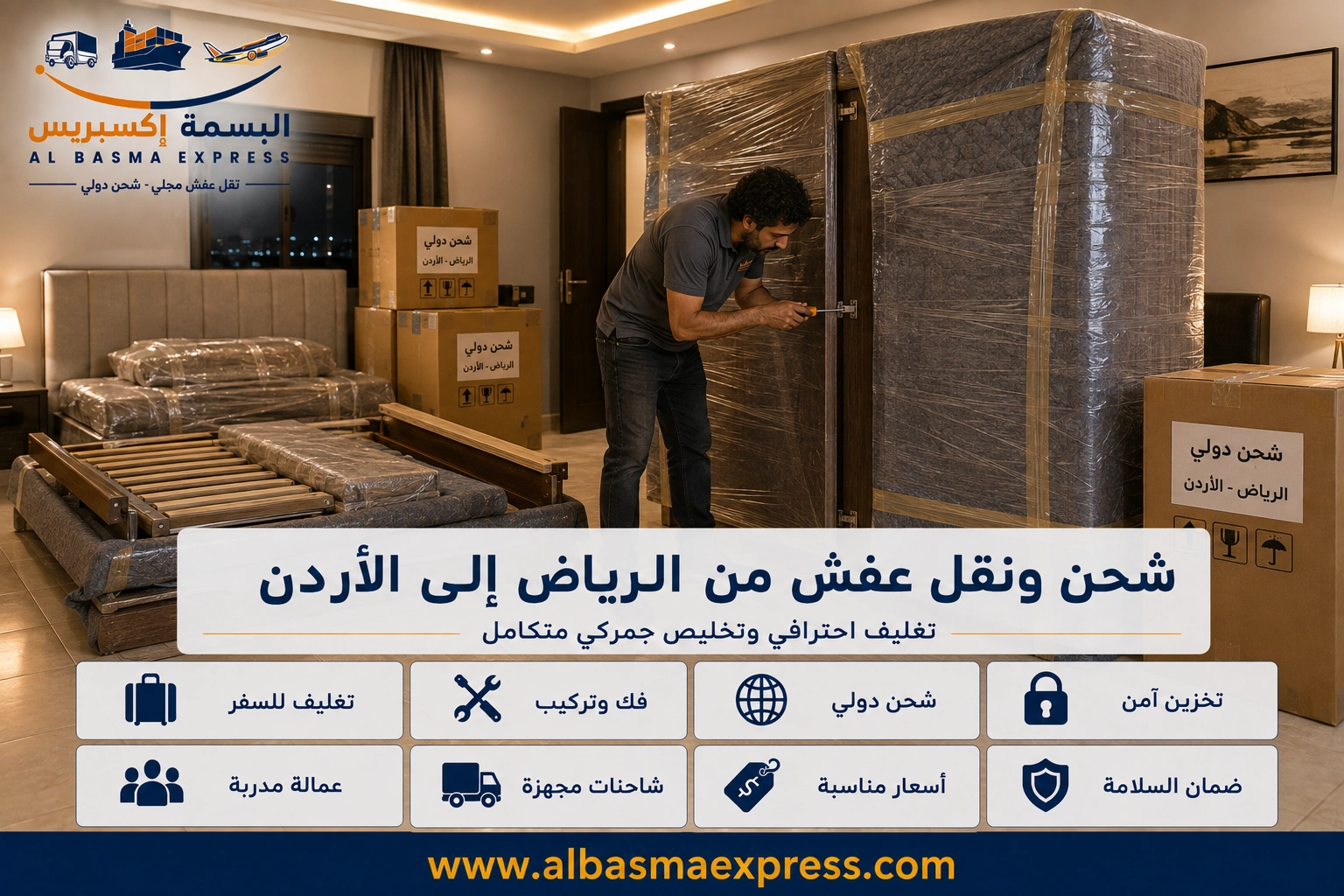
The main services
🛋️ Moving a whole home
Disassembly, packing, inventory, loading, delivery and basic assembly.
📦 Shipping cartons
For students, expatriates and small quantities.
🏢 Moving offices
Numbering the devices and furniture by department.
🚗 Car shipping
Documenting the condition, the papers and the handover.
Setting the service scope before requesting a price
Is the furniture to be moved to the building’s door or brought inside the unit? Does the agreement cover the disassembly, the assembly and removing the packing materials? Settling these details before the pricing prevents expectations differing at the handover and makes comparing companies fair.
And the service scope is written before the price rather than after, because a price with no scope is a figure with no meaning.
Sorting the furniture before the survey
Split the contents into essential, high-value, replaceable and unused. Excluding large worn pieces before the survey reduces the volume, the packing materials and the number of workers, and prevents the booking being changed on execution day.
And a piece that won’t be used in Jordan within the first six months deserves a direct question: is it shipped, or sold in Riyadh?
The on-site survey
Villas, offices and custom-made furniture benefit from an on-site visit to measure the dimensions, the entrances, the elevator and the floor. The supervisor can also identify the need for a carpenter, a hoist or a wooden crate.
The video survey
It suits small apartments and clear quantities provided all the rooms, storerooms, balconies and appliances are filmed. The distance between the home’s door and the vehicle’s parking spot must be shown, and the items not yet packed mustn’t be hidden.
The volumetric size
The number of rooms isn’t enough to set the shipping cost. What matters is the space the pieces take after disassembly and packing, and the gaps that can’t be used because of glass or sensitive surfaces.
Choosing full shipping
It suits villas, large apartments and offices needing a direct schedule and dedicated space. There’s less waiting for shipments to be consolidated and fewer handling stages, but it usually costs more than the shared option.
And a full load means your shipment alone is inside the truck from closing to unloading with no intermediate handling.
Choosing shared shipping
It suits cartons, bags and a limited number of furniture pieces. The customer pays for the space used, but the consolidation, departure and distribution dates must be known, along with how each customer’s shipment is separated from the others.
And a shared load is cheaper, but it means extra handling at consolidation, which makes precise numbering matter more.
Air freight for parcels
It suits documents, urgent parcels and small high-value devices. The volumetric weight matters in air freight, so a large light piece may cost more than a heavier but smaller parcel.
Packing wooden furniture
Wood is protected with felt, cardboard and protective corners then an outer wrap. Glossy surfaces need a layer that doesn’t stick to the paint, and protruding handles are removed or protected depending on the piece.
Dismantling the bedrooms
The wardrobes and beds are photographed before the disassembly, the panels numbered, and the screws and hinges kept inside bags carrying the same code. This system speeds up the assembly and prevents the pieces’ fittings getting mixed.
Packing sofas and majlis seating
The cushions and removable legs are separated, and a clean cover placed over the fabric before the outer insulation. The wrap mustn’t be pulled so tight that it presses the foam or leaves lasting marks.
And long majlis pieces need dedicated space and no weights are placed on them however good the packing is.
Packing glass and mirrors
The protection starts at the edges, then the piece is wrapped and secured upright. Large mirrors and glass tables may need a wooden crate or a dedicated stand, with no weights loaded on top.
And large mirrors travel standing rather than lying flat, because their own weight breaks them if they’re laid horizontally under any pressure.
Handling marble
Marble is heavy and breakable at the same time. It needs support that prevents bending and uneven pressure, and it isn’t carried from one end or left lying under other pieces.
Preparing the fridges
They’re emptied, cleaned and dried and the shelves secured or separated. The manufacturer’s instructions must be followed when switching them on again, especially if the appliance’s position changed during the transport.
Preparing the washing machines
The hoses are disconnected and dried, and the drum secured per the manufacturer’s instructions. Any remaining water may cause a leak inside the shipment or odors during storage.
Packing the screens
Screens travel upright inside solid protection with the edges and surface supported. The serial number is recorded and a photo taken of the device working before the packing.
And screens travel upright inside a suitable crate; they aren’t laid flat under any weight however light.
Dismantling the air conditioners
Dismantling air conditioners needs a qualified technician to handle the connections and the gas. It must be made clear whether the service covers the disassembly and installation in Jordan or the transport only.
And the company must be asked directly: are dismantling and installing the unit inside the price, or a service an outside technician provides at a separate cost?
Chandeliers and paintings
The separable parts are dismantled and wrapped individually, with dividers used inside the crates. High-value pieces need photos, an estimated value and a suitable insurance policy.

Rugs and soft furnishings
The rug is cleaned and dried then wrapped in a layer protecting it from dust and moisture. Mattresses are covered with clean bags and aren’t folded or compressed for long periods.
Books and bookcases
Books are packed in small boxes so they don’t become very heavy. The bookcase’s parts and shelves are numbered and the fixings kept in a separate bag carrying the same code.
Pianos and heavy pieces
They need trolleys, lifting equipment and enough workers. The entrances and the parking point are measured, and it’s set in advance whether the piece needs an external hoist.
And a piano travels on a dedicated trolley and isn’t rested on its side; it needs the corridor and the stairs’ angle measured before execution day.
Furniture that has been repaired before
The supervisor must be told about any fixed table leg, weak wardrobe back or replaced glass. The old condition is photographed so it can be told from any new remark.
And a piece that has been repaired before is photographed prior to the move, so the old mark isn’t confused with any new remark.
Inventory and numbering
Every box gets a room code, a number and a short description. The separate pieces, mirrors and fittings are recorded, and the customer keeps a digital copy of the list.
Stacking inside the truck
The heavy, stable pieces go at the base, the weights are distributed evenly, and straps and filler materials are used to prevent movement and friction.
Choosing the type of vehicle
The vehicle is set by the actual volume, the nature of the road and the final address. A light truck may suit apartments, while villas and offices need a larger truck.
The last mile inside Jordan
A large truck may only reach a nearby point, then a smaller vehicle is used in the hilly or narrow streets. The number of handling stages must appear in the quote.
And the last mile inside Jordan may need a smaller vehicle, especially in Amman’s older districts with their sloping streets.
The route through the Haditha crossing
The land route through Saudi Arabia’s Haditha crossing and Jordan’s Al-Omari crossing is used on many trips. But the crossing time changes with the congestion, the documents and the type of shipment.
And the Haditha crossing is the usual land crossing on this route, and its documents are prepared before the loading rather than after.
The packing list
Practical descriptions are written such as personal clothing, books, kitchen tools and household appliances, with the large pieces listed separately. A vague description may confuse the inventory and the procedures.
The basic documents
They may include the ID, the sender’s and consignee’s details, a packing list, authorizations and other papers depending on the shipment’s nature. The requirements must be confirmed at the time of booking.
Used furniture
Furniture being used doesn’t mean there’s an automatic exemption. The treatment relates to the importer’s status, the contents, the regulations in force and the competent authority’s assessment.
Prohibited materials
Flammable materials, cylinders, medicines, foods or chemicals mustn’t be included without checking the conditions. Declaring early protects the rest of the shipment.
And declaring any unusual material early is always faster than arguing at the Haditha crossing.
Insurance
The policy must make clear the cover, the exclusions, how used pieces are valued and the period for filing a claim. The phrase “full guarantee” in an advert isn’t enough.
And valuing used furniture differs from new, so the compensation calculation method is requested in writing before signing.
Tracking and updates
A useful update explains the actual stage, such as the loading, reaching the crossing, or the distribution starting. Having one operations contact is better than multiple calls.
Delivery to Amman
Towers and older buildings need the floor, the elevator and the parking spot known. In some hilly areas a smaller vehicle or extra workers may be needed.
Delivery to Zarqa
The district, the street, the building and the floor must be set. A light truck suits many medium shipments, while whole homes need a larger vehicle.
Delivery to Irbid
The destinations vary between apartments, villas and the surrounding areas. Photos of the entrance and the gate help in choosing the vehicle and the number of workers.
And Irbid is a distance from Amman that’s counted in the quote, so the phrase “delivery to Jordan” isn’t enough.
Delivery to Aqaba
The distance is longer than Amman and Zarqa, so the final address must appear in the price. The heat and possible storage are also taken into account.
And Aqaba is a considerable distance from Amman, so the inland transport stage is counted within the quote from the start.
Delivery to Salt and Madaba
There are elevated or narrow roads and areas that may need a suitable distribution vehicle. The exact location and photos of the entrance must be shared.
Delivery to Mafraq and Karak
A realistic date for the last mile and a substitute person to receive are set. The governorate’s name alone isn’t enough without specifying the city and the area.
Moving offices
It starts with an inventory by department, numbering the desks, devices and files, and setting what must work first. The move can be carried out in phases to reduce the downtime.
Shipping the archive
The files are packed inside small numbered boxes, and the people authorized to receive them named. Important original documents may need a separate route.
And the archive moves in small numbered boxes, with the name of the person authorized to receive them set in advance.
Moving shops
The shelving, display fronts and point-of-sale devices are arranged by the installation sequence. The commercial goods are separated from the personal belongings in the lists.
And the shop’s shipping order follows the opening sequence: what’s installed first arrives first, not what’s easiest to load.
Car shipping
The car is photographed from all sides with the odometer, the fuel and the scratches recorded, and emptied of personal items. It has documents and a route independent of the furniture.
Temporary storage
The warehouse’s nature, the period, the fees and how the belongings can be reached must be known. Documents, medicines and daily needs aren’t stored.
The execution day’s plan
The supervisor confirms the list, the customer sets aside a place for what will stay with them, and the crew starts with the least-used rooms. Only one person gives the instructions.
The first days’ box
It holds clothes, chargers, bedding, cleaning supplies and some eating utensils. The passports, medicines and jewelry stay with the customer.
And the first days’ box is loaded last and unloaded first, so it doesn’t end up under the rest of the load on arrival.
Measuring the entrances
Compare the dimensions of the wardrobes, sofas and tables with the unit’s door, the elevator and the stairs. Spotting the conflict early allows extra dismantling or using a hoist.
And the elevator door in Amman’s older buildings is usually narrower than the apartment door, so both are measured rather than one.

Buildings without an elevator
The floor, the stairway’s width and the turns must be stated before the pricing. The pieces may need extra workers, lifting means or more dismantling.
Using a hoist
It needs space, a permit and a safe entry point, and it isn’t used just for speed. Responsibility for protecting the façade, the windows and the floors is set.
Protecting the floors
Protection runs and suitable trolleys are used, and heavy pieces aren’t dragged along the ground. This step protects the building and the furniture and prevents disputes.
A change in the delivery address
The new address may change the city, the distance, the type of vehicle, the elevator and the cost. The company must be told early and the change documented.
And changing the address after the border has been crossed may mean redirection fees, so it’s reported as soon as it’s known rather than on delivery day.
The customer’s absence
An authorized person is appointed who knows the inventory, the room plan and the signing limits. Having no one to receive may lead to waiting, storage or redelivery.
Delivery inside the unit
Delivery at the entrance differs from bringing the pieces into the rooms, and both differ from the assembly and removing the packing. Where the service ends is written clearly.
The packing waste
It’s agreed who collects the cardboard, plastic and felt. Collecting it as you go keeps the corridors clear and makes the inspection and assembly easier.
Inspecting the appliances
The visible condition, the fittings and the serial numbers are reviewed. The appliances aren’t switched on before the manufacturer’s instructions are followed, and any remark is documented.
Inspecting the assembly
The doors, drawers and the stability of the beds and tables are tested, and it’s checked there are no leftover screws. The remarks are recorded before the crew leaves.
And the assembly inspection happens while the crew is still there, because calling a technician back to Amman costs time and extra fees.
Waiting fees
The free period and how the fees are calculated must be known when the building permit, the consignee or the elevator isn’t ready.
Reading the quote
Compare the packing, the disassembly, the transport, the delivery, the assembly, the insurance and the waiting. The lower quote may exclude a basic service.
Cutting the cost
Sorting the belongings, choosing shared shipping for small quantities and preparing the permits reduces the cost without reducing the protection.
Peak seasons
Demand rises in the summer and at the end of leases. Booking early leaves time for the documents and gives better options for vehicles and crews.
Delays on the road
It may come from congestion, an inspection, the crossings or the weather. The customer should get a clear update when a significant change happens.
And a delay on the road is possible because of the procedures or the congestion, so the schedule is built on a time window rather than a fixed hour.
Documenting the changes
Adding boxes, changing the date, or adding storage or assembly must be written down and reach the execution crew.
The timeline
Start from the date you take over the housing then work backwards: the delivery, the crossing, the loading, the packing and the survey. Leave a realistic margin.
The after-delivery service
There must be a channel for reviewing the inventory and the pieces needing adjustment or follow-up. Handling a remark early is easier than postponing it.
Signs of professionalism
Having a supervisor, codes, suitable materials, protection for the place and an inventory review before closing are all indicators that matter more than marketing phrases.
Wooden crates
They’re used for highly sensitive pieces such as large mirrors, paintings and screens. They must have a lining and internal securing.
And a wooden crate is reserved for what’s hard to replace: a painting, a large mirror, an antique, or a large screen.
The furniture keys
The wardrobe keys, remotes and screws are gathered in a labeled fittings box, handed to the assembly supervisor on arrival.
The condition of the boxes
The boxes must be clean, dry and strong. The base is sealed well and the room and contents written on more than one side.
The priority boxes
The first days’ and fittings boxes are placed somewhere easy to reach without upsetting the load’s balance.
Opening the boxes
It’s agreed which pieces will be opened with the supervisor present. Opening every box may need time, workers and waste removal.
The 48-hour list
Confirm the addresses, the documents, the elevator, the parking spot, the photos, the number of boxes and the substitute person to receive.
And the forty-eight-hour list covers confirming the address, the elevator and the permits and separating what won’t be shipped.
The final handover
Match the count and the codes, open the sensitive pieces, test the assembly, and record any remark with photos and a written record.
The shipment’s journey stages
1
The survey and approving the scope
2
Disassembly, packing and inventory
3
Loading and securing
4
Moving to the Haditha crossing
5
The crossing and the clearance
6
Distribution inside Jordan
7
Handover and assembly
Frequently asked questions
What’s the best way to ship furniture to Jordan?
Usually land freight for furniture and homes, while air suits urgent parcels.
Can a single carton be shipped?
Yes, through shared shipping or air freight depending on the weight and the volume.
Is the price by the kilo?
Parcels may be priced by weight, while furniture depends on the volume, the handling and the packing.
Does the price include the clearance?
It depends on the quote, and the items must be specified in writing.
Is used furniture exempt?
There’s no automatic promise; the competent authority sets the treatment according to the documents and the contents.
Is storage possible?
Yes, once the warehouse, the period and the fees are agreed.
Is the assembly done?
It can be included depending on the package, with the pieces specified.
Does the service reach Aqaba?
Delivery to Aqaba and the other cities can be arranged according to the address.
How long does the trip take?
It’s affected by the loading, the crossings, the documents and the distribution.
How do I choose the company?
Compare the clarity of the quote, the packing, the insurance and the delivery, not the price alone.
Case study: an apartment to Amman
A family moving a bedroom, a sofa, a screen and cartons to a tower in Amman. The elevator was measured and the service slot booked, and a full truck chosen to reduce the handling. The first days’ boxes were placed near the end of the load without upsetting the balance, then the bed and the wardrobe went in before the rest of the boxes.
The lesson here is that measuring the elevator before booking changed the whole loading plan; had it been left to execution day the wardrobe would have needed extra dismantling in the corridor.
Case study: a villa to Irbid
The villa has a majlis, glass tables and several rooms. An on-site survey was carried out and the packing split over two days, wooden protection was used for the mirrors, and a room plan helped the arrival crew put each piece in its place.
The lesson here is that a villa needs an inventory by floor and a bigger crew, because calculating the volume from the number of rooms alone doubles the execution time.
Case study: a student to Zarqa
The shipment is books, clothes and a computer. Small boxes were used for the books and solid protection for the computer, and shared shipping was chosen because the date is flexible and the quantity limited.
The lesson here is that an office moves in operating order rather than room order, so what the staff need the next morning is unloaded first.
Case study: an office to Amman
The devices and desks were numbered by department, and the servers moved in coordination with the IT team. The service elevator was booked outside peak hours, and the core department started working before the rest of the assembly was finished.
The lesson here is that shared shipping suits cartons, but it needs strict numbering so it doesn’t get mixed with other shipments at consolidation.
Case study: furniture to Aqaba
The shipment needs a longer schedule for the last mile, with good insulation for the fabrics because of the heat and possible storage. A substitute consignee was appointed and a realistic delivery window set.
The lesson here is that a luxury piece is valued and documented before loading, because proving its value after damage is harder than protecting it beforehand.
Case study: a change of address
The address changed from Amman to Salt before the arrival, so the vehicle required and the nature of the road changed. Documenting the change early prevented the large truck arriving at an unsuitable entrance.
The lesson here is that temporary storage is planned from the start rather than when the delivery becomes impossible, so the shipment isn’t moved twice for no reason.
Setting where the company’s responsibility ends
The quote must state whether the service ends at the building’s door, inside the unit, or after the assembly. This point affects the number of workers, the equipment and the unloading time, especially in towers or on upper floors. When the responsibility is set in writing, the disagreement shrinks and the customer knows what they need to arrange themselves.
And where the responsibility ends is written in the quote in one explicit sentence: does it end at the building’s door or inside the apartment?
Handling small elevators
The elevator may exist but not take the wardrobe or the sofa. So the door opening, the depth and the height are measured and compared with the pieces’ dimensions after disassembly. If a problem appears, the level of dismantling can be increased or the stairs or an external hoist used, rather than discovering it when the truck arrives.
And if the elevator won’t take the wardrobe, the alternative is extra dismantling or carrying it up the stairs, and both are counted in the quote in advance.
Choosing the loading time
Loading at a suitable time reduces the exposure to heat or congestion and gives the crew room to move. In large villas splitting the work over two days may be better than compressing the disassembly, packing and loading into one day. A realistic schedule protects the quality of the protection and reduces errors caused by exhaustion.
And the loading time in Riyadh is chosen away from the peak summer heat, because the furniture and the workers are both affected.
Choosing the delivery time
Some buildings allow unloading at specific hours, and some districts are busier at certain times. The consignee and the building management must be coordinated with before the vehicle arrives, because a long wait may add fees or force the crew to reschedule.
And the delivery time in Jordan is coordinated with the building management, because many buildings set hours for trucks to enter.
Handling upper floors
A high floor doesn’t always mean a higher cost if the service elevator is spacious and booked. But the absence of an elevator or a small one changes the number of workers and the equipment. Stating the floor alone isn’t enough; the elevator, the stairs and the distance from the parking to the unit must be described.
And on upper floors an extra charge is calculated by the floor, and it’s better to know it in the quote rather than on execution day.
Protecting the furniture from heat
The road trip may coincide with high temperatures, so the sensitive surfaces, the appliances and the materials affected by heat are protected. The shipment isn’t left exposed in yards, a closed vehicle is used, and adhesive materials that could leave a mark on wood or paint are avoided.
And wooden furniture is affected by the truck’s heat on the long road, so it needs a separator that stops the wrapping sticking to the paint.
Protecting the furniture from dust
Dust gets in through small openings and affects fabrics and appliances. So a clean layer is placed over the sofas and soft furnishings before the outer wrap, the boxes are sealed well, and the vehicle’s doors and condition are reviewed before loading.
And the desert road’s dust seeps into any opening that isn’t sealed, so the boxes are closed from the base and not just the top.
Arranging the boxes inside the rooms
On arrival the codes are used to send the boxes straight to the rooms. That prevents everything piling up in the living room and reduces re-carrying. A sheet can be put on each door carrying the same room name used in the inventory list.
And arranging the boxes inside the rooms starts from the room code written in Riyadh rather than a worker’s guess in Amman.
Handling items with sentimental value
Some pieces aren’t expensive on the market but can’t be replaced, such as family photos or old gifts. These pieces are identified in advance, packed separately and listed in the inventory, and it may be better for the customer to carry some of them if they’re small.
And items with sentimental value are named to the supervisor, because protecting them is a decision that isn’t left to general judgment.
Preparing the children’s things
Toys, books and school clothes are split by priority. It’s better to keep a bag or box that arrives first so the children settle quickly. They should also be kept away from the work area on disassembly and loading day for safety.
And the children’s things are gathered in a box in each child’s name, so arranging their room the first night is easier without opening the rest of the boxes.
Handling pets
The repeated door opening and the workers’ movement may cause the animal to escape or become stressed. It’s better to put it in a safe room or move it temporarily elsewhere, and not to bury its daily supplies deep in the shipment.
And pets aren’t moved with the furniture shipment; the procedures for their travel to Jordan are completely separate and arranged in advance.
Preparing older people’s needs
Medicines, medical equipment and daily needs don’t go into the large furniture shipment. They stay with the family, and an alternative is prepared for any essential device during the trip. The older person’s room is also given priority in the assembly.
And older people’s needs such as a wheelchair or a medical bed are separated and handed over first rather than within the general load.
Separating liquids and materials that could leak
Perfumes, oils, cleaning products and open containers may leak and damage several boxes. It’s better to use them up or dispose of them safely, and not to place them with clothes, books or appliances.
And liquids are excluded completely, because any leak inside the truck reaches neighboring boxes and ruins their contents.
Handling medicines
Medicines need the conditions checked and may be affected by heat. They aren’t placed inside the furniture shipment without verification, and daily medicines stay with the customer. Some medicines need a prescription or documents.
And medicines stay with the customer in their hand luggage, not inside a shipment that may be delayed or opened for inspection at the border.
Moving hobby equipment
Musical instruments, photography equipment and craft tools need special protection. The lenses, fittings and batteries are separated per the instructions, and the small pieces kept in bags or boxes carrying clear codes.
And hobby equipment such as musical instruments and precision gear needs dedicated crates rather than ordinary cardboard.
Moving bicycles
The pedals and handlebars or protruding parts are removed where needed, and the tires and frame protected. The bolts and keys are kept in a labeled bag, and the bicycle’s place inside the vehicle set so it doesn’t press on the furniture.
And bicycles have their handlebars and pedals removed with the bolts kept in a bag carrying their code, and the tires protected from pressure.
Moving sports equipment
Treadmills and weights need dismantling, securing and suitable weight distribution. The weights aren’t placed inside large boxes but split into liftable units, and the machine’s place in the new home is set before the move.
And heavy sports equipment needs measuring and lifting means, and it must be confirmed there’s space for it in the new home.
Moving garden equipment
The tools are cleaned, dried and emptied of fuel or oils where needed. Machines with batteries or engines must be reviewed, and soil or plants mustn’t be placed inside the shipment without verification.
And garden equipment is cleaned and dried before packing, because clinging soil can cause moisture and odors inside the truck.
Handling plants
Live plants may be subject to restrictions and don’t suit a land shipping trip. The regulations must be checked and they mustn’t be put inside the vehicle with the furniture without a permit. Empty pots can be kept after cleaning if that’s allowed.
And live plants may be subject to restrictions, so it’s better to arrange an alternative for them than to expose the whole shipment to delay.
Preparing the curtains
The curtains are taken down and folded or rolled in a way that prevents creasing, and the rings and holders kept in labeled bags. The new home’s window dimensions are also checked, because old curtains may need altering.
And curtains are washed, dried and folded into separate boxes, with their rails kept together with their screws in one bag.
Preparing large clocks
Wall or floor clocks need their moving parts secured and the pendulum or weights separated where present. The installation method is photographed, and they’re packed inside a suitable crate that prevents movement and pressure.
And large clocks have their pendulums and weights secured before the move, because their movement on the road damages the internal mechanism.
Preparing the tableware
Metal and glass utensils are wrapped separately, and sets kept together inside small boxes. The heavy pieces go at the bottom, and dividers are used to prevent friction.
And tableware is wrapped piece by piece with dividers, and the heavy items go at the bottom of the box rather than on top.
Preparing photos and frames
The photos are separated from the glass where possible, the corners protected and the pieces placed upright. Small frames can be gathered inside a divided box, while large pieces need their own protection.
And frames travel upright rather than lying flat, with the glass separated from the picture by protective paper if it’s large.
Handling folding furniture
Folding tables and chairs are closed and secured so they don’t open during the transport. The hinges and edges are protected, and the fittings kept with the piece itself.
And folding furniture is secured in the closed position before loading, because opening on the road breaks its hinges.
Handling medical mattresses
Some mattresses need a particular position and don’t take folding or compression. The manufacturer’s instructions are checked, they’re packed inside a clean cover, and carried in a position that prevents deformation.
And medical mattresses are covered with clean bags and aren’t folded, because folding them for a long period ruins their internal layers.
Handling filing cabinets
The cabinets are emptied of files before the move, and the drawers locked or secured. The files themselves are packed in small numbered boxes and aren’t left inside the cabinet, because they add weight and cause internal movement.
And filing cabinets are emptied before the move, because the paper’s weight inside can ruin the runners and make lifting dangerous.
Choosing a company that gives a clear contract
A clear contract states the addresses, the type of shipment, the services, the insurance, the payment method and the amendment policy. Refusing to write the details or using only general phrases is a sign worth caution.
And a clear contract states where the service ends and the waiting and insurance policy, not just the price and the date.
Reading the reviews intelligently
The number of stars isn’t enough; read the comments relating to international shipping, packing, delays and claims. Look for a recurring pattern, and don’t rely on a single extremely positive or negative review.
And reading the reviews focuses on how problems are described and how they were handled, not on the number of stars alone.
Handling the deposit
The quote must make clear the deposit’s value, when the remaining amounts fall due, and what happens on cancellation or rescheduling. Payment tied to clear stages is safer than a request for an unexplained amount.
And the deposit is documented with a receipt stating the service scope, not with a general confirmation message.
Handling cancellation
If the customer has to cancel the trip, the cost differs by the stage. Cancelling before the materials are bought or the vehicle booked differs from cancelling after the packing or the loading. The policy is reviewed before signing.
And the cancellation policy is read before paying, because changing the date after the truck is booked may incur fees.
Verifying the truck’s details
In some buildings or compounds the vehicle’s and driver’s details are requested before entry. They must be sent in good time, with the vehicle confirmed to match what was agreed.
And the truck’s and driver’s details are sent to the customer before the loading, so they know who will reach their door and when.
In summary
The success of the furniture shipping and moving from Riyadh to Jordan service rests on linking the survey and the packing with the land route, the documents and the final delivery. With Al Basma Express the service can be designed by the shipment’s size, the city and the level of protection required, from the home’s door in Riyadh through to the handover inside Amman, Zarqa, Irbid, Aqaba and the rest of Jordan’s cities.